A 10% fee on a six-month advance sounds like 20% a year. Repaid weekly, it costs about 37%. Ecommerce funding and invoice factoring, worked through on one $300,000 advance.
Last edited 5 min read
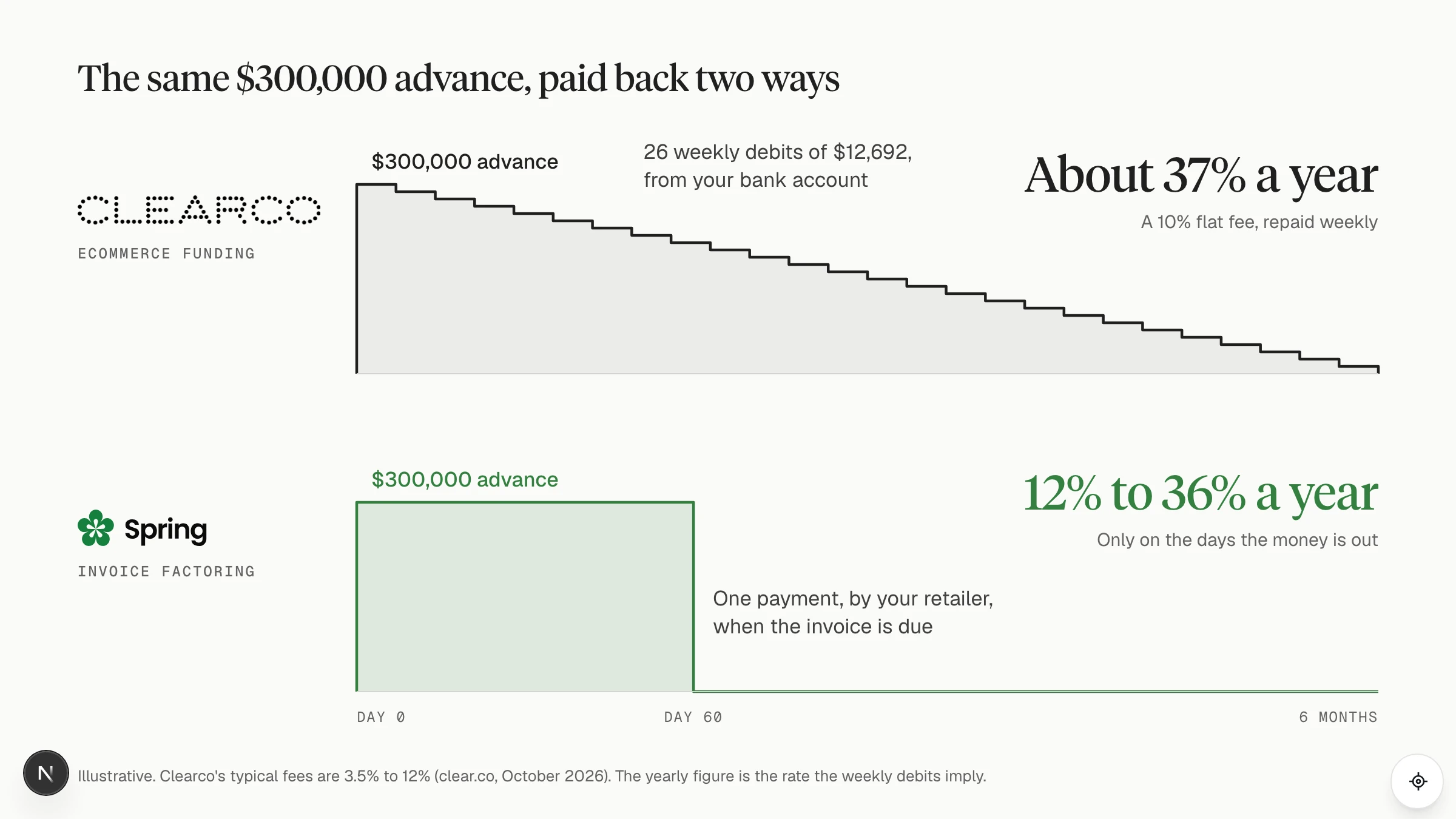
A 10% fee on a six-month advance sounds like 20% a year. Repaid weekly, it costs about 37%.
That gap is not a trick. It comes from when the money goes back. A Clearco advance is repaid every week from your bank account, starting in week one, out of your online sales. A Spring advance is repaid once, by your retailer, when the invoice comes due. This post shows the arithmetic on both, using Clearco's own published terms, read in October 2026 and footnoted at the end. We sell one side of this comparison, so check our work. None of it is legal or financial advice.

| Question |  Ecommerce funding Ecommerce funding |  Invoice factoring Invoice factoring |
|---|---|---|
| Built for | Online, direct-to-consumer sales1Six months of history and more than $100,000 a month in revenue | Sales to retailers on net termsUS brands that invoice retailers or distributors |
| Sized on | Your online revenue1Read from the platforms you connect. Up to $10 million | A retailer invoice or purchase orderUp to $10 million across products |
| Repaid by | You, every week2A capped share of revenue over an estimated 4 to 12 months | Your retailer, onceWhen it pays the invoice. Demand plan financing is repaid by you, monthly |
| Price | A flat fee, typically 3.5% to 12%5No penalty for paying early | 12% to 36% a yearCharged only on the days the money is out |
| Speed | As little as 24 hours4To review an application | DaysThe first funding waits on your retailer acknowledging a notice |
How each Spring product works is on its own page: invoice factoring, purchase order financing and demand plan financing.
Why a 10% fee is not 20% a year
Clearco prices an advance as one flat fee and says its typical fees run from 3.5% to 12%.5 Take an illustrative $300,000 at 10%, repaid over 26 weeks: you pay back $330,000 in weekly debits of about $12,692.
Divide the $30,000 fee by six months and it looks like 20% a year. But the debits start in week one, so on average you hold only about half the advance. The same fee on half the money is roughly twice the rate: worked out from the actual weekly payments, it is about 37% a year. The same 10% repaid over 52 weeks is about 19%, and the low end of Clearco's range over 26 weeks is about 13%. The term matters as much as the fee.
Spring's price is a yearly rate on the days the money is out, so it needs no conversion. A $300,000 advance on a retailer invoice that pays in 60 days costs $5,918 at 12% a year and $17,753 at 36%.
One Clearco term changes its number, so ask about it: Clearco says there is no penalty for paying early and that the fee is prorated for the time the funding was outstanding.2 A fee that shrinks when you repay early behaves more like a rate.
A weekly debit meets a retailer's calendar
A brand that sells online is paid a little every day, and a weekly payment capped at a share of that revenue rises and falls with it. For that brand, the schedule and the cash arrive together.
A brand that sells into retail is paid a lot, rarely, and late. You ship in March and the money arrives in May, in one payment, less deductions. Weekly debits in March and April come out of a bank balance the retailer has not yet replenished. Invoice factoring is repaid by the retailer's payment itself, so it cannot fall due before the cash exists. If the retailer takes 70 days instead of 60, the schedule moves with it.
Clearco also has an Invoice Funding product, but it points the other way: it funds invoices you owe your suppliers, and you repay it weekly.3 Spring's invoice factoring funds invoices you are owed by a retailer.
What Spring asks of you
A Notice of Assignment. Invoice factoring, purchase order financing and demand plan financing all require one: a letter re-pointing your retailer's payments to a collection account Spring holds for you. Your retailer will know you have a funding partner, and your first funding waits until it acknowledges the notice, which takes days and occasionally a couple of weeks. More in what a NOA is. Bridge Funding is the one Spring product that needs no notice.
When each is the better choice
Clearco, when:
- Most of your revenue is online. That is who Clearco funds, and Spring has no retailer invoice to advance against.
- The spend is not tied to an order. Advertising, stock for your own store, a launch.
- You need an answer in a day, or would rather your retailer was not sent a notice.
Spring, when:
- Most of your revenue is retailer invoices. They are what Spring funds, and the retailer's payment repays it.
- Your online sales are small next to your retail orders. Clearco asks for more than $100,000 a month in direct-to-consumer revenue.1
- You want repayment to wait for the retailer. Nothing leaves your bank account while it pays on its terms.
Four questions to ask of either
- What does it cost per year? Not the fee: work it out from the amount advanced, the total repaid and the schedule.
- Who repays, and from which account?
- What happens if I repay early, or in my slowest month?
- Who else gets told, and what do I connect? A notice to your retailer, a filing, access to your store and bank.
Ask them of us too. We have run the same comparison against revenue-based financing, asset-based lending and consignment inventory funding. If you sell into retail, get started or talk to the team.
1 Clearco, Ecommerce funding, read October 2026.
2 Clearco, Cash Advance, read October 2026.
3 Clearco, Invoice Funding, read October 2026.
4 Clearco, home page, read October 2026.
5 Clearco, Why Clearco, "Our typical fixed fees range from 3.5% to 12%", read October 2026. The yearly figures above are our arithmetic: the weekly rate that makes the payments worth the advance (the internal rate of return), times 52.