Funding is the need a growing brand can't put off. It connects us to how the business runs, and shows us how the invoices we fund actually end. Our AI CFO runs on that record.
Last edited 6 min read
The first product a business buys from you decides what you learn about it. Sell a dashboard and you see what the customer chooses to show you. Fund the customer and you see what the decision needs, and then you see how it turned out.
Capital first is our go-to-market: funding gets Spring in the door, and we build our AI CFO on what funding shows us. An AI CFO is software that reads a business's live bank, books and retailer data, answers its finance questions with the arithmetic shown, and drafts the work that follows, while the decisions stay with the owner.
The funding is invoice factoring, purchase order financing, demand plan financing and Bridge Funding. The AI CFO is Spring's agent.
Why can't funding wait?
A consumer brand that wins a retail order pays for the goods long before it is paid for them. Its manufacturer wants paying up front or on short terms. The retailer pays 60 to 90 days after delivery, and in food and beverage those terms have stretched toward 120.1 Add the weeks the goods spend being made and shipped, and a growing brand can have its cash tied up for three months or more in an order it has already won.
A founder can put off new finance software for a year. They cannot put off paying for the next purchase order. Funding is the need a growing brand can't defer, so it is where we start.
What does funding connect that software can't?
Any app a brand connects can read its bank feed, its books and its storefront. To fund a brand well we go further: the retailer and distributor portals it sells through, and the EDI feed its purchase orders and invoices arrive on. We have paid out more than $220 million to over 220 businesses. Of the 207 with a funded request in our app, 193 have a bank account connected.2
Those connections stay live, because the next funding request runs on them. Software sold first has to earn each connection on its own. Funding arrives with a reason to connect.
What does a funder see that the books don't?
When we fund an invoice, the retailer is usually told to pay Spring instead of the brand. That is the notice of assignment, and it means the payment comes to us. So for the invoices we fund, we see the result directly: whether the retailer paid, on which day, how much it held back, and the reason it gave.
The books record the invoice and, once someone matches it, the deposit. The reason a payment came in short usually sits in the retailer's portal, one line at a time.
Those short lines are deductions, taken for promotions, shortages and late deliveries. Some are owed and some are not, and a brand can't plan its cash without knowing how much of that will come back.
Many of the brands we fund sell to the same retailers, so we see, in aggregate, how a retailer actually pays: how long it takes and what it tends to deduct. That goes into our next funding decision. No brand sees another brand's data. What pools is the retailer's behavior.
Why not start with software, like Square and Shopify?
Square and Shopify found this link from the software side: they began making funding offers to their sellers from the sales data their platforms already held.3 We run it the other way round, because sales and bank data are the easy part. What is hard to come by is the outcome: whether each invoice was paid, when, and how short.
A deduction tool reads the short lines in the portal, the books record the deposit, a forecasting tool watches the bank balance, and someone joins the three by hand, if at all. A funder has to join them, because the money is owed to it: we match each payment to the invoice it settles and each short line to its reason, or we don't know what we are still owed.
What does an AI CFO do?
A founder has questions no report answers. Will the cash hold through the next order? Which deductions are worth disputing? Which retailer actually makes us money? What happens if a retailer pays late and we take the next order anyway?
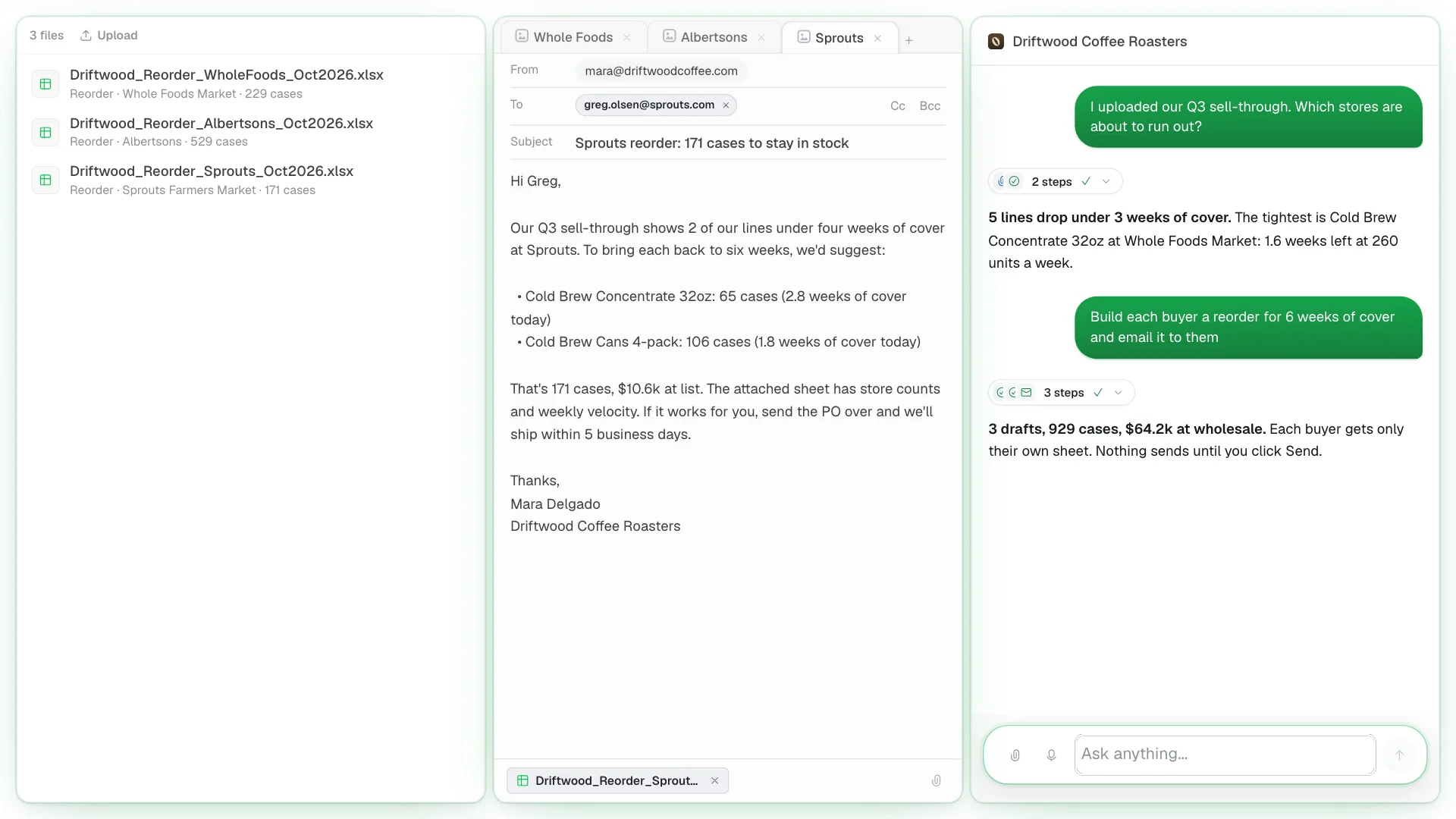
Spring's AI CFO answers those today. It is an agent in every Spring account, reading the same live data our funding runs on:
- Cash flow forecast. Thirteen weeks from the bank and the books, plus questions about what a feed can't see.
- Deductions. A year of them totalled by reason, each claim checked against the proofs of delivery and the price list, and the disputes drafted with the backup attached.
- What-ifs. A late payment plus a new order, run against the forecast.
- Margin by retailer. What the brand keeps after deductions, freight and fees.
It drafts the emails and builds the files; sending, signing and submitting stay with the owner. Eight of those requests are filmed, start to finish, and you can drive the agent yourself on the software page.
What we are still building is the part that runs without being asked: watching the data between conversations and telling an owner what changed, like a retailer paying more slowly than it used to. We are also building capital planning, which shows how many more orders the business can fund, and when.
Connectivity comes out of our stack first. It already reads the bank accounts, books, storefronts, retailer portals and EDI feeds of the businesses we fund, along with how the invoices we fund actually get paid.
It is a new layer, built on that data rather than on funding. It turns what the data says into answers, likely outcomes and drafted next steps. A brand can use it whether or not it takes funding.
Four of them: cash flow forecasts, insights on what changed, deductions matched to the line and the reason, and capital planning. Forecasts and deductions work today, along with the what-ifs and margin by retailer above. Insights that arrive unasked and full capital planning are what we are building now.
The stack re-forms on a wider base. Funding and the AI CFO share the rails, the ledger and the data. A brand we fund gets the AI CFO on connections it already has, and every invoice we fund gives it another real outcome to check its forecasts against.
Funding is how we start with a brand, because it can't wait. The AI CFO is how we stay useful between one funding request and the next.
Two ways to start
- Get funded. Connect your bank and books, and see what your purchase orders and retailer invoices are worth.
- See the agent. Try the AI CFO in the sandbox before you connect anything.
Frequently asked questions
What does capital first mean?
Spring starts with a brand by funding it, then builds software on what funding shows: the brand's live connections, and how each funded invoice was actually paid. Funding comes first because it is the need a growing brand can't put off.
What is an AI CFO?
Software that reads a business's live bank, books and retailer data, answers its finance questions with the arithmetic shown, and drafts the work that follows. At Spring it is an agent in every account: it forecasts cash, totals and disputes deductions, and models what-ifs. Sending, signing and submitting stay with the owner.
Do I have to take funding to use Spring's AI CFO?
No. The agent is part of the Spring platform and runs on the data you connect; funding an invoice or a purchase order is a separate choice. Try it in the sandbox first.
What does Spring learn from funding a brand?
How the invoices we fund actually end: whether the retailer paid, on which day, how much it held back and why. Across many brands that shows how each retailer pays. No brand sees another brand's data; what pools is the retailer's behavior.
1 Kristen Palmer, First Business Bank, writing in New Hope Network, September 2026: "Sixty- to 90-day payment terms are standard in retail," and in food and beverage they have stretched toward 120.
2 Spring's records, October 19, 2026: $222.9 million disbursed to 223 businesses. 207 businesses have a funded request in the Spring app, and 193 of those (93%) have a bank account connected today.
3 Square Capital launched in 2014 and Shopify Capital in 2016. Shopify bases eligibility on a merchant's sales and activity on Shopify.