One funds up to 100% of an inventory order and is repaid by you as the stock sells. The other pays your supplier 60% of the order's cost and is repaid by your retailer. One $600,000 order, worked through both.
Last edited 5 min read
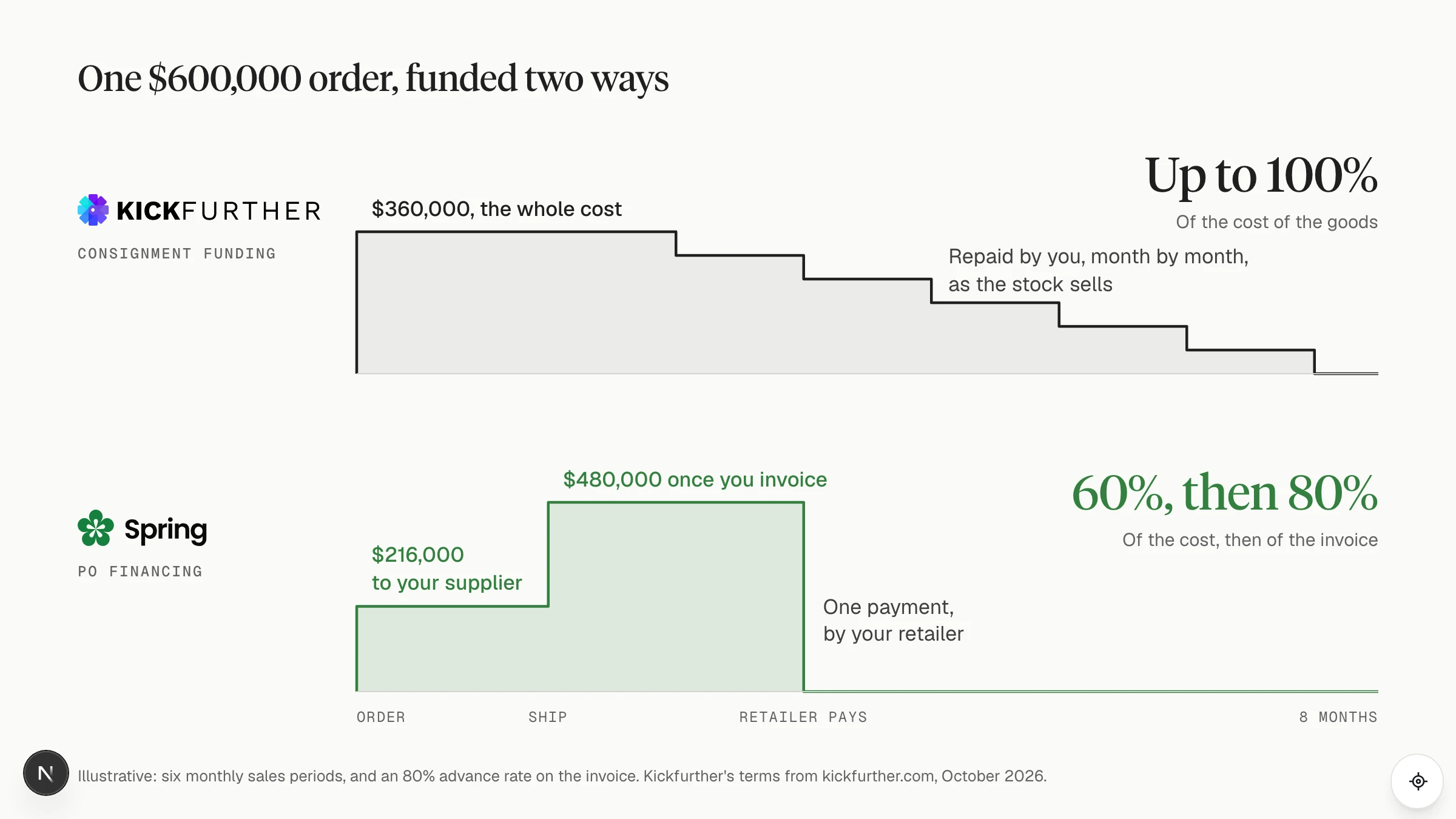
Kickfurther will fund up to 100% of the cost of an inventory order. Spring's purchase order financing funds up to 60% of it. On the day you place the order, theirs is the bigger number. By the day you invoice the retailer, ours usually is.

The two are funding different things, so different people pay them back. Consignment funding pays for the inventory: a community of buyers purchases it, consigns it to you, and you pay them back as it sells.2 PO financing pays for the retailer's order: Spring pays your supplier, and the retailer's payment on the invoice settles it. Everything about Kickfurther here comes from its own public pages, read in October 2026 and footnoted at the end. We sell one side of this comparison, so check our work. None of it is legal or financial advice.
| Question |  Consignment funding Consignment funding |  PO financing PO financing |
|---|---|---|
| Built for | Brands selling through any channel3Ecommerce, wholesale and multichannel, from $200,000 in yearly revenue | Sales to retailers on net termsA brand that only sells online has no retailer invoice to fund |
| Sized on | The cost of the inventory3Up to 100% of it, and up to $5 million | The retailer's orderUp to 60% of the cost of goods, then the invoice at that retailer's advance rate |
| Repaid by | You, as the stock sells3Nothing is due until you receive the goods and start selling | Your retailer, onceWhen it pays the invoice. Demand plan financing is repaid by you, monthly |
| Price | A funding fee plus a monthly consignment fee3Quoted per deal, not published. Lower with repeat use | 12% to 36% a yearCharged only on the days the money is out |
| Speed | Most deals fund within a day3Once a deal is live | DaysThe first funding waits on your retailer acknowledging a notice |
How each Spring product works is on its own page: purchase order financing, invoice factoring and demand plan financing.
Why 100% and 60% are not the same measurement
Take one order through both, the one in the picture above. A retailer sends you a $600,000 purchase order, and it costs $360,000 to make.
Consignment funding can cover the whole $360,000 before anything ships.3 Spring pays your supplier $216,000, 60% of the cost, and you find the other $144,000: the part of this comparison that does not flatter us. When you ship and invoice the retailer, invoice factoring tops the funding up to your advance rate for that retailer, $480,000 at an illustrative 80%. Then the retailer pays the invoice to Spring, the advances and the fee are settled, and the rest is released to you.
One number is larger at the start and the other at the end, because of what stands behind each. Inventory funding is measured against what the goods cost. Order funding ends up measured against what the retailer has agreed to pay for them.
Who repays decides what a slow month costs
With Kickfurther, repayment follows your sell-through, which suits stock sold through many channels at once. If it sells more slowly than planned, Kickfurther says extending the timeline may adjust your costs, and part of its price is a monthly fee, so ask what an extra month does to the total.1
With Spring, repayment is the retailer's payment. It cannot fall due before the retailer pays, and if the retailer takes 70 days instead of 60, the fee covers ten more days. What Spring cannot do is fund stock that no retailer has ordered.
What Spring asks of you
A Notice of Assignment. Invoice factoring, purchase order financing and demand plan financing all require one: a letter re-pointing your retailer's payments to a collection account Spring holds for you. Your retailer will know you have a funding partner, and your first funding waits until it acknowledges the notice, which takes days and occasionally a couple of weeks. More in what a NOA is. Bridge Funding is the one Spring product that needs no notice.
When each is the better choice
Kickfurther, when:
- You sell mostly online, or through many channels at once. No retailer invoice means nothing for Spring to fund.
- No retailer has ordered the stock yet. You are building inventory ahead of demand you cannot show on a purchase order.
- You need the whole production cost covered before the goods ship.
Spring, when:
- The order comes from a retailer or a distributor. The purchase order and the invoice are what Spring funds, and the retailer's payment repays it.
- You want repayment to wait for the retailer. Nothing leaves your bank account while it pays on its terms.
- You want a yearly price on the days the money is out. A shorter term costs less.
Using both? Kickfurther describes itself as one layer of a brand's capital stack.1 If one provider funds the inventory and another the invoice, ask both, in writing, who is paid first when the retailer pays.
Four questions to ask of either
- What does it cost per year? If the price is a fee plus a monthly charge, work it out from the amount funded, the total repaid and the schedule.
- Who repays, and from which account?
- What happens if the goods sell, or the retailer pays, a month late?
- Who owns the inventory and the receivable while the funding is out, and who else gets told?
Ask them of us too. We have run the same comparison against revenue-based financing, asset-based lending and ecommerce funding. If you need to fund a retailer's purchase order or a stack of retailer invoices, get started or talk to the team.
1 Kickfurther, home page, "Frequently Asked Questions", read October 2026.
2 Kickfurther, Consignment Model Funding, read October 2026.
3 Kickfurther, Inventory Funding Built for CPG Brands, read October 2026.