A big order from Walmart, Costco or Target has to be made and shipped before the retailer pays for it. The ways a consumer brand can fund that gap, compared honestly, with one order worked through.
Last edited 7 min read
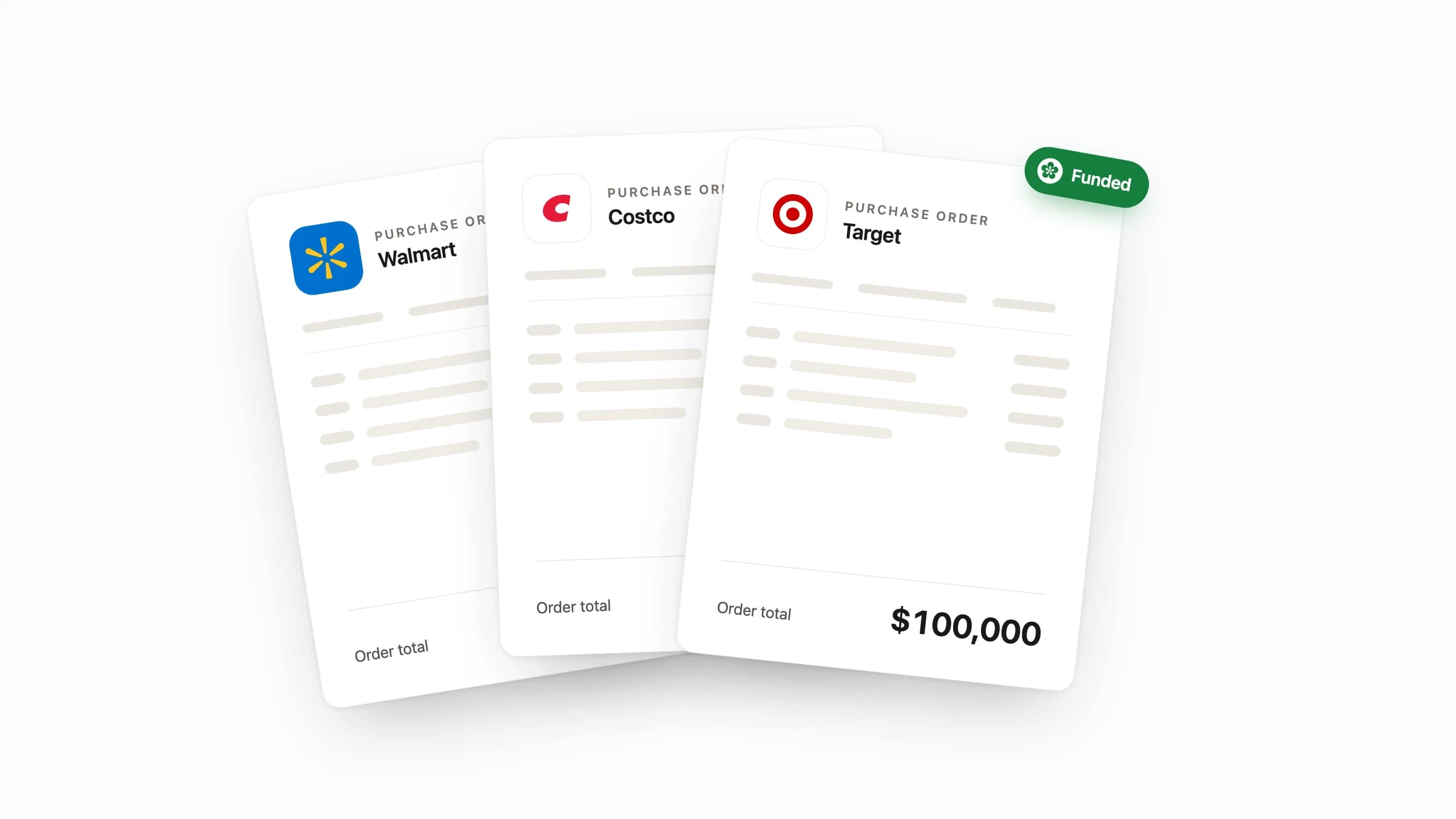
To fund a big Walmart, Costco or Target order, most consumer brands use purchase order financing to pay the supplier before production and invoice factoring to cover the wait after shipping.
A first big retail order is good news that arrives as a cash problem. The retailer pays weeks or months after the goods reach its distribution center, and your co-packer, your packaging supplier and your freight carrier all want paying before then. This post compares the five ways a food, beverage or personal-care brand can fund that gap: purchase order financing, invoice factoring, retailer early-pay programs, SBA-backed bank financing and equity. Then it works one order through from purchase order to payment. We sell two of the five, so check our work. It is not legal or financial advice.
Why a big order needs funding at all
Because you pay for the goods long before the retailer pays you for them.
A purchase order is a promise to buy. Before it turns into cash you have to buy ingredients and packaging, book a production run, ship to the retailer's distribution centers and invoice. The retailer then pays on its own terms, often 30 to 60 days or more after it receives the goods, and deductions for shortages or late delivery can come off first. The bigger the order relative to your business, the longer you carry its whole cost yourself.
So the question is really two questions. Who pays for production, before anything ships? And who carries the wait between shipping and the retailer's payment? Each option below answers one or both.
The options, side by side
Only purchase order financing pays for production; factoring and early pay cover the wait after shipping, and SBA and equity are slower, general-purpose money.
- Purchase order financing
- Pays for making the goods?Yes. Your supplier is paid against the signed order
- When the money arrivesDays, once the order and the retailer are verified
- Invoice factoring
- Pays for making the goods?No. It starts when you ship and invoice
- When the money arrivesDays after you invoice
- Retailer early pay
- Pays for making the goods?No. It needs an approved invoice
- When the money arrivesAfter the retailer approves the invoice, if it runs a program and you are enrolled
- SBA-backed bank financing
- Pays for making the goods?Yes, if the line is already in place
- When the money arrivesWeeks to months to set up
- Equity
- Pays for making the goods?Yes, and anything else
- When the money arrivesMonths, and you give up part of the company
Purchase order financing
Purchase order financing pays your supplier against a signed retailer order, so production starts before you have the cash for it.
The funder looks at the order and at the retailer behind it more than at your balance sheet, which is why it suits a brand whose orders are growing faster than its bank account. The money goes to the co-packer or supplier, not to you. When the goods ship, the invoice is usually factored, and the retailer's payment settles both. Specialist purchase order funders and some factoring companies offer it; Spring's version is built for brands selling to retailers.
Invoice factoring
Invoice factoring advances most of an invoice's value soon after you ship, so you are not waiting out the retailer's payment terms.
It is the most common way consumer brands carry the wait, and a big retailer is exactly the kind of customer a factor wants: the advance depends on the retailer paying, not on how long you have been in business. What factoring cannot do is pay for production, because until you ship there is no invoice. Retailer payment usually runs through a Notice of Assignment, which tells the retailer to pay the factor. More on how it works: invoice factoring.
Retailer early-pay programs
Some large retailers will pay an approved invoice early in exchange for a discount, but only after the goods have shipped and the invoice is approved.
These programs, often called supply chain finance, are usually run through a bank or a platform such as C2FO or Taulia. When your retailer offers one and you are enrolled, it can be a tidy way to shorten the back half of the wait, and you do not need a separate funder. But it starts later than factoring (the invoice has to be approved first), not every retailer offers it, and it does nothing for the cost of making the goods.
SBA-backed bank financing
An SBA-backed bank line is steady, inexpensive money for a business that will use it all year, but it takes weeks to months to put in place.
The SBA's CAPLines program exists for exactly this kind of need: its Contract CAPLine finances the costs of specific contracts, and its Seasonal CAPLine finances seasonal swings in receivables and inventory.1 The bank does the work, and it will want financial statements, collateral and, usually, a personal guarantee from the owners. If you already have a line, use it. If the order is in hand and the co-packer wants a deposit next week, it will not arrive in time.
Equity
Selling a share of the company funds growth permanently, but it is slow and the most expensive way to pay for a single order.
Equity is the right answer when the need is permanent: a new production line, a team, years of growth ahead of revenue. A purchase order is a temporary need that the retailer's payment closes out in a few months. Trading a piece of the company for it means paying forever for money you needed for one season.
A worked example: a $100,000 Target order
One order, start to finish, funded with purchase order financing and then invoice factoring.
A snack brand gets a $100,000 purchase order from Target. Making it costs $60,000: ingredients, film and cartons, the co-packer's run and freight to Target's distribution centers. The brand has $20,000 in the bank and a payroll to meet. Here is how the order moves.
- The order arrives. The brand uploads the purchase order. Without funding, it stalls here: the co-packer wants paying before it books the run.
- The supplier is paid. Against the signed order, purchase order financing pays most of the $60,000 directly to the co-packer and the packaging supplier. Production starts that week.
- The order ships. The goods leave the co-packer for Target's distribution centers, and the brand invoices Target for $100,000.
- The invoice is advanced. Invoice factoring tops the funding up against the invoice, so the brand has working cash while Target's payment terms run.
- Target pays. Target pays the invoice to the account named in the Notice of Assignment. The funding is settled out of that payment, and the rest goes to the brand.
The brand filled the order without selling equity, without waiting months for a bank and without draining the $20,000 it needs to run the business. The next order starts from zero.
Where Spring fits
Spring does both halves: it pays your supplier against the order, advances on the invoice when you ship, and the retailer's payment settles both.
Purchase order financing pays the supplier, never the brand, for most of the cost of goods behind a signed retailer order. Invoice factoring covers the rest once you ship. Orders can come straight from your retailer portal or EDI, and each retailer pays Spring on its own account number, so you can see every payment land.
One thing you should know before you apply: Spring needs a Notice of Assignment for purchase order financing and invoice factoring. It is a letter to your retailer's accounts payable team asking it to pay invoices to an account Spring holds for you. Your retailer will know you have a funding partner, and your first funding waits until the retailer acknowledges the notice, which usually takes days and occasionally a couple of weeks. Retailers process these routinely; here is what one actually does.
When something else is the better choice
When the need is not one order but the whole business, or the money has to arrive this week with no retailer involved.
- You will use the money all year. A brand with steady receivables and inventory in the millions, drawn most of the year, will usually do better with a bank or an asset-based line sized on what it already owns.
- Your retailer already pays you early. If you are enrolled in its early-pay program and production is not the bottleneck, use the program before adding a funder.
- The need is permanent. New equipment, a new category, years of growth ahead of revenue: that is what equity is for.
- You have no retailer order. Purchase order financing and factoring fund retail orders and invoices. Without one, look at Bridge Funding, which needs no Notice of Assignment.
Frequently asked questions
How can a food or beverage brand get funding to fill a big Walmart, Costco or Target order?
Most brands combine two products. Purchase order financing pays the co-packer and suppliers against the signed purchase order, so production can start. Invoice factoring then advances the invoice once the order ships, so the brand is not waiting out the retailer's payment terms. The retailer's payment settles both. Spring offers both for brands selling to retailers.
What companies offer purchase order financing for CPG brands?
Three kinds of company offer it: specialist purchase order funders, factoring companies that add purchase order funding to their invoice products, and platforms built for retail brands such as Spring, which pays your supplier against the order and factors the invoice when you ship. Compare them on whether they pay the supplier directly, how fast they fund after an order is verified, and what they need from your retailer.
Can I factor a purchase order?
No. Factoring needs an invoice, and an invoice exists only once the goods have shipped. Before that, the order is funded with purchase order financing, which pays your supplier against the signed order. Many brands use purchase order financing for production and factoring for the wait after shipping.
Will Walmart, Costco or Target know I am using a funder?
Yes, with Spring and with most factors. A Notice of Assignment asks the retailer's accounts payable team to pay your invoices to an account the funder holds for you. Retailers process these routinely. What a NOA is and what it does.
Does a retailer early-pay program pay for production?
No. An early-pay program pays an invoice the retailer has already approved, so it starts after the goods have shipped. It can shorten the wait for payment, but the cost of making the order still has to be funded some other way.
How long does it take to get funded?
With Spring, days once the order and the retailer are verified and the retailer has acknowledged the Notice of Assignment, which usually takes days and occasionally a couple of weeks. An SBA-backed bank line usually takes weeks to months to put in place, and equity takes months.
If you have a retailer order to fill, get started or talk to the team.
1 U.S. Small Business Administration, Types of 7(a) programs: CAPLines, read October 2026.