Every retailer you sell to pays Spring on its own bank account number, so every payment names its owner the moment it lands.
Last edited 5 min read
When you factor an invoice, your retailer stops paying you and pays the factor instead. Invoice factoring is selling an unpaid retailer invoice for cash now; the retailer pays the factor when it falls due. A Notice of Assignment is the letter that tells the retailer where to send that payment. At Spring, the place it names is an account number for your brand and that retailer alone, so every payment arrives already saying whose it is.
In the 90 days to October 8, 2026, 97% of the payments sent to a Spring account number were attributed to the right brand and the right retailer automatically, typically within about four seconds of arriving.
That is a design choice, not a given. Your money now goes to someone else, so the first question to ask any funder is where it lands and how they know it is yours. This post shows our answer.
The simple way to collect for many clients is one account. Costco, Walmart and UNFI all pay into it, and the payments pool together until someone matches each one to a client and an invoice, usually from a remittance email that arrives separately, if at all. Until then it is unapplied cash: money that has arrived but belongs, on the books, to nobody.
When you sign a Notice of Assignment with a retailer, Spring creates a bank account number for that one pairing: your brand and that retailer. Ridgeline's number for Costco is not Ridgeline's number for Walmart, and neither is Tidewater's number for Costco. It is the number printed on the notice, so it is the number the retailer's payables desk puts on file.
All of these numbers point at Spring's collections account at our partner bank, so the money is held in one place. But every payment carries the number it was sent to, and that number has exactly one owner.
When a payment lands, the bank notifies us, we look up the number, and the payment is recorded against your business and that retailer. No remittance email has to arrive first and nobody has to guess. The median time from arrival to attribution is about four seconds.
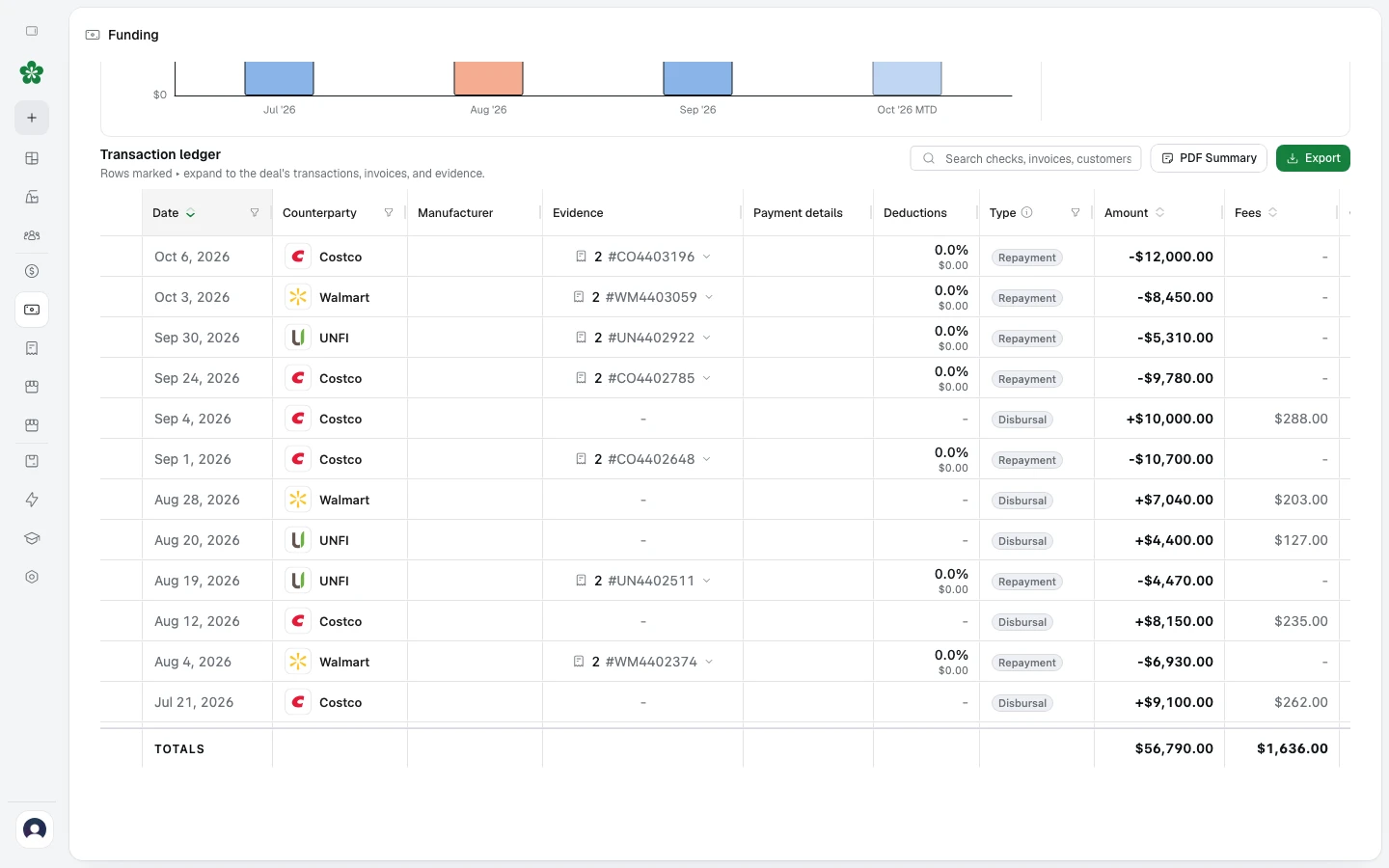
Each payment shows up in the payment history on your Funding page, under the retailer that sent it. You can export the full history as a spreadsheet or a PDF summary at any time.
Why is a shared account a risk?
Pooling is not wrong in itself. Banks and fintechs hold money for many owners in one account all the time. The risk is in the ledger: when an account holds money for many owners, the ledger that says who owns what is the only thing protecting each of them, and when that ledger is wrong, everyone waits.
Two recent examples show how long that wait can be. When the fintech middleware company Synapse collapsed in 2024, its partner banks held about $180 million against $265 million in customer balances. More than 100,000 people were locked out of their money for weeks, and customers whose funds were pooled in "for benefit of" accounts had the hardest time getting it back.1 In the First Brands bankruptcy in 2025, a supply-chain finance firm alleged that roughly $1.9 billion of receivables that had been sold to others was collected without being passed on to their owners, and asked the court for a full accounting of whose money was whose.2
Neither case is about a factor taking a client's money. Both show what happens when ownership lives only in a ledger: proving whose money is whose takes months, and while that happens the money stays frozen.
A number per brand and retailer does not replace the ledger. It means every payment arrives with its owner already named by the bank transfer itself. Your money cannot be mistaken for another client's, because no other client's retailer pays that number.
Why does the number on the notice matter?
The account number is not an internal label. It is the remit-to on the notice your retailer acknowledges. Under Article 9 of the Uniform Commercial Code, once a retailer has been notified that an invoice is assigned and where to pay, it can only settle the invoice by paying there.3 So the place the retailer is legally told to pay is also the thing that identifies the payment. Our banking platform, Increase, is built for this: one account can carry many account numbers, each created on demand, so incoming money reconciles itself.4 Purchase order financing needs the same notice, so the retailer's payment on a PO-financed order lands on the same number.
What do you see in your Spring account?
Open Funding in your Spring account and every payment a retailer has sent us is in the transaction ledger: the date, the retailer, the amount, and the reference it arrived with.
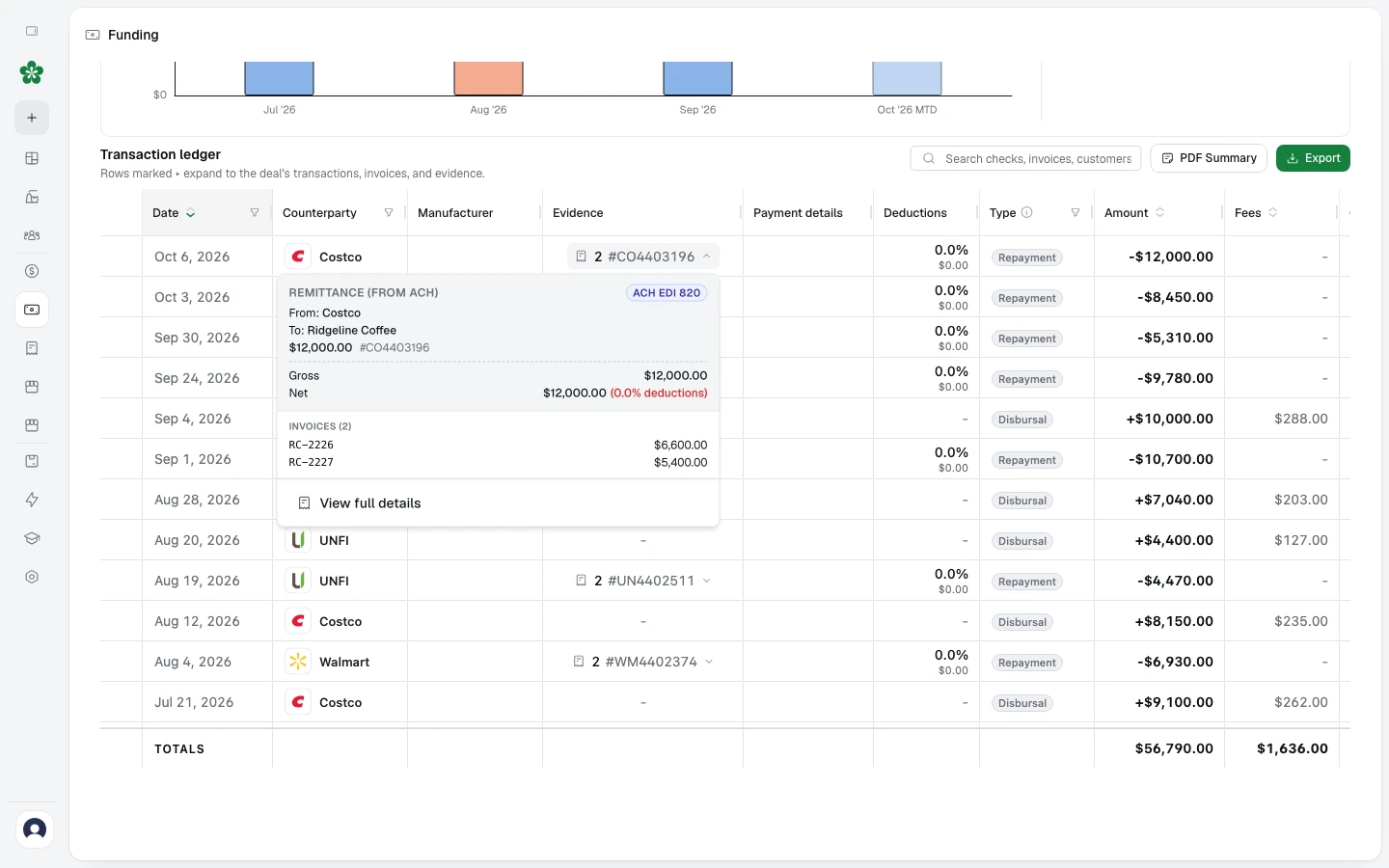
Open a payment and you see what came with it: who sent it, to whom, the gross and net, and the invoices it paid.
The whole history exports as an Excel spreadsheet, and as a PDF summary you can send to your accountant.
What should you ask any funder about collections?
- Where does my retailer's payment land, and is that account shared with your other clients?
- How do you know a payment is mine: from the account it arrived on, or from a remittance someone reads?
- How long between the money arriving and it showing in my account with you?
- Can I see every payment, and export it, without asking?
- What happens to a payment that arrives without a remittance?
Ask them of us too.
Frequently asked questions
Where does my retailer's payment go when I factor an invoice?
To the remit-to on the Notice of Assignment your retailer acknowledged. At Spring that is an account number for your brand and that retailer alone, in Spring's collections account at our partner bank. What isn't owed to Spring is sent on to you.
Will my retailer know I'm factoring?
Yes. The Notice of Assignment goes to its accounts payable desk, and your first funding waits until the retailer acknowledges it, which takes days and occasionally a couple of weeks. What a NOA is.
Is my money pooled with other brands' money?
It is held in one collections account at our partner bank, but every payment arrives on a number with exactly one owner: your brand and that retailer. No other client's retailer pays that number, so your payment can't be mistaken for theirs.
How soon does a payment show in my Spring account?
An electronic payment to your number is typically attributed within about four seconds of arriving, and shows in the payment history on your Funding page under the retailer that sent it. Checks are deposited and matched by our team.
If you sell to Costco, Walmart, Target or the big distributors, get started or talk to the team. How the notice itself works is in What Is a NOA?.
1 Hugh Son, CNBC via NBC News, Synapse bankruptcy trustee says $85 million of customer savings is missing in fintech meltdown, June 2024, read October 2026.
2 Vehicle Service Pros, Raistone seeks court appointment of independent examiner in First Brands bankruptcy, October 2025, read October 2026. These are allegations in a court filing, not findings; an examiner was appointed in December 2025.
3 Uniform Commercial Code § 9-406(a): once notified of the assignment and where to pay, the retailer can settle the invoice only by paying the assignee; paying the brand no longer settles it.
4 Increase, Accounts and Account Numbers, read October 2026.