A Sephora, Ulta or Target launch is dozens of SKUs made months before the retailer pays. The ways a beauty brand funds it, how Alleyoop funded its Target launch, and one order worked through.
Last edited 5 min read
120 days from the invoice date is how long Target's annual report says its payment date can run for suppliers in its supplier finance programs.1 A beauty brand launching at Sephora, Ulta Beauty or Target therefore usually funds the order in two halves: purchase order financing pays the manufacturer and component suppliers, then invoice factoring advances the retailer's invoice once it ships. At Spring that costs 12% to 36% a year, and the first funding waits on the retailer acknowledging a Notice of Assignment.


This post covers why a beauty launch strains cash, the ways to fund one, how Alleyoop funded its Target launch, and one order worked through. We sell some of these options, so check our work. It is not legal or financial advice.
Why does a Sephora, Ulta or Target launch strain a beauty brand's cash?
Because a beauty line is many small things ordered months ahead, and the retailer pays after it has the goods.
Shades, sizes and sets multiply the SKUs: Alleyoop's full-brand Target launch was 40 or 50 of them. Each needs its own components, fill and packaging, often from different suppliers with their own minimums and lead times, plus testers and the marketing that has to start before launch day. The national shelf is large: Target ended its 2025 fiscal year with 1,995 stores,1 and Ulta operates more than 1,500 U.S. stores carrying about 30,000 products from about 600 brands.2 Sephora and Ulta set their payment terms in your vendor agreement. Until that payment arrives, you carry the whole cost of the order.
What are the ways to fund a beauty brand's retail launch?
Only purchase order financing and inventory funding pay for production before you ship; factoring covers the wait after, and the rest are general-purpose money.
| Question | Pays your manufacturer before you ship? | Who repays it |
|---|---|---|
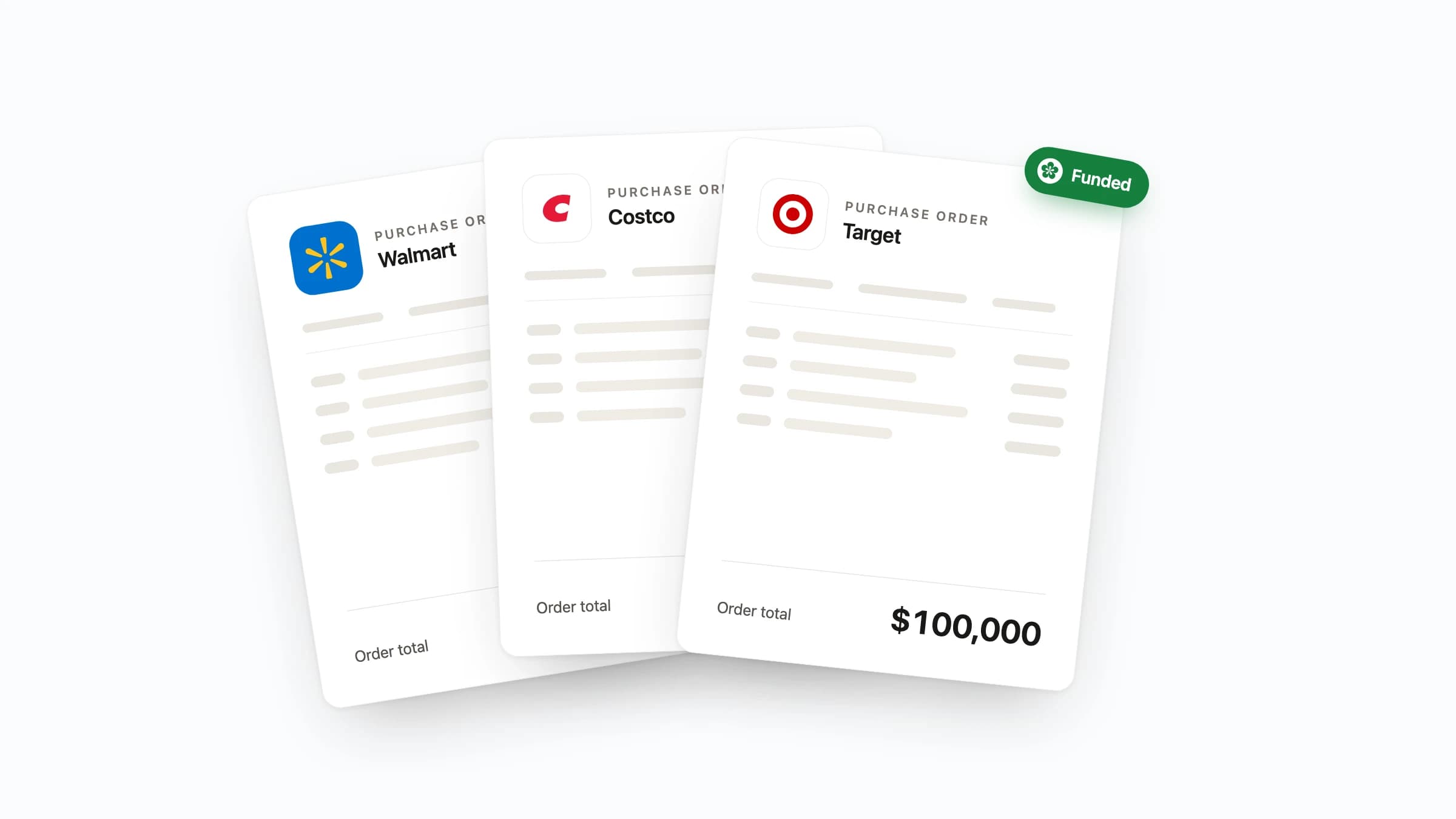
| Purchase order financing | YesA share of the cost of goods, paid to your supplier against the signed order | The retailer's paymentThe invoice it pays settles the funding |
| Invoice factoring | NoIt starts when you ship and invoice the retailer | The retailer's paymentPaid to the account named in the notice |
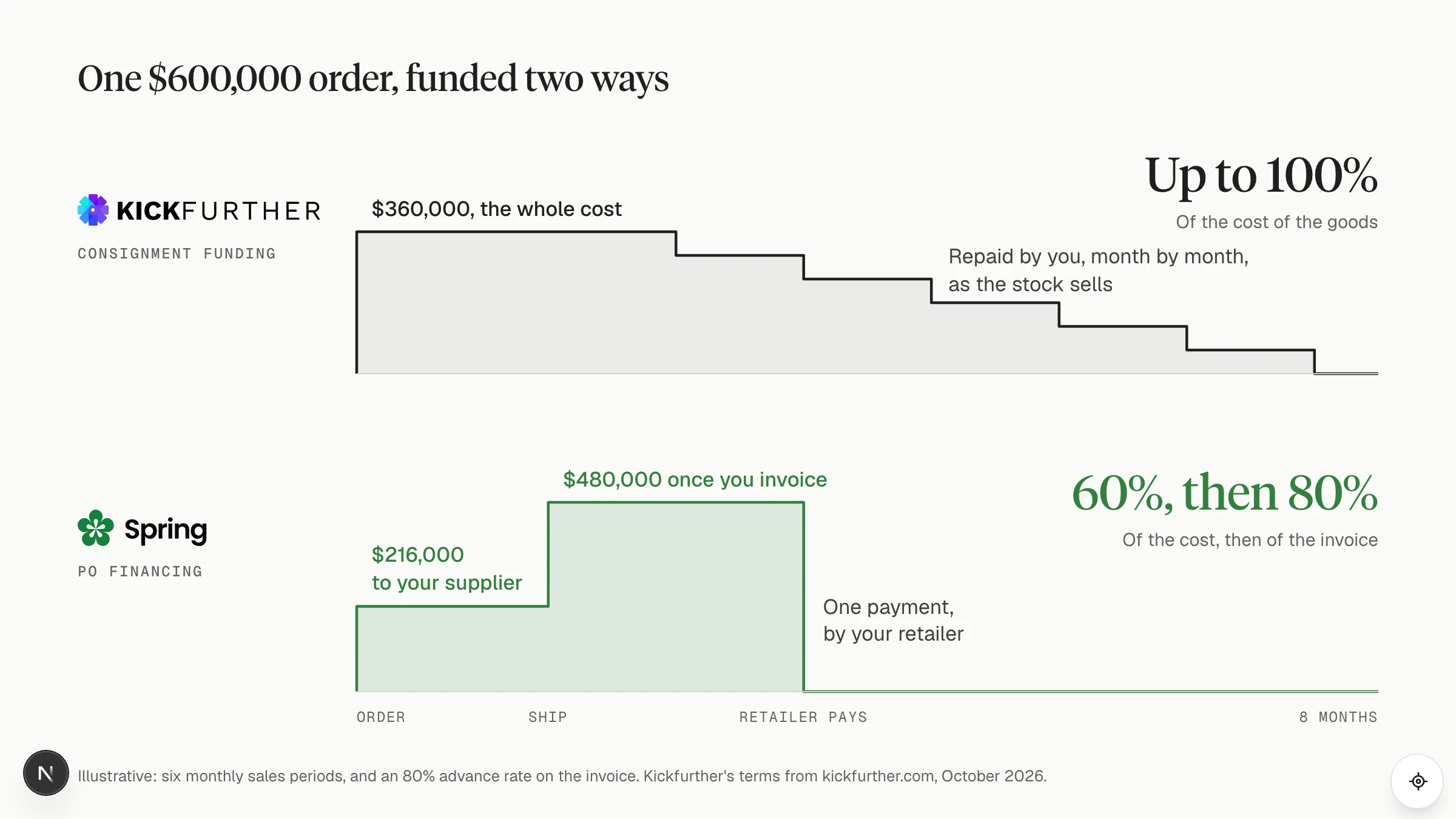
| Consignment inventory funding (Kickfurther) | Yes3Up to 100% of the inventory's cost | YouAs the stock sells, through any channel |
| Working capital (Settle) | Yes, from the funds advanced4From $20,000 to $15 million | YouIn 30 days, extendable up to 180 |
| Revenue-based financing (Wayflyer, Clearco) | Only from cash in hand5, 6Sized on your past sales | YouA share of daily sales, or weekly payments capped at a share of revenue |
Purchase order financing is built for the signed order: the funder looks at the order and the retailer behind it more than at your balance sheet. Invoice factoring takes over once you ship. When the retailer has shared a forecast rather than a purchase order, demand plan financing funds production against that plan and is repaid in equal monthly payments. Consignment funding from Kickfurther pays for inventory and you repay it as it sells; we compared the two in consignment inventory funding vs PO financing.

How did Alleyoop fund its Target launch?
With funding that started before Target's official award, then advances on the invoices once the goods shipped.
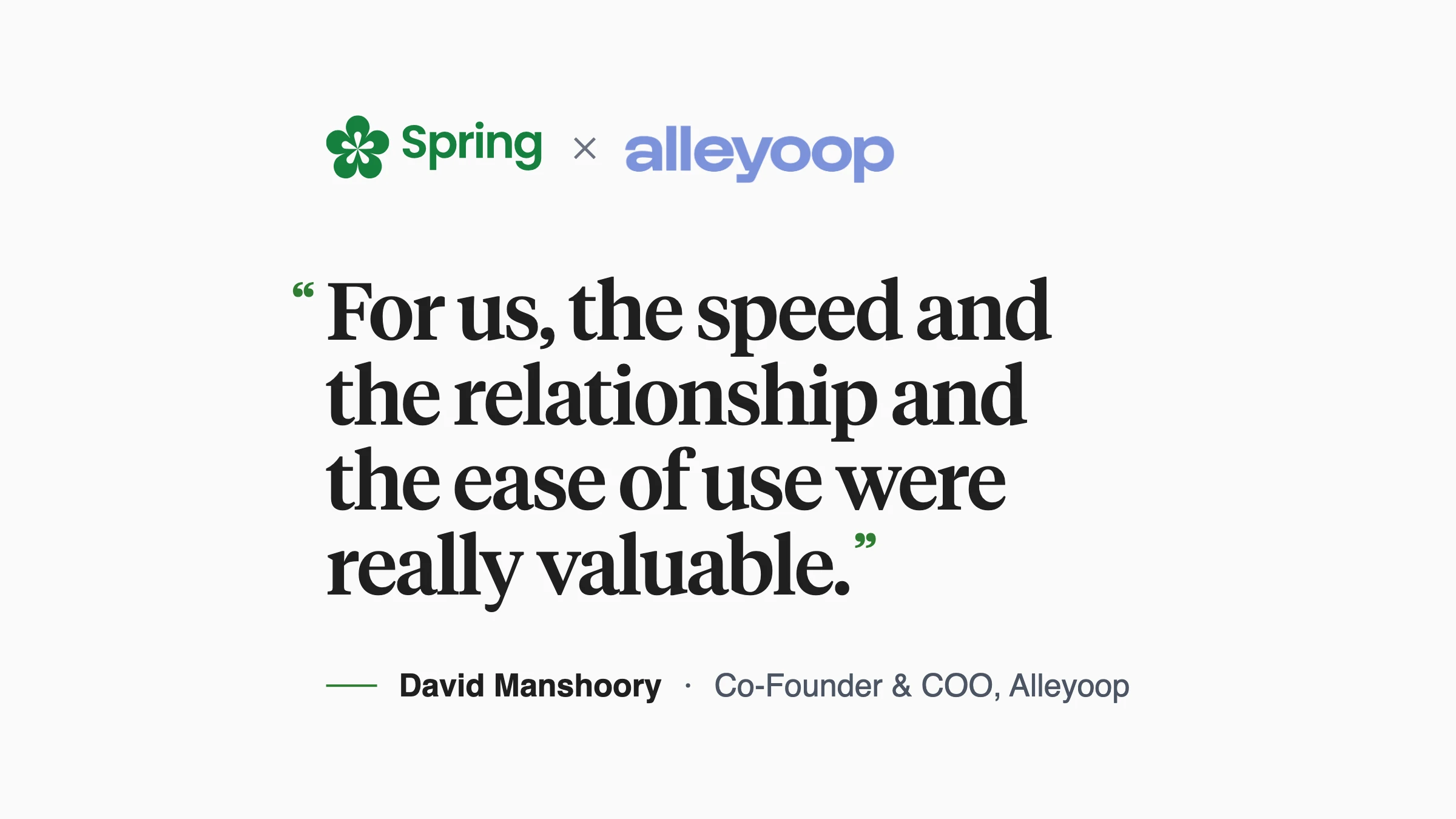
Alleyoop, a multi-use beauty brand, launched in more than 600 Target stores with five to six months to make, airship and deliver its whole line. Its co-founder and COO, David Manshoory, wanted to keep cash for hiring and marketing, and production had to start on the soft award:
You guys were also down to finance without the official business award yet. That almost has to happen, because these retailers give it to you about a month before you need to ship in, but you're already placing orders five months in advance of that, off the soft business award.
After shipping, Spring reads Alleyoop's invoices from its Target portal. "When I give you a bill of lading and you know it's been picked up, you're giving me AR financing knowing it's in Target's hands." The whole story: inside Alleyoop's Target launch.
How does purchase order financing work on a beauty order?
Spring pays your suppliers against the signed order, advances on the invoice when you ship, and the retailer's payment settles both.
Take an illustrative brand with a $400,000 purchase order that costs $140,000 to make, counting formula, components, filling, testers and freight.
- The order arrives. The brand sends the purchase order to Spring, or Spring reads it from the retailer portal or EDI.
- The suppliers are paid. Spring pays up to 60% of the cost, $84,000, directly to the filler and component suppliers. The brand covers the other $56,000.
- The order ships. The brand delivers to the retailer's distribution centers and invoices $400,000.
- The invoice is advanced. Invoice factoring tops the funding up to $320,000 at an illustrative 80% advance rate, so $236,000 more reaches the brand.
- The retailer pays. It pays the invoice to the account named in the Notice of Assignment. Spring keeps the $320,000 and its fee, and releases the rest.
The fee runs only on the days the money is out. If the first $84,000 is out for 120 days and the top-up for 60, both illustrative, the fee is about $8,000 at 12% a year and about $23,900 at 36%.
What does Sephora, Ulta or Target see when I use a funder?
A Notice of Assignment: a letter asking the retailer's accounts payable team to pay your invoices to an account Spring holds for you.
Spring needs one for every product except Bridge Funding. The retailer will know you have a funding partner, and your first funding waits until it acknowledges the notice, which usually takes days and occasionally a couple of weeks. It does not change the price, the terms or your placement. What a NOA is and exactly what it changes.
When is Kickfurther, Settle, Wayflyer or Clearco the better choice?
When the money is not tied to one retailer's order.
- Most of your sales are online. With no retailer invoice to fund, revenue-based financing from Wayflyer or Clearco is sized on the sales you have; see Spring vs revenue-based financing.
- You want to repay as stock sells everywhere. Kickfurther's consignment funding follows sell-through across channels.
- You need a short bill-pay bridge. Settle advances working capital repaid on a biweekly or monthly schedule.4
- The money is for the brand, not an order. A new line, a team or years of growth ahead of revenue is what equity is for.


Frequently asked questions
How do beauty brands finance a Sephora, Ulta or Target launch?
Most split it in two. Purchase order financing pays the manufacturer and component suppliers against the signed purchase order, so production can start. Invoice factoring then advances the retailer's invoice once the goods ship, and the retailer's payment settles both. Spring offers both at 12% to 36% a year.
How long does Target take to pay beauty suppliers?
Target's annual report says that for vendors in its supplier finance programs, its payment date is up to 120 days from the invoice date. Your own terms are in your vendor agreement. Factoring the invoice shortens the wait to days after you ship.
Can I get funding before Sephora, Ulta or Target sends the final purchase order?
Sometimes. Alleyoop's production for its Target launch started on the soft award, months before the official one, and Spring funded it. Demand plan financing funds production against a retailer's forecast. The Alleyoop story.
Is Kickfurther or purchase order financing better for a beauty brand?
It depends on who you want to repay. Kickfurther's consignment funding pays for inventory, and you repay it as the stock sells through any channel. Purchase order financing pays your supplier against the retailer's order, and the retailer's payment settles it. The two compared on one order.
How is Settle different from purchase order financing?
Settle advances working capital that you repay on a schedule, in 30 days and extendable up to 180, according to its own site. Purchase order financing is repaid by the retailer's payment on the invoice, so the repayment date follows the retailer, not a calendar.
Should a beauty brand use Wayflyer or Clearco for a retail order?
They suit brands that sell mostly online, because revenue-based financing is sized on past sales and repaid from them. For a retail order, the retailer's invoice is the stronger thing to fund against. Spring vs revenue-based financing.
Will Sephora, Ulta or Target know I am using a funder?
Yes. Spring and most factors send the retailer a Notice of Assignment asking it to pay your invoices to an account the funder holds for you. Retailers process these routinely, and it does not change your price or terms. What a NOA is.
If you have a beauty order to fill, get started or talk to the team.
1 Target Corporation, Form 10-K for the fiscal year ended January 31, 2026, Store Data and Note 14, Supplier Finance Programs, read October 2026.
2 Ulta Beauty, Inc., Form 10-K for the fiscal year ended January 31, 2026, Item 1, read October 2026.
3 Kickfurther, Inventory Funding Built for CPG Brands, read October 2026.
4 Settle, Working capital, read October 2026.
5 Wayflyer Help Center, What is Wayflyer funding?, read October 2026.
6 Clearco, Cash Advance, read October 2026.