Food and beverage payment terms have stretched to 120 days. How a drinks brand pays for cans, concentrate and a co-packer run before the retailer pays, with one order worked through.
Last edited 5 min read
120 days: that is how far payment terms in food and beverage have stretched, from 60 a decade ago.1 A beverage brand pays for cans, concentrate and a co-packer run months before a retailer or distributor pays for the drinks, so most fund production with purchase order financing and the wait with invoice factoring. Spring does both, priced at 12% to 36% a year, and the retailer's payment settles it.
This post is for founders of non-alcoholic beverage brands: sparkling water, functional drinks, cold brew, juice, energy and mixers. It walks where the cash goes, the ways to fund each stage, one order worked through, and how Spring compares with Kickfurther, Settle and bridge.co, from their own pages. We sell one side of this, so check our work. None of it is legal or financial advice.

Why do beverage brands run out of cash after a big order?
Because a drink is paid for in full before it is poured, and paid back in pieces months later.
A beverage run starts weeks before the co-packer's line does. Cans or bottles, sleeves or labels, caps, concentrate and flavors are bought ahead, often in minimums sized for the supplier rather than for your order. The co-packer usually wants a deposit to book the run and the balance before the pallets leave. Then come freight, warehousing and a distributor's or retailer's payment terms, with deductions for chargebacks, promotional allowances and spoilage taken off what you collect.1
So a growing beverage brand can be profitable on paper and short of cash every time it wins a bigger order. The bigger the order, the earlier and larger the outlay.
How do beverage brands pay a co-packer before the retailer pays?
By funding each stage with the product built for it: production against the order, the wait against the invoice, and a season against the plan.
| Question | Other providers | Spring |
|---|---|---|
| Cans, concentrate and packaging | Settle working capital3Paid to your vendors; repaid in 30 days, extendable to 180 | Purchase order financingPaid to your suppliers against a signed retailer order |
| The co-packer run | bridge.co production financing4Up to 100% of the cost of producing retail orders; facilities from $250,000 | Purchase order financingUp to $500,000; suppliers, freight and 3PL |
| Stock for a whole season | Kickfurther consignment funding2It buys the inventory and consigns it to you; you repay as it sells | Demand plan financing100% of next quarter's retailer orders, before they ship; repaid monthly |
| The wait for payment | A retailer early-pay programOnly after the invoice is approved, and only if the retailer runs one | Invoice factoringUp to $500,000 against retailer and distributor invoices; they repay it |
| Price | Set by each providerAsk for the yearly figure from the amount, the total repaid and the schedule | 12% to 36% a yearFixed when you sign |
How each Spring product works is on its own page: purchase order financing, invoice factoring and demand plan financing.
What does a funded beverage order look like?
One illustrative order, start to finish, funded with purchase order financing and then invoice factoring.
A sparkling-water brand wins a $240,000 order from a regional grocer. Making it costs $140,000: cans and sleeves, concentrate, the co-packer's run and freight to the grocer's distribution centers. The brand has $35,000 in the bank.
- The order arrives. The brand uploads the signed purchase order, and Spring verifies it and the grocer behind it.
- The suppliers are paid. Purchase order financing pays the can supplier, the concentrate house and the co-packer directly, for most of the $140,000. The run is booked.
- The drinks ship. The pallets leave the co-packer, and the brand invoices the grocer for $240,000.
- The invoice is advanced. Invoice factoring tops the funding up against the invoice, so the brand has cash for the next run while the grocer's terms run.
- The grocer pays. It pays the account named in the Notice of Assignment. The funding and its fee are settled out of that payment, and the rest goes to the brand.
The brand filled the order without selling equity and without spending the $35,000 it needs for payroll. If the next quarter's orders are already planned with the grocer, demand plan financing can fund all of them at once instead of one by one. A bigger national order works the same way; how to fund a big retailer order walks one from Target.
How is Spring different from Kickfurther, Settle or bridge.co?
In who repays, and in what the money is tied to.
- Kickfurther funds inventory through consignment: it buys the inventory, consigns it to you, and your repayments begin once sales do.2 It suits a drink sold through many channels at once, including your own site. We worked one order through both in consignment inventory funding vs PO financing.
- Settle offers working capital from $20,000 to $15 million for inventory, packaging, marketing and trade spend, sent to your vendors or your bank account, which you repay.3 It is not tied to a retailer order.
- bridge.co funds up to 100% of the cost of producing retail orders, in facilities from $250,000 to $50 million, and says it gives terms in 48 hours.4
- Spring funds the retailer order and the invoice, up to $500,000, and the retailer's payment repays it, so nothing leaves your account while its terms run. Bridge Funding is Spring's one product not tied to a retailer order.
What does Spring need from a beverage brand?
A Notice of Assignment. Purchase order financing, invoice factoring and demand plan financing all require one: a letter asking your retailer's or distributor's accounts payable team to pay your invoices to an account Spring holds for you. Your retailer will know you have a funding partner, and your first funding waits until it acknowledges the notice, which usually takes days and occasionally a couple of weeks. Here is what a NOA actually does. Bridge Funding is the one Spring product that needs no notice.
When is something else the better choice?
- Most of your sales are on your own site or Amazon. With no retailer order or invoice, look at Bridge Funding or a provider repaid from online sales.
- You need money for a launch, not an order. Sampling, a sales team, a trade show: that is working capital not tied to an order, from Bridge Funding or elsewhere.
- A bank line already covers it. Use it.
- The need is permanent. A canning line of your own or a new category is what equity is for.
Frequently asked questions
How do beverage brands finance production with a co-packer?
Most use purchase order financing, which pays the co-packer and packaging suppliers directly against a signed retailer order, so the run can be booked before the retailer pays. When the drinks ship, invoice factoring advances the invoice. The retailer's payment settles both. How Spring's purchase order financing works.
Can I get purchase order financing for a Walmart, Costco, Target or Kroger beverage order?
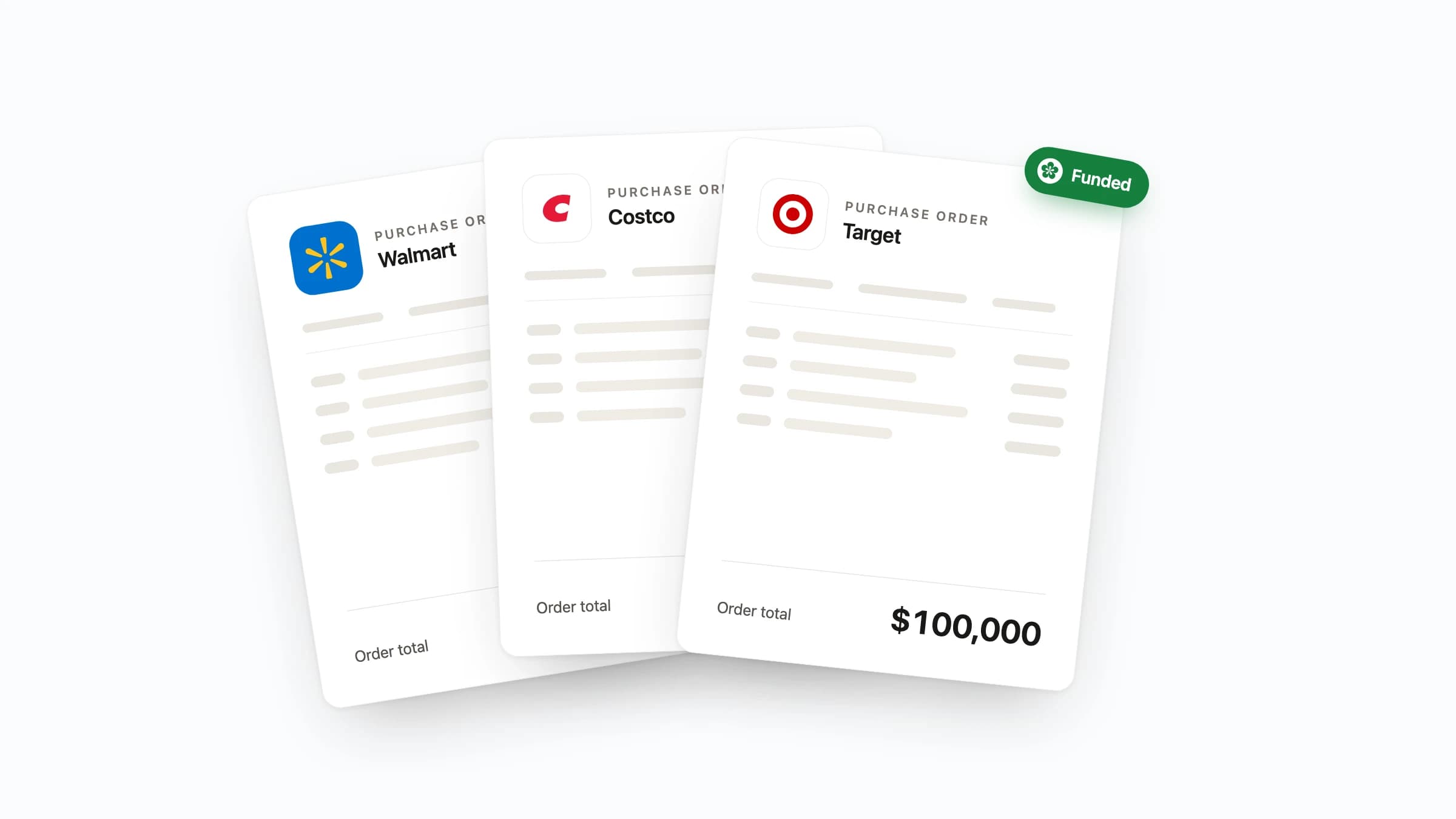
Yes. Spring pays your suppliers, freight and 3PL against a signed order from a retailer, up to $500,000, and is repaid when the retailer pays the invoice. Your first funding waits until the retailer acknowledges a Notice of Assignment.
Can I factor invoices to UNFI, KeHE or a beverage distributor?
Yes. Spring's invoice factoring advances invoices owed by retailers and distributors, and the distributor repays it when it pays the invoice. Deductions it takes off the payment come off what is released to you. Factoring UNFI and KeHE invoices.
Is Spring an alternative to Kickfurther for a beverage brand?
For retailer orders, yes. Kickfurther funds inventory through consignment and you repay as it sells. Spring funds the retailer order and the invoice, and the retailer's payment repays it. A brand selling mostly online or through many small channels may suit Kickfurther better. The two compared on one order.
How does Spring compare with Settle or bridge.co?
Settle offers working capital you repay on a schedule, sent to your vendors or your account. bridge.co funds the cost of producing retail orders in facilities from $250,000. Spring funds a retailer order or invoice up to $500,000, and the retailer's payment repays it, at 12% to 36% a year.
What does working capital cost for a beverage brand?
Spring's price is 12% to 36% a year on the days the money is out, fixed when you sign. To compare any offer, work out the yearly cost from the amount advanced, the total repaid and the repayment schedule, not from the headline fee.
Do I have to give up equity to fund a beverage order?
No equity. Spring's purchase order financing, invoice factoring and demand plan financing are repaid from your retailer orders and invoices, and they need a Notice of Assignment to your retailer. Bridge Funding needs no notice.
If you have a retailer order to make, get started or talk to the team.
1 Kristen Palmer, First Business Bank, Fast growth, tight cash: Why successful CPG brands run out of working capital, New Hope Network, September 14, 2026: "A decade ago, the standard term in food and beverage was 60 days. It's since stretched to 90, and now 120."
2 Kickfurther, Consignment Model Funding, read October 2026.
3 Settle, Working Capital, read October 2026.
4 bridge.co, CPG Financing, read October 2026.