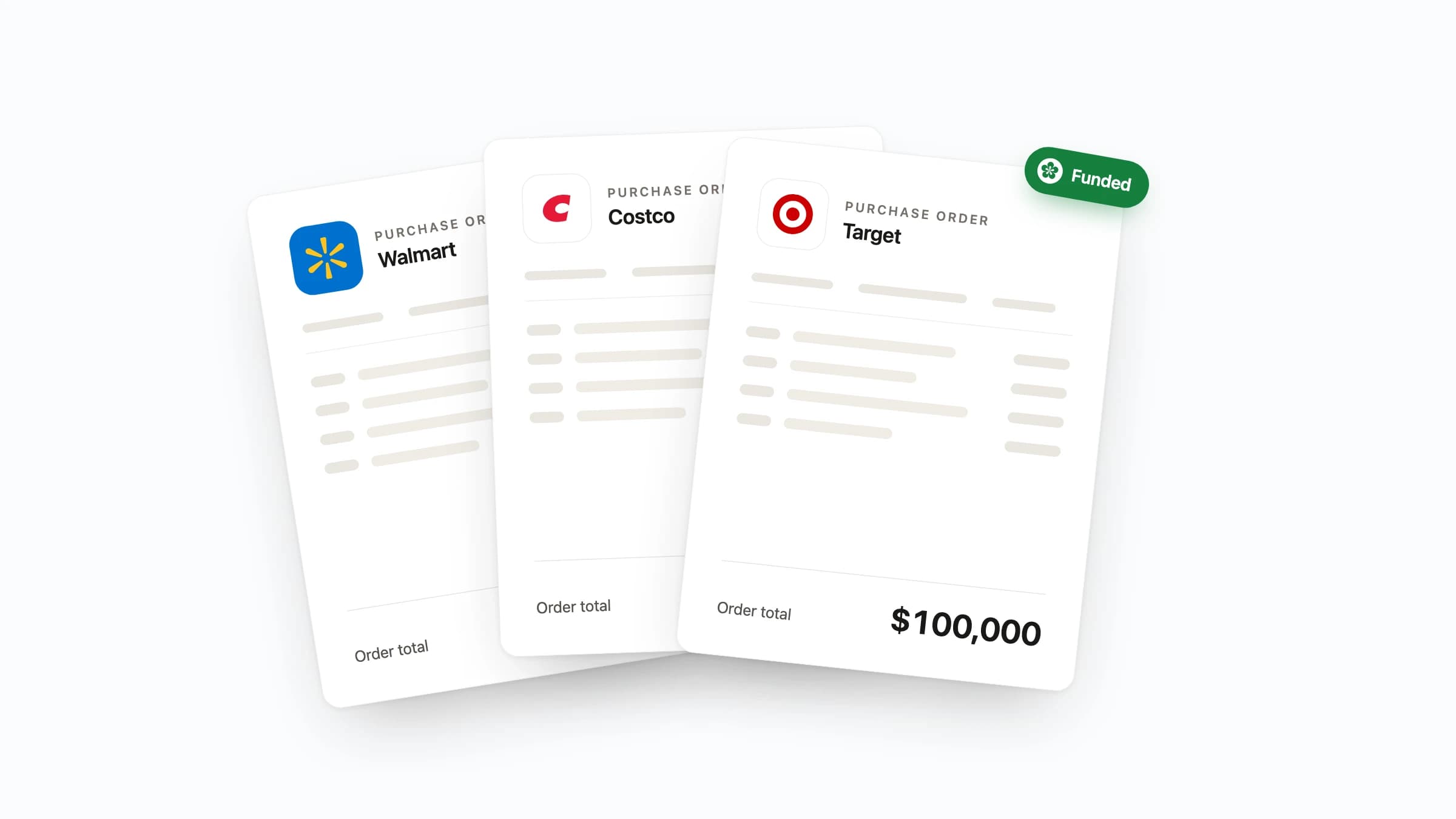
Slotting fees rarely arrive as a bill. Most come off a launch's first invoices, in the same weeks you pay for its first production run. How retailers collect them, and how brands fund the gap.
Last edited 6 min read
$9,182 per product, per retailer, per metro area: that was the average slotting fee in the Federal Trade Commission's study of new grocery products, and some products paid more in slotting than they sold in their first year.1 Most brands never write a check for it. The retailer takes it as free product or as a deduction off the first invoices, so the cost lands in the same weeks you are paying for the launch's first production run.
This post explains what slotting fees are, how retailers collect them, and the ways a food, beverage or personal-care brand can fund them. We sell some of the options, so check our work. It is not legal or financial advice.
What is a slotting fee?
A one-time payment a brand makes to a retailer to get a new product onto its shelves or into its warehouses.
The FTC defines it as a fee "charged by or received by" the retailer "as a condition for the initial placement of a supplier's product on the company's store shelves or for initial access to the company's warehouse space", paid as a lump sum or in installments, "in cash, in free goods, or in any other thing of value".1 A pay-to-stay fee is the same thing for keeping a product on the shelf. Whether a retailer charges one, and how much, varies by retailer, by category and by how the product is delivered: the FTC found fees were less frequent and lower for products delivered straight to stores than for products that go through the retailer's warehouse.
How much do slotting fees cost?
In the FTC's study, the average fee per product per retailer per metro area ran from $2,313 to $21,768 depending on the retailer, with an overall average of $9,182 and a median of $6,500.1 Refrigerated and frozen categories paid the most. At one retailer the median fee was 20% to 30% of the product's first-year revenue, and at another more than a third of new ice cream products paid more in slotting than they sold in their first year.
Those figures come from retailer data for 1998 to 2001 and a small sample, and today's fees are negotiated privately and not published, so treat them as a sense of scale rather than a price list. The arithmetic is what matters: fees are charged per item and per region, so they multiply. Four flavors launched in three regions at the FTC's average would be 12 × $9,182 = $110,184, before you have sold a case.
How do retailers collect slotting fees?
Mostly by paying you less, not by sending you a bill.
The retailers the FTC studied collected slotting in several ways:1
- Free fill: free cases in the first shipment, so the shelf is stocked at your cost.
- A deduction off the first invoice, sometimes after a bill goes unpaid for 15 days.
- A bill-back, which reduces what the retailer pays across your invoices.
- A lower cost per case on the new item.
- A bill from the retailer, paid as a lump sum or, for some smaller suppliers, over time.
Whichever it is, the effect on your cash is the same. Your first orders arrive with smaller payments attached, at exactly the moment you have paid for ingredients, packaging, a production run and freight.
How do brands fund slotting fees?
Free fill and deductions push the cost onto the first invoices; the funding question is how to carry that gap.
| Question | How the fee gets paid | The catch |
|---|---|---|
| Cash on hand | A check or wire before launch | Cash that could have gone into inventory |
| Free fill | Free cases in the first shipment | You still pay to make those cases |
| Deductions off the first invoices | The retailer pays your first invoices short | Your first payments arrive smaller while production bills are due |
| A payment plan | Spread over months, if the retailer agrees | Not every retailer offers one; ask before you sign |
| Invoice factoring | Cash for the invoice when you ship, with the deduction taken from the part held back | A fee for the days until the retailer pays |
| Equity | However you like | Slow, and permanent, for a one-time cost |
The most common shape is the third row: the fee comes off the first invoices, and the brand funds the rest of the launch around it. Factoring helps there because a factor advances part of the invoice when you ship and holds the rest back until the retailer pays. A deduction comes out of the part held back, not out of your advance. More on the mechanics: how invoice factoring works.
Can Spring fund a launch that carries slotting fees?
Spring funds the orders and invoices around the fee, not the fee itself as a separate payment to the retailer.
- Purchase order financing pays your supplier for the cost of goods behind a signed retailer order, so your own cash is free for the fee or the free fill.
- Invoice factoring advances your invoices when you ship. Spring sets the advance rate per retailer from how that retailer actually pays you, deductions included, so a launch's deductions come out of what is held back.
- Demand plan financing is capital sized to a retailer's demand plan before the purchase orders arrive: Spring pays your manufacturers and can add working capital to your account.
Spring's fee is 12% to 36% a year. What you should know before you apply: every product except Bridge Funding needs a Notice of Assignment, a letter asking your retailer to pay your invoices to an account Spring holds for you, and your first funding waits until the retailer acknowledges it. Here is what one actually does. A business without retailer orders can look at Bridge Funding, which needs no notice.
What should you ask before you agree to a slotting fee?
- Is the fee per item, per store, per warehouse or per region?
- Is it paid in cash, in free fill, or as a deduction, and off which invoices?
- Is there a pay-to-stay fee after the first year?
- What happens to the fee and any unsold product if the item is discontinued?
- Can it be spread over several months?
Frequently asked questions
How do CPG brands pay slotting fees at Kroger, Walmart or Target?
It depends on the retailer and the category, and terms are negotiated item by item. In practice most slotting is taken as free fill (free cases in the first shipment) or as a deduction off the first invoices rather than paid by check. Ask the buyer which applies before you plan the launch's cash.
How much are slotting fees for a new product?
In the FTC's study of grocery retailers, the average was $9,182 per product per retailer per metro area, with retailer averages from $2,313 to $21,768. That data is from 1998 to 2001; current fees are negotiated privately and are not published.
Can I finance slotting fees?
Usually indirectly. Because most slotting comes off the first invoices, brands fund the launch around it: purchase order financing pays the supplier, and invoice factoring advances the invoices when you ship, with deductions taken from the part held back.
What is free fill?
Free product in a new item's first shipment, so the retailer stocks the shelf at your cost. It is a common alternative to a cash slotting fee, and you still pay to make every free case.
Are slotting fees deducted from my invoices?
Often. In the FTC's study, retailers collected slotting as a deduction off the first invoice, as a bill-back across invoices, or as a lower cost per case, as well as by billing the supplier directly.
Do slotting deductions reduce my factoring advance?
Not the advance you already have. A factor holds back part of each invoice, and a deduction comes out of that first. At Spring, the advance rate is set per retailer from how that retailer pays you, deductions included, and a deduction bigger than what is held back comes out of your next payment.
If you are planning a retail launch, get started or talk to the team.
1 Federal Trade Commission, Slotting Allowances in the Retail Grocery Industry: Selected Case Studies in Five Product Categories, November 2003 (retailer data for 1998 to 2001), read October 2026.