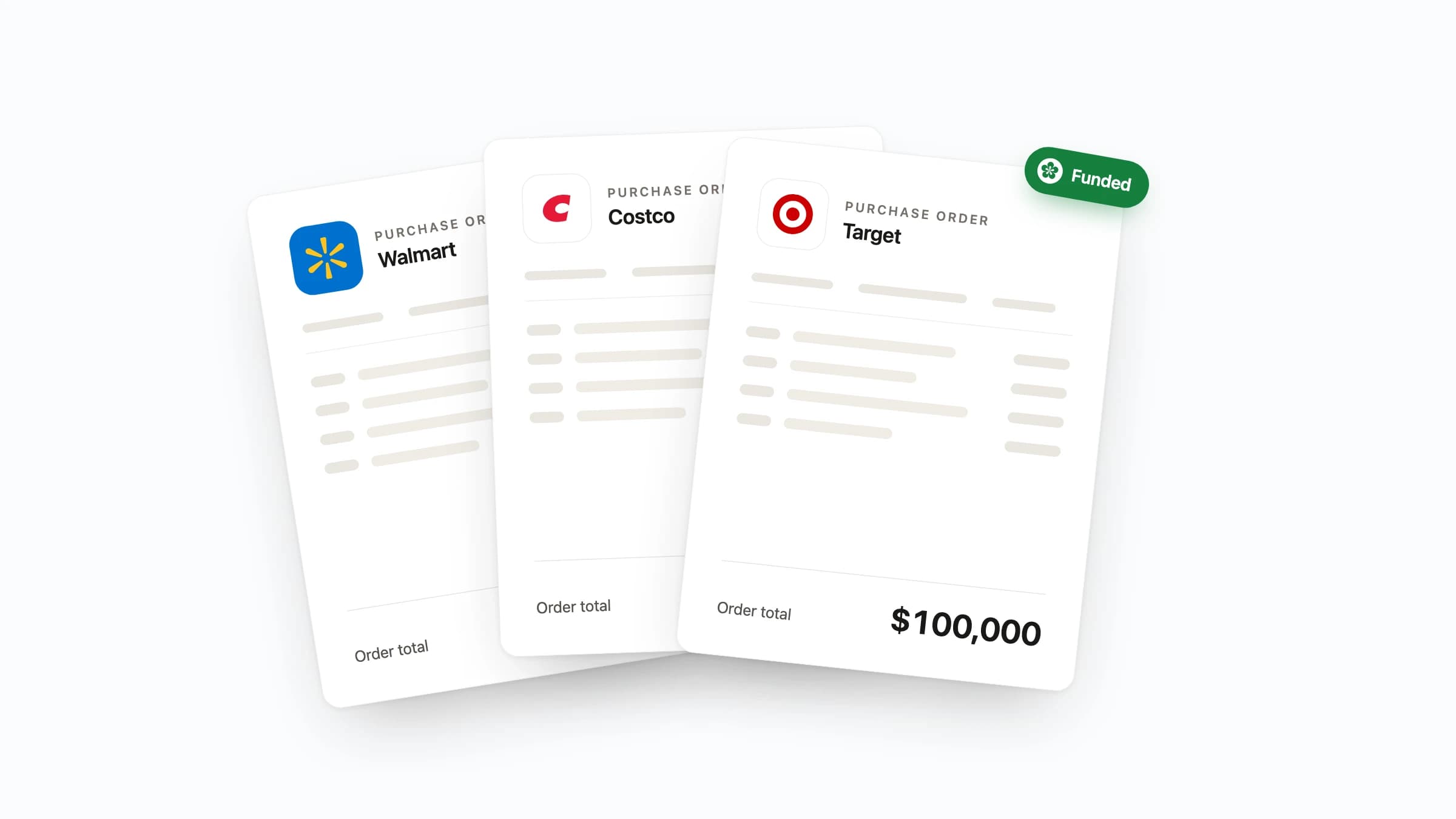
Selling through UNFI, KeHE or Whole Foods means paying for the order long before the distributor pays you. Who pays you in the natural channel, and the ways to fund the gap.
Last edited 5 min read
Up to 60% of the cost of making a UNFI, KeHE or Whole Foods order can be paid to your supplier before it ships, and most of the invoice can be advanced once it does, both at 12% to 36% a year. That pair, purchase order financing and then invoice factoring, is how a natural or organic food brand can fund distributor growth without selling equity, and the distributor's payment settles both.

A new distributor listing is good news that arrives as a cash problem. This post covers who actually pays you when you sell into the natural channel, the ways a brand can fund the gap, and when something other than Spring is the better fit. We sell two of the options, so check our work. None of it is legal or financial advice.
Why does a natural food brand run short of cash when UNFI or KeHE says yes?
Because you pay for the order long before anyone pays you for it.
A new listing means organic ingredients, packaging, a co-packer's run and freight to the distributor's warehouses, all paid up front. The distributor then pays on its own terms (how UNFI and KeHE count the days), and promotions, spoils and shortages can come off what it pays. A new item often launches with promotional support the brand pays for, so the first orders can cost more than they bring in for a while. The faster the natural channel picks you up, the more of that cost you carry at once.
Who pays you when you sell to Whole Foods?
Usually UNFI. UNFI is the primary distributor of natural, organic and specialty products to Whole Foods Market, its largest customer at about 28% of UNFI's fiscal 2026 net sales and the only one above 10%.1 The distribution agreement now runs to 2032.2 How a first Whole Foods order is funded is worked through in funding a Whole Foods launch. A brand that reaches Whole Foods shelves through UNFI invoices UNFI, and UNFI's payment is the one a funder relies on. Some brands, often local ones, sell to Whole Foods stores or regions directly, and then Whole Foods pays the invoice. KeHE plays the distributor's role for many natural and specialty chains and independent stores.
Funding follows the invoice. Whoever you invoice is who pays the funder, so name the distributor, not just the store, when you ask a funder whether it works with your channel.
What are the ways to fund a natural food order?
Five, and only two of them pay for production and wait for the distributor to repay.
| Question | Pays for making the goods? | Who repays, and when |
|---|---|---|
| Purchase order financing | YesYour supplier is paid against the signed order | The distributorIts payment on the invoice settles it |
| Invoice factoring | NoIt starts when you ship and invoice | The distributorWhen it pays the invoice on its terms |
| Consignment inventory funding | Yes3Up to 100% of the inventory cost | YouMonth by month, as the stock sells |
| Bank or SBA line | Yes, if it is already in placeWeeks to months to set up | YouOn the bank's schedule, usually with a personal guarantee |
| Equity | Yes, and anything elseMonths to raise | No oneYou give up part of the company instead |
Purchase order financing pays your co-packer or ingredient supplier directly against the distributor's purchase order. Invoice factoring advances most of the invoice once you ship. Consignment funding, offered by Kickfurther, pays for inventory and is repaid by you as it sells; we compared it with order funding in consignment inventory funding vs PO financing. A bank line is steady and inexpensive once it exists, and equity is permanent money for a permanent need.

How does Spring fund a UNFI or KeHE order?
In three steps, with the distributor's payment closing the funding.
- The order arrives. Spring pays your supplier up to 60% of the cost of goods against the signed purchase order, so production starts.
- You ship and invoice. Invoice factoring tops the funding up to your advance rate for that distributor, which is shown in your offer before you accept.
- The distributor pays. Its payment lands in a collection account Spring holds for you. Spring settles the funding and its fee, and the rest is released to you.
The price is 12% to 36% a year, charged on the days the money is out, so a distributor that pays sooner costs you less. Distributor portals connect read-only, so you are not exporting invoices and payments by hand. Deductions are expected in this channel: they are one reason an advance is less than the full invoice. If you sell against a retailer's demand plan rather than one order, demand plan financing funds the plan, and you repay it monthly.
What does Spring need from you before the first funding?
A Notice of Assignment. Purchase order financing, invoice factoring and demand plan financing all require one: a letter asking the distributor's accounts payable team to pay your invoices to the collection account Spring holds for you. UNFI and KeHE will know you have a funding partner, and your first funding waits until they acknowledge the notice, which usually takes days and occasionally a couple of weeks. Distributors process these routinely; here is what one actually does. Bridge Funding is the one Spring product that needs no notice.
When is something else the better choice?
- You are not on a natural shelf yet. Whole Foods runs an accelerator, LEAP, for grocery and body-care brands not yet selling in its stores, and a program that funds local suppliers.4 With no distributor order, there is nothing for order funding to fund.
- You need inventory ahead of any order. Consignment funding pays for stock no one has ordered yet.
- You will draw the money all year. A brand with millions in steady receivables and inventory may do better with a bank or an asset-based line.
- You sell mostly online. No distributor invoice means nothing to factor; look at Bridge Funding.
Frequently asked questions
How do natural and organic food brands get funding to sell through UNFI, KeHE or Whole Foods?
Most combine two products. Purchase order financing pays the co-packer and ingredient suppliers against the distributor's signed purchase order, so production can start. Invoice factoring then advances most of the invoice once the order ships. The distributor's payment settles both. Spring offers both at 12% to 36% a year: purchase order financing and invoice factoring.
Can I factor invoices to UNFI or KeHE?
Yes. Spring factors invoices to UNFI, KeHE and Whole Foods. Each distributor is set up once with a Notice of Assignment before its first invoice is funded, and has its own advance rate, shown in your offer before you accept. How each one's payment clock runs: invoice factoring for UNFI and KeHE.
If I sell to Whole Foods through UNFI, who pays my invoice?
UNFI. It is the primary natural and organic distributor to Whole Foods Market, so a brand that ships through UNFI invoices UNFI and is paid by UNFI. If you sell to Whole Foods stores directly, Whole Foods pays. Funding follows whoever you invoice.
Will UNFI, KeHE or Whole Foods know I am using a funding partner?
Yes. A Notice of Assignment asks the distributor's accounts payable team to pay your invoices to an account Spring holds for you. Distributors process these routinely, and the first funding waits until they acknowledge it. What a NOA is and what it does.
Do distributor deductions affect how much I can get?
They are part of why an advance is less than the full invoice. Promotions, spoils and shortages can come off what UNFI or KeHE pays, and the advance rate for each distributor leaves room for that. The rest of the invoice is released to you when the distributor pays.
Is Kickfurther or purchase order financing better for a natural food brand?
It depends on whether a distributor has ordered the goods. Kickfurther funds inventory and is repaid by you as it sells, which suits stock no one has ordered yet. Purchase order financing funds a signed order and is repaid by the distributor's payment. The full comparison: consignment inventory funding vs PO financing.
Does Whole Foods offer its own funding for brands?
Whole Foods runs a program that funds local suppliers and an accelerator, LEAP, for grocery and body-care brands not yet in its stores. Both are listed on its page for potential suppliers. Once you are shipping through UNFI or KeHE, order and invoice funding take over.
If you have a UNFI, KeHE or Whole Foods order to fill, get started or talk to the team.
1 United Natural Foods, Inc., Form 10-K for fiscal 2026, read October 2026.
2 United Natural Foods, Inc., "United Natural Foods, Inc. Extends Distribution Partnership with Whole Foods Market to 2032", Form 8-K exhibit 99.1, May 21, 2024, read October 2026.
3 Kickfurther, Inventory Funding Built for CPG Brands, read October 2026.
4 Whole Foods Market, Information for Potential Suppliers, read October 2026.