An 8.75% fee that works out to about 85% a year. A revenue-based cash advance is repaid out of your bank account every day; Spring is repaid by your retailer, once, when the invoice is due. The arithmetic, shown on a real Wayflyer offer.
Last edited 5 min read
An 8.75% fee sounds cheaper than a 36% rate. It is not. On a real Wayflyer offer a brand showed us this spring, 8.75% worked out to about 85% a year. The same $100,000 from Spring, against a retailer invoice, costs between 12% and 36% a year.

Revenue-based financing is a cash advance repaid out of your sales, debited daily or weekly, for a flat fee fixed on day one. Invoice factoring is cash now for a retailer invoice, repaid by the retailer when the invoice comes due.
The gap is not a trick. It comes from one design choice: a cash advance is repaid out of your bank account every day, starting tomorrow; Spring is repaid by your retailer, once. Here is the arithmetic, so you can run it on an offer from Clearco, Shopify Capital or anyone else. We sell the other side, so check our work. It is not legal or financial advice.


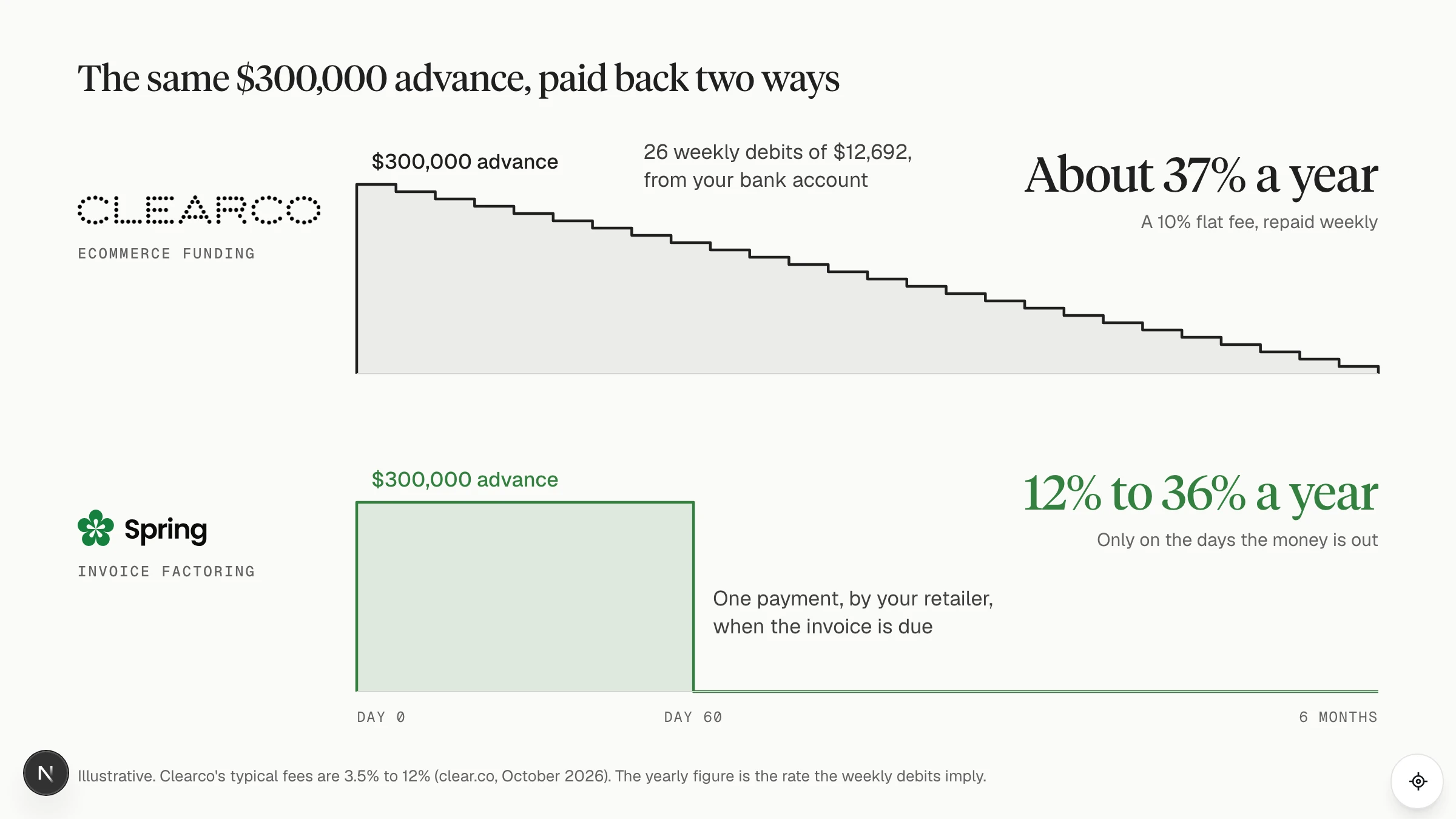
Sized on your store, ad and bank data, $100,000 lands in your account. Day zero is the best the chart ever looks.
The advance plus the 8.75% fee is $108,750: 72 payments of about $1,510, leaving your account every day from tomorrow, before the inventory it bought arrives.
By the halfway mark you hold less than half the advance, but the $8,750 fee is owed in full whether repayment takes 72 days or 40. You had about $50,000 on average and paid for $100,000.
Spring advances 80% of a $125,000 invoice to a retailer on net 60. Nothing leaves your bank account; the full $100,000 is yours for the invoice's whole term.
The retailer pays the invoice to the collection account it was re-pointed to, and the remaining $25,000 is released to you. The fee is an annual rate on $100,000 for 74 days (60 plus a 14-day buffer): between $2,433 and $7,299.
As an annual rate, 72 daily payments of $1,510 against $100,000 is roughly 85% a year, or 61% if the debits run only on business days. The top of Spring's range, 36%, is under half of that. Grey is what a cash advance leaves you; green is what Spring does.
Why is a flat fee not a rate?
A rate is a price per year on the money you actually have. A flat fee is a price on the money you were handed on day one, however quickly you hand it back. With daily debits you hold about half of it, for ten weeks: 8.75% for half the money for a fifth of a year is 60% to 85% a year.
So selling faster makes it more expensive: a great month repays the advance sooner, the fee is unchanged, and the annualized cost rises, as Wayflyer's own writing says.1 And paying it off early saves nothing.
California and New York require sales-based financing to disclose an estimated annual rate;2 elsewhere, ask for one.
How do revenue-based financing and invoice factoring compare?
| Question |  Cash advance |  Invoice factoring |
|---|---|---|
| What it is sized on | Your past sales: store, ad and bank data | A specific retailer invoice, purchase order or demand plan |
| Who repays it | You, from your bank account | Your retailer, when it pays the invoice. Demand plan financing is repaid by you, monthly |
| When | A share of sales, debited daily, from day one | On the invoice's own due date |
| What it costs | A flat fee, typically 5% to 10% of the advance, fixed on day one | 12% to 36% a year, for the invoice's terms plus 14 days, fixed when you are funded |
| Speed | Hours to a day or two | Days. The first funding waits on your retailer acknowledging a notice |
Wayflyer publishes its fee range.3 Spring's products: invoice factoring, purchase order financing and demand plan financing.
What do daily debits do to a wholesale business?
A brand selling into retail is paid a lot, rarely, and late: you ship in March and the money arrives in May. A debit every day through March and April re-opens the gap the financing was meant to cover. Factoring's repayment is the retailer's payment, so if the retailer takes 70 days instead of 60, the schedule moves with it.
What does Spring ask of you?
A Notice of Assignment, for invoice factoring, purchase order financing and demand plan financing: a letter re-pointing your retailer's payments to a collection account Spring holds for you (what a NOA is). Your retailer will know, and your first funding waits days, occasionally a couple of weeks, for it to acknowledge the notice. Bridge Funding needs no notice.
When is revenue-based financing the better choice?
- Most of your revenue is online. With no retailer invoices there is nothing to factor. Wayflyer, Clearco and Shopify Capital were built for you.
- You need the money this week. Wayflyer can fund in hours.
- You are small. Wayflyer starts at around $10,000 a month in revenue with six months of trading.4
- The spend pays back inside the term. A fast-turning restock can be worth a high annualized cost.
Wayflyer's wholesale product is repaid in set instalments;5 ask what happens when one falls due before your retailer pays.
What should you ask of any offer?
- What does it cost per year? Not the fee.
- Who repays, and from which account?
- What happens if I repay early?
- What happens in my slowest month? And in my best one.
- Who else gets told? Your retailer, a filing, your store and bank accounts.
Ask them of us too, and of ecommerce funding and consignment inventory funding.
Frequently asked questions
How do I convert a flat fee to an annual rate?
Find the rate that makes the payments worth the advance (a spreadsheet's RATE or IRR function), times the payment periods in a year. As a check, it is roughly twice the fee divided by the term in years. This post's 8.75% over 72 daily payments is about 85% a year.
Does paying a cash advance off early save money?
Usually not: a flat fee is owed in full, so repaying early raises the yearly cost. Clearco says it prorates its fee. Ask before you sign.
Is invoice factoring cheaper than revenue-based financing?
On this post's offer, about 85% a year against Spring's 12% to 36%. But factoring needs retailer invoices.
Does a cash advance have to show an annual rate?
In California and New York, yes. Most states do not require one.
If you sell into retail and want to see real numbers for your business, get started or talk to the team.
1 Wayflyer, The consumer brand financing stack, read September 2026.
2 California: 10 CCR §930 and following, under SB 1235. New York: 23 NYCRR Part 600, under the Commercial Finance Disclosure Law.
3 Wayflyer Help Center, What is Wayflyer funding?, read September 2026.
4 Wayflyer Help Center, What are the requirements to get funding from Wayflyer?, read September 2026.
5 Wayflyer, Wholesale financing, read September 2026.