A holiday or summer season is paid for months before it sells. The ways a consumer brand can fund the build, sorted by who has committed to buy it.
Last edited 5 min read
Four kinds of funding pay for a seasonal inventory build: funding against a retailer's demand plan or purchase order, invoice factoring once the season ships, inventory or revenue-based funding repaid as the stock sells, and a seasonal bank line. Which one fits turns on a single question: has a retailer committed to buy the season, or are you betting on selling it yourself?
A holiday, summer or back-to-school season is paid for months before it sells. Ingredients, packaging and the co-packer's run are due in the spring or summer, and the retailer pays weeks after the goods reach its shelves. This post compares the ways a food, beverage or personal-care brand can carry that gap, and what happens to each when the season sells slower than planned. We sell three of the options, so check our work. None of it is legal or financial advice.
When do you have to pay for seasonal inventory?
Long before the season, and the cash comes back long after it.
A brand building for a November shelf orders packaging and books production in the summer, ships to the retailer's distribution centers in early autumn, and invoices then. Sixty- to 90-day payment terms are standard in retail, and in food and beverage they have stretched toward 120.1 Goods delivered in October can be paid for in the new year. For that whole stretch the season's cost sits on your balance sheet, at the moment you also want to fund next season.
What are the ways to finance a seasonal build?
Two questions sort them: does the option pay for production, and who repays it?
| Question | Pays for production? | Repaid by |
|---|---|---|
| Demand plan financing | Yes, before the orders arriveSized on the retailer's demand plan | You, monthlyThe retailer's payments pass through to you |
| Purchase order financing | Yes, against a signed orderYour supplier is paid directly | Your retailer, onceWhen it pays the invoice |
| Invoice factoring | No. It starts when you shipIt carries the wait for payment | Your retailer, onceWhen it pays the invoice |
| Inventory or revenue-based funding | YesSized on the stock's cost or your sales | You, as you sellDaily, weekly or as the stock sells |
| SBA Seasonal CAPLine | Yes, if the line is already in placeWeeks to months to set up | YouOut of the season's receivables |
How do you finance a season a retailer has already planned?
Fund production against the retailer's plan, then let the retailer's payments do the repaying.
Retailers often share a demand plan for a season before they send purchase orders. Demand plan financing pays your manufacturers against that plan, so production starts on the retailer's calendar rather than when your cash catches up. You repay it in monthly installments while the retailer's payments for the season pass through to you.
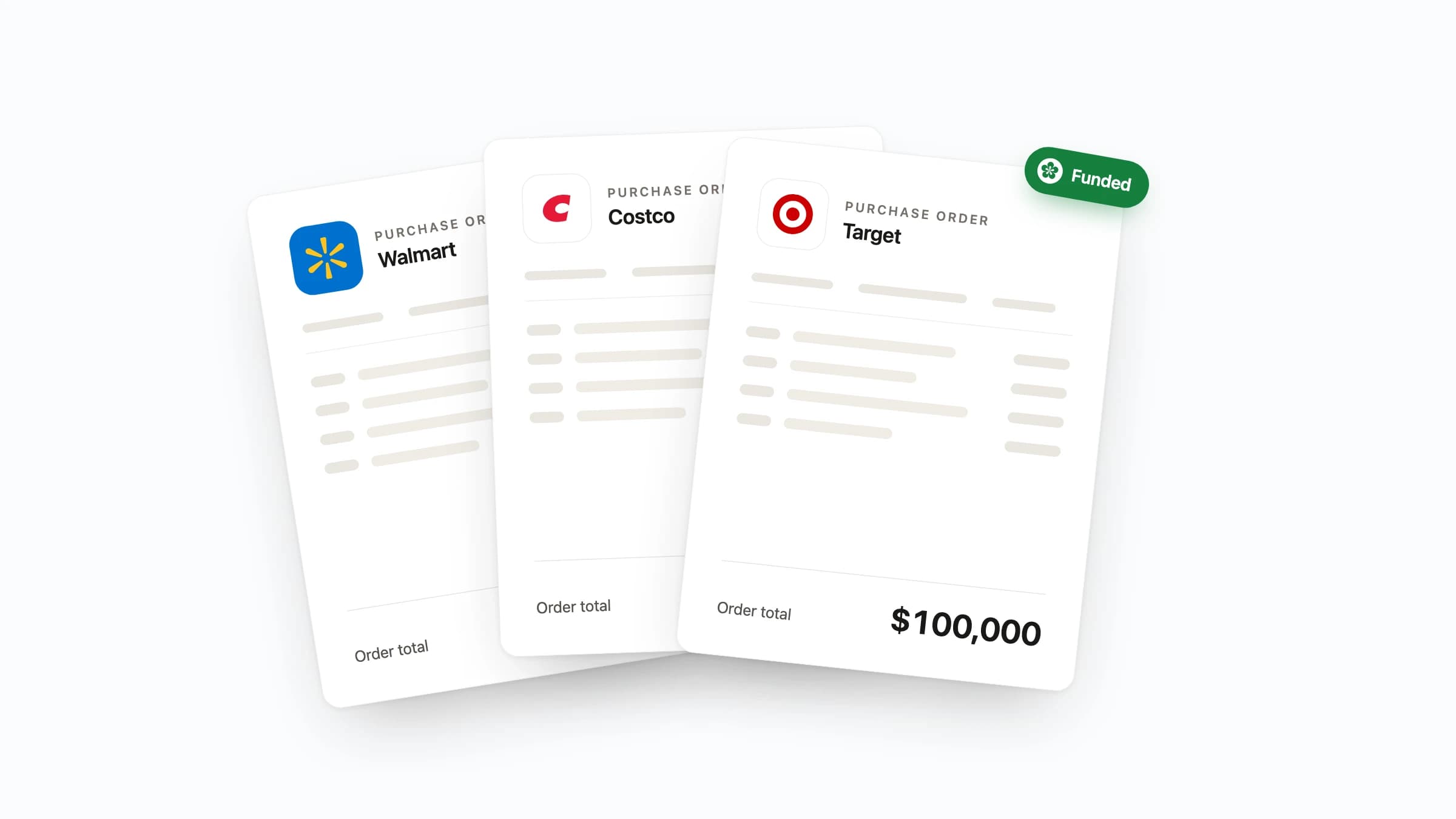
Once a retailer sends the season's purchase orders, purchase order financing pays your supplier against each signed order. When the goods ship, invoice factoring advances the invoice, and the retailer's payment settles both, so nothing falls due before the retailer pays. A brand that ships its holiday orders to Target, Walmart or Costco in October does not have to wait for January to fund the spring. We worked one order through from purchase order to payment in how to fund a big retailer order.
What if no retailer has committed to the season?
Then the funding has to be sized on the stock or on your sales, and you repay it as you sell.
Kickfurther funds the cost of an inventory order, from brands with $200,000 in yearly revenue, and you pay it back as the stock sells.2 Revenue-based funders such as Wayflyer and Shopify Capital advance against your online sales and take a share of them until the advance and a flat fee are repaid. Both suit a brand selling a season through its own store and marketplaces. Bridge Funding is sized on the deposits your business already receives, with no retailer and no notice involved.


Can a bank line cover seasonal inventory?
Yes, if you set it up well before the season.
The SBA's Seasonal CAPLine exists for this: it finances seasonal swings in receivables and inventory.3 The bank will want financial statements, collateral and, usually, a personal guarantee, and it takes weeks to months to arrange. For a brand that builds the same season every year it is steady, inexpensive money. For a season that starts next month it will not arrive in time.
What happens if the season sells slower than planned?
That depends on who repays, so ask before you sign.
- Retailer-repaid funding (purchase order financing, invoice factoring) cannot fall due before the retailer pays. With Spring the fee runs on the days the money is out, so a retailer that pays ten days late adds ten days of fee, nothing more.
- Monthly installments (demand plan financing, a bank line) stay on schedule however the season sells, so plan your cash for the months after it.
- Sell-through funding follows your sales. Kickfurther says extending the timeline may adjust your costs and part of its price is a monthly fee, so ask what an extra month does to the total.4
- A flat fee taken from daily or weekly sales does not shrink when sales do; it only takes longer to repay. Annualise it first: on one real offer an 8.75% fee came to about 85% a year (the arithmetic).
What does Spring need before it funds a season?
A retailer order, invoice or demand plan, a read-only bank connection, and a Notice of Assignment.
Purchase order financing and invoice factoring cost 12% to 36% a year, charged only on the days the money is out. Purchase order financing, invoice factoring and demand plan financing all need a Notice of Assignment: a letter asking your retailer's accounts payable team to pay your invoices to an account Spring holds for you. Your retailer will know you have a funding partner, and your first funding waits until it acknowledges the notice, which takes days and occasionally a couple of weeks. Send it before the season, not during it. What a NOA is and what it does.
When is something else the better choice?
When the season has no retailer behind it, or you build the same season every year.
- You sell the season online. Inventory or revenue-based funding repaid as you sell fits a season with no retailer invoice behind it.
- You build the same season every year and are profitable. A seasonal bank line, arranged in the off-season, will usually cost less.
- You are still losing money while you grow. Read how CPG brands get funding before they are profitable first.
Frequently asked questions
How do I finance holiday inventory for Target, Walmart or Costco?
Most brands fund production against the retailer's plan or order and carry the wait after shipping with invoice factoring. Demand plan financing pays your manufacturers against a retailer's demand plan before the orders arrive; purchase order financing pays your supplier against a signed order; invoice factoring advances the invoice when you ship. The retailer's payment settles the order and the invoice. Spring offers all three.
Can I get seasonal inventory funded before the purchase order arrives?
Yes, if the retailer has shared a demand plan for the season. Demand plan financing pays your manufacturers against that plan, and you repay it in monthly installments while the retailer's payments pass through to you. Without a demand plan or an order, look at inventory funding or Bridge Funding.
Is Kickfurther or a revenue-based funder like Wayflyer better for seasonal stock?
They suit different seasons. Kickfurther funds the cost of an inventory order and is repaid as the stock sells, with a monthly fee, so a slow season costs more. Wayflyer and Shopify Capital advance against online sales and take a share of them until a flat fee is repaid. For stock a retailer has already ordered, funding repaid by the retailer's payment is usually cheaper; see consignment inventory funding vs PO financing.
What is an SBA Seasonal CAPLine?
An SBA-backed bank line for seasonal swings in receivables and inventory. It is steady, inexpensive money for a business that builds the same season every year, but the bank will want financial statements, collateral and usually a personal guarantee, and it takes weeks to months to set up.
How much does seasonal inventory financing cost with Spring?
Purchase order financing and invoice factoring cost 12% to 36% a year, charged only on the days the money is out, so a retailer that pays sooner costs less. Demand plan financing and Bridge Funding are priced in your offer, shown before you accept. Apply in minutes to see yours.
Will my retailer know I am using a funder for seasonal inventory?
Yes, with Spring and with most factors. A Notice of Assignment asks the retailer's accounts payable team to pay your invoices to an account the funder holds for you, and first funding waits on the retailer acknowledging it. Retailers process these routinely. What a NOA is and what it does.
If you have a season to build, get started or talk to the team.
1 Kristen Palmer, First Business Bank, writing in New Hope Network, September 2026: "Sixty- to 90-day payment terms are standard in retail," and in food and beverage they have stretched toward 120.
2 Kickfurther, Inventory Funding Built for CPG Brands, read October 2026.
3 U.S. Small Business Administration, CAPLines authorization, read October 2026.
4 Kickfurther, home page, "Frequently Asked Questions", read October 2026.