An asset-based line at 11% can cost you 35%, and the day after your biggest purchase order it grows by exactly nothing. When a line sized on what you already own is the right tool, and when it is not.
Last edited 5 min read
An asset-based line at 11% can cost you 35%. A facility also charges for dollars you do not draw, so a large line used lightly costs far more than its rate. Used heavily, it is the cheapest money a consumer brand can get, cheaper than ours.
Asset-based lending is a revolving line sized on a borrowing base: a share of the invoices and inventory already on your books. Purchase order financing is money paid to your supplier against a retailer's order, settled when the retailer pays the invoice. One looks back at what you own; the other looks forward at what you have sold.
A brand will be sent to Dwight Funding, Assembled Brands, Siena Lending Group or eCapital. This post shows when that is right, and the one thing such a line cannot do: fund the order you won this morning. We sell the other side, so check our work: the asset-based figures come from Dwight's pages and the OCC's examiner handbook. Not legal or financial advice.


Quick answers
How do I compare asset-backed financing rates and fees from different lenders?
Turn each offer into a yearly cost on the amount you expect to draw on average. Add the interest (on the minimum balance, if you draw less than it) to the facility, unused-line, field audit and appraisal fees, then divide by your average draw. An illustrative $3 million line at 11% costs about 12.5% drawn at $2 million, and about 35% drawn at $400,000.
Is an asset-based line cheaper than Spring?
If you keep it busy, yes. A line drawn most of the year is the cheapest money a consumer brand can get. Used lightly, its fees on the facility and the unused part push the cost up: about 35% in the illustrative $3 million example. Spring charges 12% to 36% a year only on what you draw, deal by deal.
Does a purchase order count toward a borrowing base?
No. A borrowing base counts eligible receivables and inventory, and a purchase order is neither. It counts once the goods are made (inventory) or invoiced (a receivable): after you needed the money.
How long does an ABL facility take to close?
About a month: Dwight says to plan on that from term sheet to close. Without a line already, there is a field exam, an inventory appraisal, legal documents and a lockbox. Spring's first funding takes days, once your retailer acknowledges a Notice of Assignment.
Is Spring an alternative to Assembled Brands?
For a new purchase order, yes. Assembled Brands sizes a line of $1 million to $25 million on the inventory and receivables you already hold, for brands with $10 million or more in revenue. Spring funds the retailer's order and invoice at 12% to 36% a year on what you draw. For a large, steady pool of inventory and receivables, a line is usually cheaper.
Is Spring an alternative to Dwight Funding?
For a new purchase order, yes. Dwight advertises lines of $1 million to $15 million for brands with $5 million to $100 million in revenue and suggests planning on about a month from term sheet to close. Spring funds the order in days once your retailer acknowledges a Notice of Assignment.
Can I use PO financing alongside an asset-based line?
Sometimes. The lender's lien covers all receivables and inventory, so it has to carve out the specific orders and receivables another funder finances. Ask before you sign the facility.
What does Spring need from my retailer?
A Notice of Assignment, for every product except Bridge Funding. It re-points your retailer's payments to a collection account Spring holds for you, and first funding waits until the retailer acknowledges it: days, occasionally a couple of weeks.
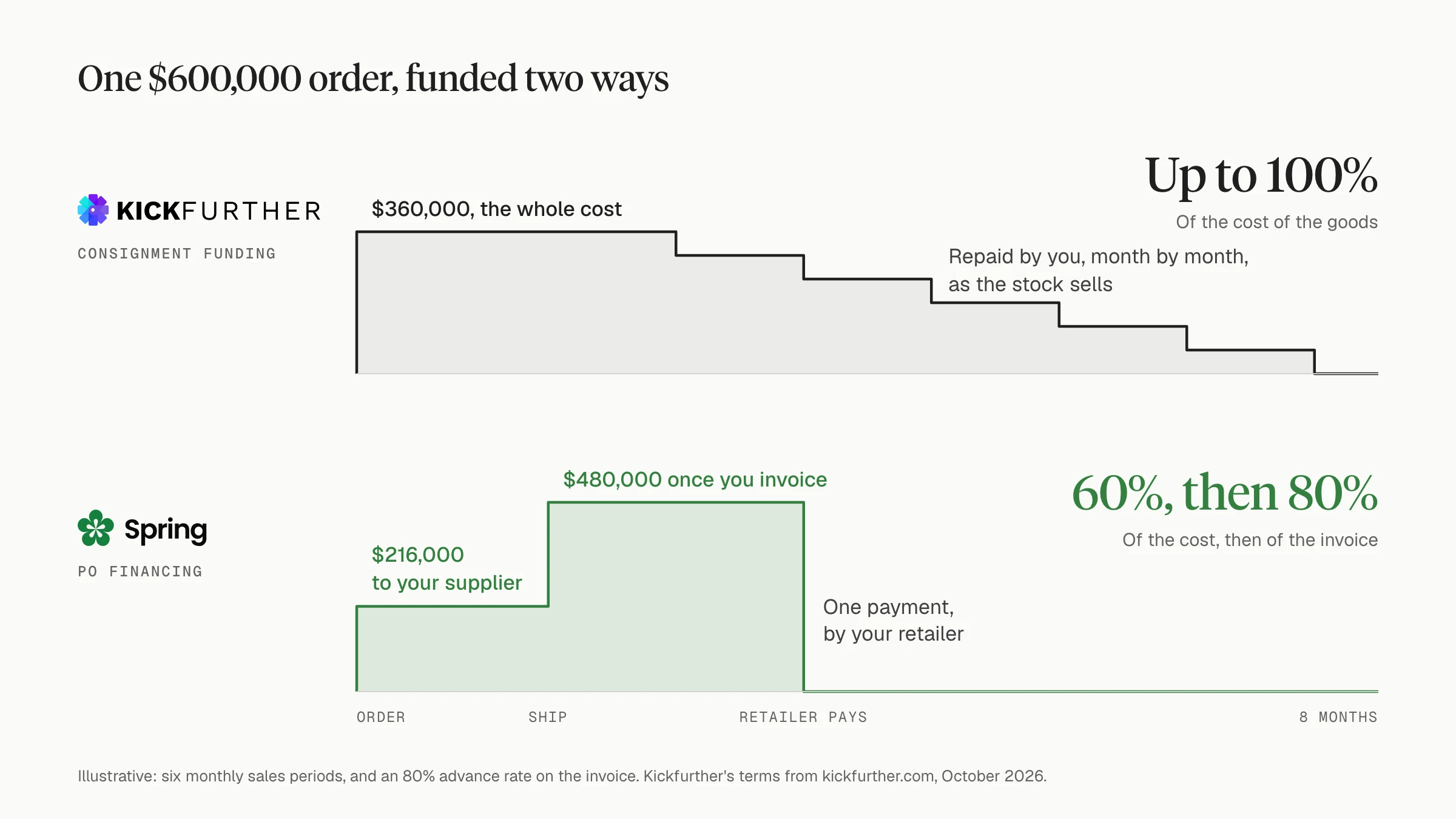
It ships in 90 days. Before then you buy ingredients and packaging, book the co-packer and pay freight: $360,000 to make it, needed now.
The lender asks what you have today that could be collected or sold: $400,000 of invoices and $300,000 of finished goods, both pledged to the line. The new order sits on the other side of today.
$340,000 against the receivables plus $165,000 against the inventory make a borrowing base of $505,000, before ineligibles and reserves. For an established brand, most of it is already drawn.
A purchase order is a promise to buy goods that do not exist. It is neither a receivable nor inventory, so it adds $0 to your line, the day after your biggest order.
Without a line already, there is a field exam, an inventory appraisal, legal documents and a lockbox. Dwight says to plan on about a month from term sheet to close.1 Quick for the category, and a third of your 90 days.
Spring sizes the funding on the order and the retailer behind it, and pays your supplier up to 60% of the cost of goods, here $216,000. Your existing receivables and inventory are untouched.
When the goods ship, invoice factoring tops the funding up to your advance rate for that retailer. The retailer pays Spring, fees are settled, and the rest is released to you. The last frame holds both answers.
Where does the 35% come from?
Asset-based money is cheaper than ours per dollar per day. But the OCC describes its pricing as spreads and fees: field audits, lockboxes, appraisals, and commonly a fee on the line and its unused part.2
Take an illustrative $3 million line at 11%, with a 1% facility fee and a $1 million minimum balance for interest: the handbook's fee types, not any lender's quote.
A brand drawing $2 million on average pays $220,000 in interest and $30,000 in fees: about 12.5% a year. That is excellent money.
A brand drawing $400,000 on average pays interest on the $1 million minimum, $110,000, plus the same $30,000. That is $140,000 on $400,000 of borrowing: about 35%.
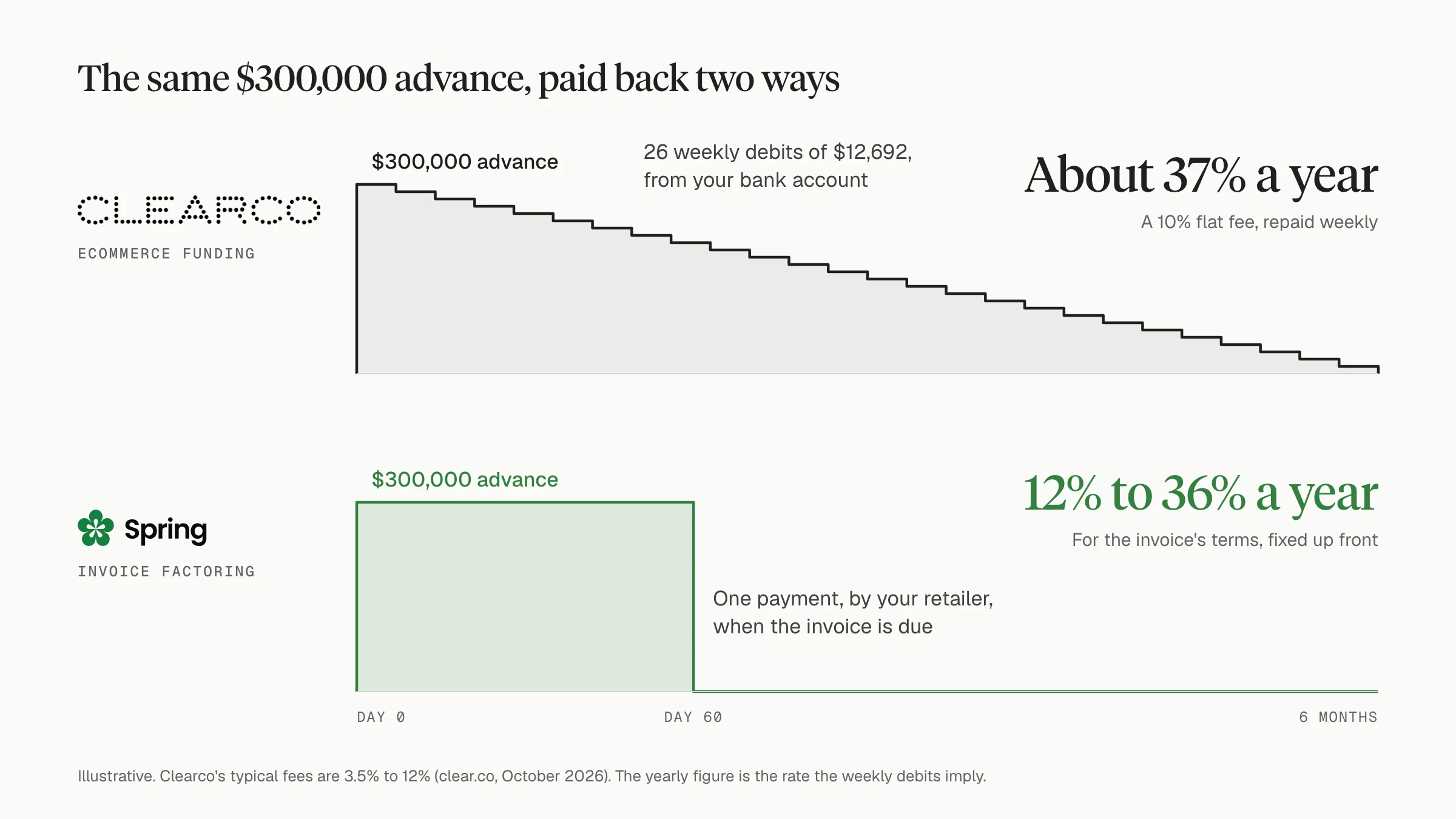
If your need is a big order twice a year, you pay for availability you do not use. Spring charges 12% to 36% a year on the amount advanced, deal by deal, with no minimum use, term or exit fee.
How do the two compare?
| Question | Asset-based line |  PO financing |
|---|---|---|
| Sized on | Invoices and inventory you own2A new order adds nothing until the goods exist | The retailer's orderThe order is what is funded |
| Time to first dollar | About a month1After exams, appraisal and legal | DaysOnce your retailer acknowledges a notice |
| Commitment | A $1M to $15M facility, often multi-year3Monthly certificates, field exams, appraisals | Deal by dealNo minimum use, no term. You report the order funded |
| Price | Lower per dollar drawn2Plus fees on the facility and its unused part | 12% to 36% a yearOnly on what you draw, for the days you have it |
| Security | A first lien on everything2Collections through a lockbox | The receivables we fundUnder a notice to that retailer. Demand plan financing is a secured loan |
Each Spring product has its own page: invoice factoring, purchase order financing, demand plan financing.
Is Spring an alternative to Assembled Brands?
For funding a new order, yes. For financing the inventory and receivables you already hold, usually not. Assembled Brands lists facilities of $1 million to $25 million, at up to 85% of receivables and up to 70% of inventory, for brands with $10 million or more in annual revenue, a year in business and $1 million of inventory.4 That is an asset-based line in the sense above: sized on what is on your books today. Spring is sized on the order or invoice in front of you and charges 12% to 36% a year on what you draw; its purchase order financing starts at $1 million in yearly revenue. A brand with a line can use both only if the lender carves the funded orders out of its lien, as the quick answers above explain.
What does Spring ask of you?
A Notice of Assignment, for every product but Bridge Funding: a letter re-pointing your retailer's payments to a collection account Spring holds for you. Your retailer will know you have a financing partner, and first funding waits until it acknowledges the notice: days, occasionally a couple of weeks. See what a NOA is.
When is an asset-based line the better choice?
- You will keep it busy. Receivables and inventory in the millions, drawn most of the year.
- Your need is inventory you already hold. A direct-to-consumer brand with $2 million of stock and no retailer orders has nothing for Spring to fund. Stock not yet bought is consignment funding's case.
- You have a finance team. Certificates, exams and appraisals are routine for a controller, a tax on a founder.
- You want one committed facility. Dwight's has no personal guarantees and light covenants, and lends to brands not yet profitable.3
What should you ask before you sign either?
- What can I actually draw after ineligible invoices, concentration limits and reserves?
- What do I pay in a month when I borrow nothing?
- What does it cost to leave?
- What is pledged, and who controls my collections?
- When my biggest order arrives, does my availability go up that day?
Ask them of us too.
To fund a purchase order or retailer invoices, get started or talk to the team.
1 Dwight Funding, Comparing revenue-based financing and asset-based lending, read September 2026.
2 Office of the Comptroller of the Currency, Comptroller's Handbook: Asset-Based Lending, on borrowing bases, field audits and fees.
3 Dwight Funding, Product, read September 2026.
4 Assembled Brands, Consumer products, read October 2026.