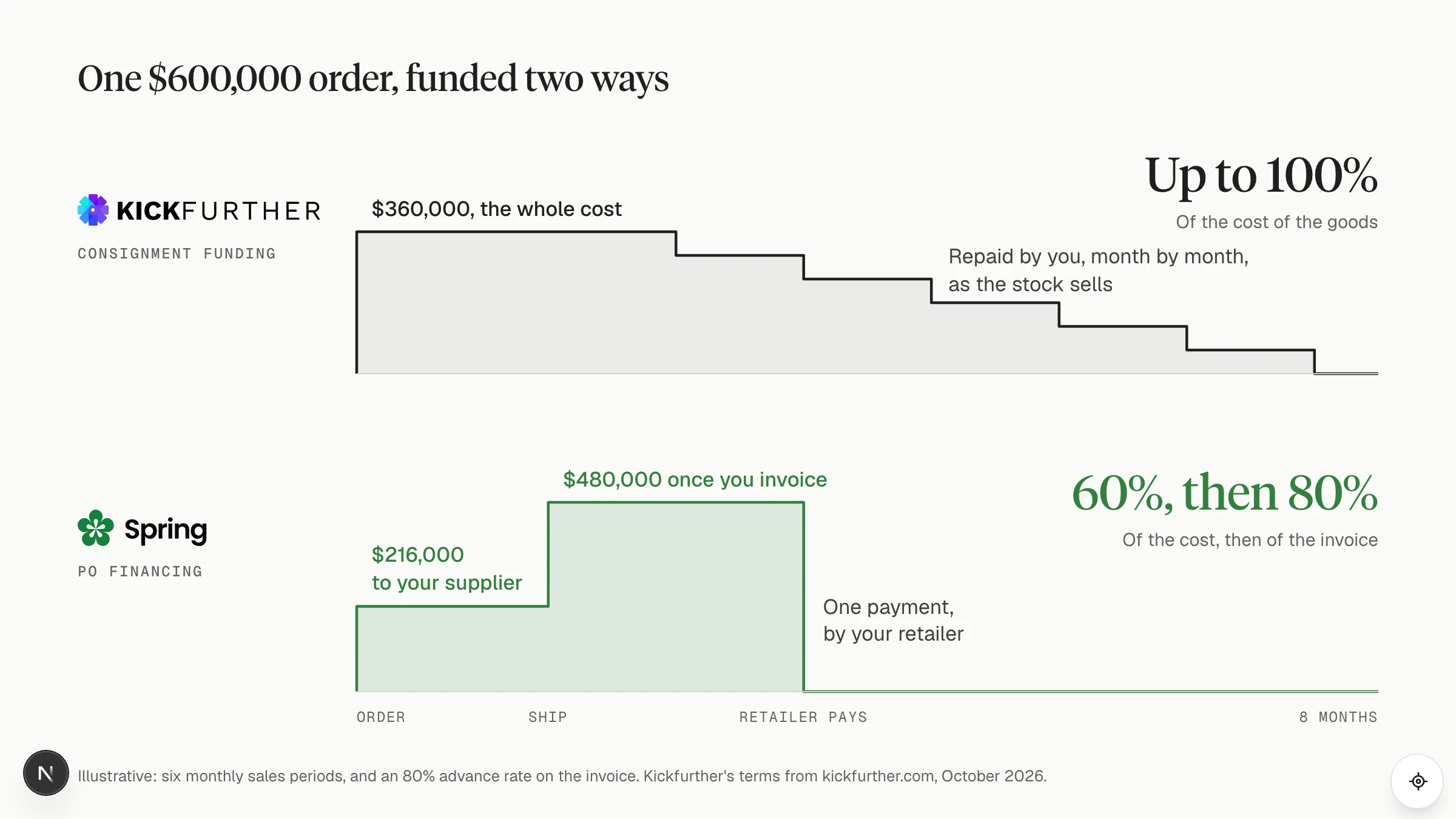
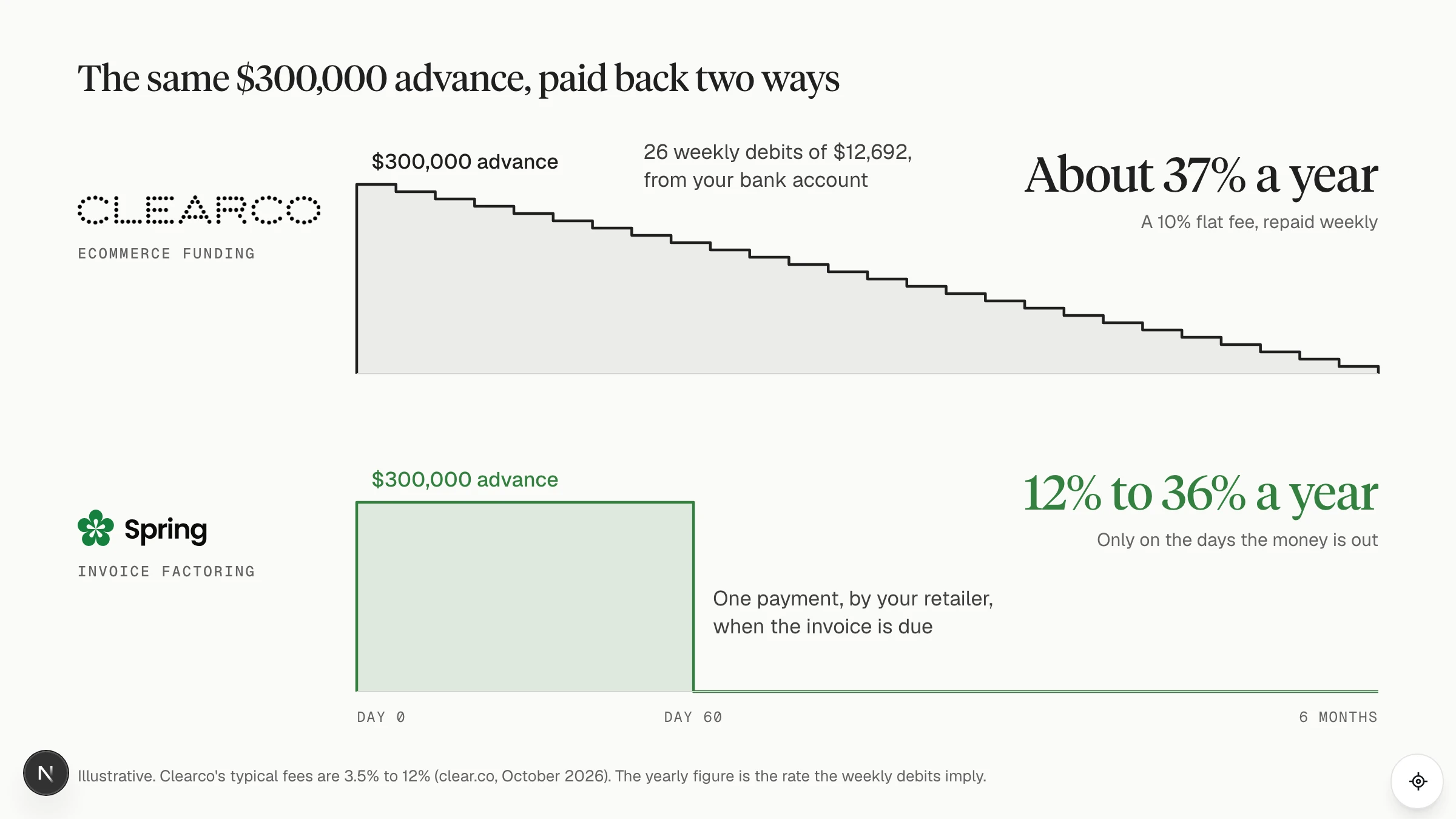
Most inventory money is repaid by you, out of your sales or on a fixed schedule. Some is repaid by your retailer when it pays. The alternatives a consumer brand will be offered, sorted by who pays the money back.
Last edited 5 min read
Five kinds of funding compete with Wayflyer for a consumer brand's inventory money, and they split on one question: who pays it back. Most are repaid by you, out of your sales or on a fixed schedule; purchase order financing and invoice factoring from Spring are repaid by your retailer when it pays the invoice, at 12% to 36% a year.


Which one fits depends on where your revenue comes from and when it arrives. Everything about the other companies here comes from their own public pages, read in October 2026 and footnoted at the end. We sell one of the options, so check our work. None of it is legal or financial advice.
What does Wayflyer offer a consumer brand?
Four products, and the brand repays every one of them.
- Cash advance. Repaid as a share of your sales, collected daily, weekly or every two weeks, for one fixed fee that Wayflyer says is typically 5% to 10%.1, 2
- Fixed-term funding. The same single fee, with fixed repayments on a set schedule. Security is optional and, Wayflyer says, can lower the cost.1
- Rolling financing. Repeat access to either product over a 12-month contract, paying only for what you draw.1
- Inventory financing for brands that sell through at least one physical retailer: up to $20 million, one fixed fee agreed upfront, repaid in set instalments. Wayflyer's own example is a $4,200 fee on $100,000. It asks for at least $250,000 in annual sales and six months of trading, in the US or the UK.3
Wayflyer says money can arrive in as little as 24 hours, with no equity taken and no personal guarantee.4 Those are real strengths. They are also why the alternatives are worth comparing on cost and on the repayment schedule rather than on speed.
What are the alternatives to Wayflyer?
| Question | Who repays it, and when | What it costs |
|---|---|---|
| Revenue-based financing | You, from your sales1, 2A share of revenue, daily or weekly, from the first days | A flat fee, fixed on day oneWayflyer's is typically 5% to 10% of the advance |
| Inventory financing on a schedule | You, in set instalments3, 5Weekly to monthly, whether or not the stock has sold | A fixed fee, or interest on the balanceSettle charges simple interest on what is still outstanding |
| Consignment inventory funding | You, as the stock sells6Through any channel | A funding fee plus a monthly feeQuoted per deal |
| Asset-based line | You, from collections on a revolving line7Sized on inventory and receivables you already hold | Interest on what you draw, plus feesBuilt for larger brands with a finance team |
| Purchase order financing and invoice factoring | Your retailer, when it pays the invoiceNothing leaves your bank account in the meantime | 12% to 36% a yearOnly on the days the money is out |
Clearco and Shopify Capital sell the same revenue-based design as Wayflyer's cash advance. Settle funds inventory and purchase orders at simple interest on the outstanding balance, repaid in 30 days and extendable to 180, for brands with at least $500,000 in trailing yearly revenue.5 Kickfurther funds up to 100% of an inventory order through consignment, and you repay it as the goods sell.6 Assembled Brands and Dwight Funding run asset-based lines for larger brands; Assembled Brands lists $10 million or more in annual revenue.7


Is Spring an alternative to Wayflyer?
Yes, if you sell to retailers or distributors on net terms. No, if most of your revenue is online.
Spring funds a specific retailer order or invoice, not your sales history. Purchase order financing pays your supplier up to 60% of the cost of goods against a signed purchase order. Invoice factoring advances the invoice once you ship. Your retailer's payment settles both, so repayment cannot fall due before the cash it depends on has arrived. Demand plan financing funds production against a retailer's forecast, and that one you repay monthly.
The difference shows up in the price. On a real Wayflyer cash-advance offer a brand showed us, an 8.75% fee repaid every day worked out to about 85% a year, because the debits start straight away and on average you hold only about half the money. The arithmetic is in revenue-based financing vs invoice factoring. Wayflyer's inventory financing changes the schedule, not the logic: ask what happens in the weeks an instalment comes due before your retailer has paid.
When is Wayflyer the better choice?
- Most of your revenue is online. No retailer invoice means nothing for Spring to fund.
- You need the money this week. Wayflyer can fund within a day. Spring's first funding waits on a notice to your retailer.
- You are early. Wayflyer's cash advance accepts brands from about $10,000 a month in revenue.4
- The spend pays back inside the term. An ad campaign or a fast-turning restock whose return arrives in weeks can be worth a high yearly cost.
What does Spring ask of you that Wayflyer does not?
A Notice of Assignment. Purchase order financing, invoice factoring and demand plan financing all require one: a letter asking your retailer's accounts payable team to pay your invoices to a collection account Spring holds for you. Your retailer will know you have a funding partner, and your first funding waits until it acknowledges the notice, which takes days and occasionally a couple of weeks. More in what a NOA is. Bridge Funding is the one Spring product that needs no notice.
Frequently asked questions
What are the alternatives to Wayflyer for a consumer brand?
It depends on who you want to repay the money.
- Revenue-based financing from Clearco or Shopify Capital works like Wayflyer's cash advance: a flat fee, repaid out of your sales.
- Inventory funding from Settle or Kickfurther is repaid by you, on a schedule or as the stock sells.
- Asset-based lines from Assembled Brands or Dwight Funding suit larger brands with inventory and receivables already on the books.
- Purchase order financing and invoice factoring from Spring are repaid by your retailer when it pays, at 12% to 36% a year.
Is Spring an alternative to Wayflyer?
Yes, for brands that sell to retailers or distributors on net terms. Spring funds the retailer's order or invoice and the retailer's payment settles it, so nothing is debited from your bank account while you wait. It is not an alternative for a brand that sells mostly online: Spring needs a retailer order or invoice to fund.
How does Wayflyer compare with Clearco?
Both sell revenue-based financing with one fixed fee, no equity and no personal guarantee. Wayflyer's own comparison with Clearco says Clearco requires US incorporation and $100,000 a month in revenue, while Wayflyer accepts brands from $10,000 a month in more countries. It is Wayflyer's page, so check Clearco's current criteria too. Clearco compared with invoice factoring.
How does Wayflyer compare with Settle?
Wayflyer publishes a comparison with Settle that promises better rates but lists no fees. Settle charges simple interest on the balance still outstanding, repaid in 30 days and extendable to 180, while Wayflyer charges one fixed fee agreed upfront. Ask both for the total you would repay on the same amount over the same term.
Is Kickfurther an alternative to Wayflyer for inventory?
Yes. Kickfurther funds up to 100% of an inventory order through consignment, and you repay it as the stock sells rather than on a fixed schedule. Its price is a funding fee plus a monthly fee, so ask what a slow month adds. Kickfurther compared with purchase order financing.
Does Wayflyer fund brands that sell to retailers?
Yes. Its inventory financing is built for brands selling through at least one physical retailer, from $250,000 in annual sales in the US or the UK, with a fixed fee and set instalments. You still repay it on Wayflyer's schedule, not when the retailer pays.
How much does Spring cost compared with Wayflyer?
Spring charges 12% to 36% a year, only for the days the money is out. Wayflyer charges one fixed fee, typically 5% to 10% of a cash advance, that does not shrink if you repay sooner, so its yearly cost depends on how fast you repay. How to compare a flat fee with a yearly rate.
If you sell to retailers and want to see real numbers for your business, get started or talk to the team.
1 Wayflyer, Financing options, read October 2026.
2 Wayflyer Help Center, What is Wayflyer funding?, read October 2026.
3 Wayflyer, Wholesale financing, read October 2026.
4 Wayflyer, Better rates than Clearco, read October 2026.
5 Settle, Working capital financing for CPG brands, read October 2026.
6 Kickfurther, Inventory Funding Built for CPG Brands, read October 2026.
7 Assembled Brands, Consumer products, read October 2026.