A first Whole Foods placement has to be made, shipped and promoted before anyone pays for it, and the payment often comes from UNFI. The ways an emerging brand funds it, with one order worked through.
Last edited 5 min read
Three kinds of money fund most Whole Foods launches: purchase order financing for the first production run, invoice factoring for the wait after delivery, and savings or equity for the launch costs no order pays for. The invoice is often paid by UNFI, Whole Foods' primary distributor through May 2032, rather than by Whole Foods itself. Whole Foods' own accelerator, LEAP, can add a $25,000 equity investment for the brands it selects.

This post is for an emerging food or beverage brand, a snack brand say, that has just won its first Whole Foods placement and has to pay for it before any money comes back. It covers what the launch costs, who pays you, the ways to fund it and one order worked through. We sell two of the options, so check our work. It is not legal or financial advice.
What does a Whole Foods launch cost before the first payment?
The production run, the freight and the launch support, all before the first invoice is paid.
The biggest line is the first order: ingredients, film and cartons, the co-packer's minimum run and freight to the distribution center. Around it sit costs no purchase order covers: samples and in-store demos, introductory promotions your agreement may ask you to fund, the marketing that gets a new item noticed and, in some agreements, free product for the first shelf fill. Read your vendor and distributor agreements for which apply to you before you build the cash plan.
Who pays you for a Whole Foods order: Whole Foods or UNFI?
Often UNFI. UNFI serves as Whole Foods' primary distributor under an agreement that runs to May 2032.1
When your product reaches the shelf through UNFI, UNFI buys it from you, so UNFI's purchase order is the one you fill and UNFI's payment is the one you wait for. Depending on how your item is set up, you may instead deliver to stores and invoice Whole Foods directly. Ask your buyer which, because it decides whose payment terms you are financing and who receives the funding notice.
What are the ways to fund a Whole Foods launch?
Each option pays for a different part of the launch, so most brands combine two or three.
| Question | What it pays for | Who repays it |
|---|---|---|
| LEAP, Whole Foods' accelerator | Anything2A $25,000 equity investment, for brands selected into a cohort | NobodyYou give up a share of the company instead |
| Consignment inventory funding | The inventoryFunded up front, sold through any channel | YouAs the stock sells |
| Purchase order financing | The production runPaid to your co-packer against the signed order | Whoever pays the invoiceUNFI or Whole Foods, through the notice |
| Invoice factoring | The wait after deliveryAn advance on the delivered invoice | Whoever pays the invoiceWhen it pays |
| Bridge Funding | Launch costs no order coversDemos, promotions, samples | YouA share of your daily sales receipts |
LEAP, Whole Foods' Local and Emerging Accelerator Program, takes brands not yet sold in its stores through a 12-week curriculum, and participants may qualify for a $25,000 equity investment. The 2026 cohort was chosen from more than 2,000 applications, and each brand's products are evaluated for Whole Foods shelves when the program ends.2 It is worth applying for, but it is selective and it is not a production budget.
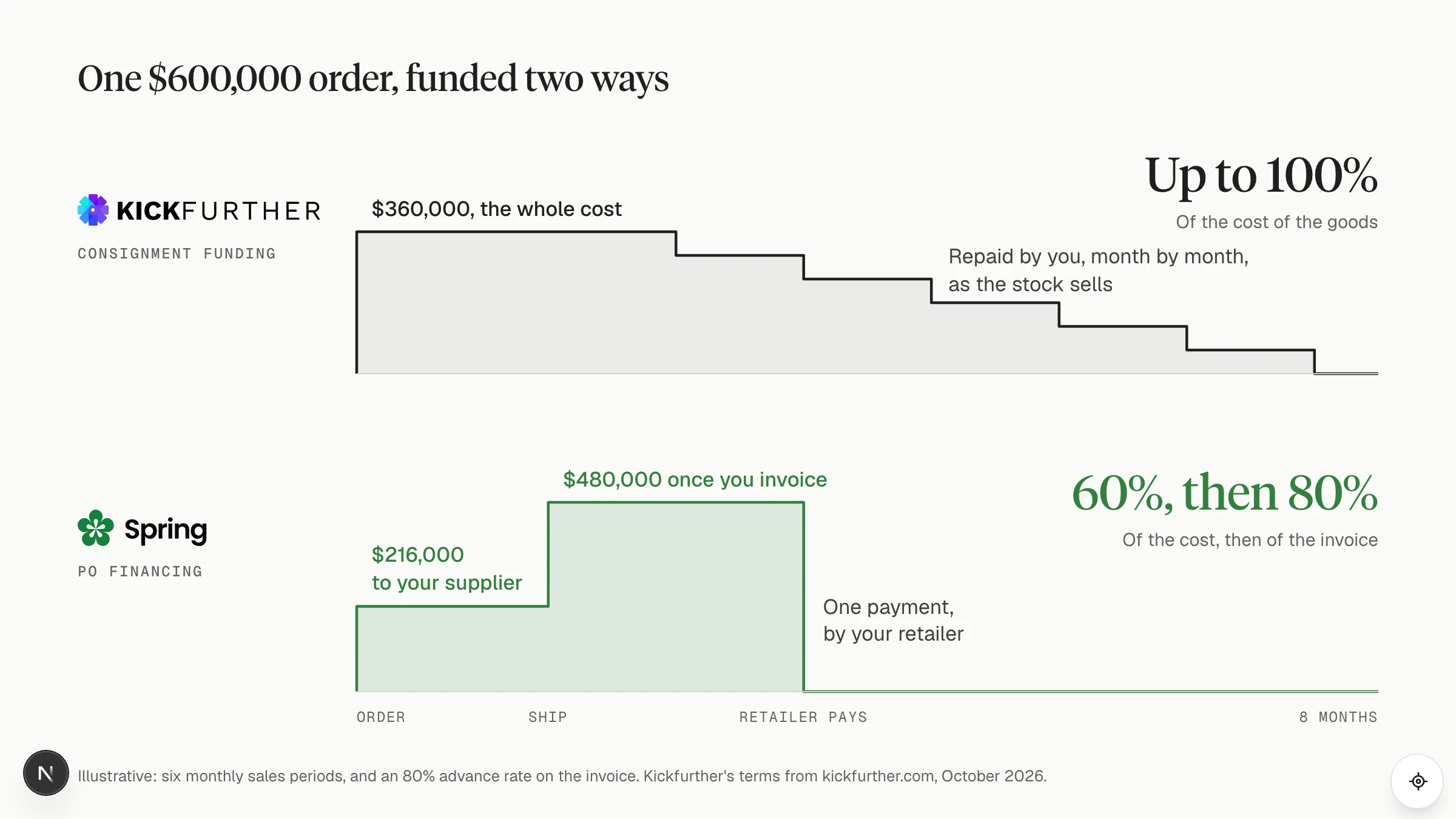
Consignment funding from companies such as Kickfurther pays for inventory and is repaid by you as it sells; it suits a brand selling through many channels at once (compared with PO financing here). Purchase order financing and invoice factoring are repaid by the payment on the invoice, so they grow with your orders. Bridge Funding is the Spring product for costs with no order behind them.

How does a snack brand fund its first Whole Foods order?
Purchase order financing pays the co-packer, factoring advances the invoice, and the distributor's payment settles both.
Take an illustrative snack brand doing $1.2 million a year in other stores. Its Whole Foods placement turns into a $90,000 purchase order from UNFI, and the run costs $54,000 to make and deliver.
- The order arrives. The brand sends Spring the UNFI purchase order.
- The co-packer is paid. Spring pays up to 60% of the cost, $32,400, directly to the co-packer and packaging supplier. The brand covers the other $21,600, plus its demo and promotion budget.
- The order ships. The cases go to UNFI's distribution center, and the brand invoices UNFI for $90,000.
- The invoice is advanced. Invoice factoring tops the funding up to the advance rate for UNFI, $72,000 in total at an illustrative 80%, so $39,600 more reaches the brand in time for the launch.
- UNFI pays. UNFI pays the invoice to the account named in the Notice of Assignment. Spring keeps the $72,000 and its fee, 12% to 36% a year for the days the money was out, and releases the rest to the brand.
The brand launched without giving up equity for a single order, and the reorders that follow a good sell-through fund the same way.
Spring's purchase order financing needs at least $1 million in yearly revenue. A brand below that can fund the first run from savings, equity or consignment funding, then factor the invoice the day it ships, which needs no revenue floor because the advance rests on the distributor paying.
What will Whole Foods or UNFI see when I use a funder?
A Notice of Assignment, sent to whoever pays your invoices, asking it to pay them to an account Spring holds for you.
Spring needs one for purchase order financing, invoice factoring and demand plan financing; Bridge Funding needs none. Your distributor or retailer will know you have a funding partner, and your first funding waits until it acknowledges the notice, which usually takes days and occasionally a couple of weeks. Distributors and retailers process these routinely. What a NOA is and what it changes.
When is something else the better choice?
When the launch is small, or the money is really for the brand.
- The first order is small. A few stores in one region may cost less than the effort of setting up funding; pay it from cash and fund the reorders.
- You were selected for LEAP. Use the $25,000 first; it carries mentorship with it.
- The money is for the brand, not the order. A new line, a team or a national rollout plan is what an equity round is for.
Frequently asked questions
How does a snack brand fund a Whole Foods launch?
Usually in layers. Purchase order financing pays the co-packer for the first run against the signed order, invoice factoring advances the invoice once the cases ship, and savings or equity cover demos and promotions. The distributor's or retailer's payment settles the funding. Spring offers the first two at 12% to 36% a year.
Does Whole Foods help fund emerging brands?
Through LEAP, its Local and Emerging Accelerator Program. Brands not yet in Whole Foods stores go through a 12-week curriculum, may qualify for a $25,000 equity investment, and are evaluated for placement when it ends. It is selective: the 2026 cohort was chosen from more than 2,000 applications.
Do I invoice Whole Foods or UNFI?
It depends on how your item is set up. UNFI is Whole Foods' primary distributor, so many brands sell to UNFI and invoice UNFI; some deliver to stores and invoice Whole Foods directly. Ask your buyer before you plan your cash.
Can I factor invoices to UNFI?
Yes. A distributor's invoice can be factored like a retailer's: UNFI receives a Notice of Assignment and pays your invoices to the funder's account. How invoice factoring works.
Is Kickfurther a good fit for a Whole Foods launch?
It can be, if you sell through many channels. Kickfurther's consignment funding pays for inventory and you repay it as the stock sells. Purchase order financing pays for one order, and the payment on that order settles it. The two compared.
Will Whole Foods know I am using a funder?
Whoever pays your invoices will: Spring sends that party, Whole Foods or UNFI, a Notice of Assignment. It does not change your price, terms or placement. What a NOA is.
If you have a Whole Foods order to fill, get started or talk to the team.
1 United Natural Foods, Inc., "United Natural Foods, Inc. Extends Distribution Partnership with Whole Foods Market to 2032", Form 8-K exhibit 99.1, May 21, 2024, read October 2026.
2 Whole Foods Market, "Whole Foods Market Unveils the 2026 Local and Emerging Accelerator Program Early Growth Cohort", September 24, 2026, read October 2026.