Your retailer orders already arrive through SPS Commerce as purchase orders, ship notices and invoices. How a supplier funds those orders from the documents themselves, with one order worked through.
Last edited 5 min read
Four SPS Commerce documents are enough to fund a retail order: the 850 purchase order, the 856 ship notice, the 810 invoice and the 812 credit memo. Spring joins your SPS org as a read-only member, funds the purchase order or the invoice straight from the document at 12% to 36% a year, and the first funding waits on your retailer acknowledging a Notice of Assignment.


This post is for a brand that already trades EDI with its retailers through SPS Commerce. It covers why those orders strain cash, what Spring reads from SPS, the ways to fund the orders and one order worked through. We sell two of the options, so check our work. It is not legal or financial advice.
Why do SPS Commerce suppliers run short of working capital?
Because the order arrives long before the payment, and the bigger the retailer, the bigger the gap.
SPS Commerce lets a supplier connect once and trade documents with thousands of retailers, distributors and logistics partners.1 That makes winning a new account fast: the purchase order lands in your SPS inbox the day the buyer sends it. Paying for it is slower. You buy the ingredients or materials, pay the factory, ship, send the 810 invoice, and then wait out the payment terms in your vendor agreement while the retailer may take deductions from the check.
A supplier growing through EDI is often profitable on paper and short of cash in the bank, because every new order needs money before it makes any.
What does Spring read from SPS Commerce?
The four documents that describe an order from start to finish, read-only, as they clear.
When you connect, Spring joins your SPS org as a read-only member and syncs:
- 850 purchase orders, the order your retailer sent;
- 856 ship notices, what you shipped and when;
- 810 invoices, what you billed;
- 812 credit memos, the deductions and adjustments taken against those invoices.
That is the whole list. Spring cannot send documents for you, change a document, or trade with your partners. Full details are on the SPS Commerce connector. Trading through Crstl instead? Spring connects there too.
What are the ways to fund orders that arrive through SPS?
Purchase order financing pays for production, invoice factoring covers the wait, and the rest is money that does not follow the order.
| Question | Pays for production before you ship? | How it is repaid |
|---|---|---|
| Purchase order financing | YesPaid to your supplier against the 850 | The retailer's paymentThe invoice it pays settles the funding |
| Invoice factoring | NoIt starts with the 810, once you ship | The retailer's paymentPaid to the account named in the notice |
| Settle working capital | Yes2Pays a vendor bill or your account | YouOn a fixed biweekly or monthly schedule |
| Revenue-based financing | Only from cash already in handSized on your past sales | YouA share of revenue, often every week |
| Bank line of credit | Yes, if it is already in placeWeeks to months to set up | YouMonthly, usually with a personal guarantee |
Purchase order financing and invoice factoring grow with your orders because the retailer's payment repays them. Settle's working capital pays a vendor or your account and is repaid on a fixed schedule; it needs a year in business and $500,000 in trailing revenue.2 A bank line is usually the cheapest money there is, if you already have one with room on it.
How does an order on SPS Commerce turn into funding?
The documents carry it: the 850 opens the funding, the 810 tops it up, and the retailer's payment closes it.
Take an illustrative supplier that receives a $200,000 purchase order through SPS. The run costs $120,000 to make and ship.
- The 850 arrives. Spring reads the purchase order from SPS. There is nothing to upload.
- The supplier is paid. Spring pays up to 60% of the cost, $72,000, directly to the factory. The brand covers the other $48,000.
- The 856 and 810 go out. The order ships, and the brand invoices the retailer for $200,000. Spring sees both as they clear.
- The invoice is advanced. Invoice factoring tops the funding up to the retailer's advance rate, $160,000 in total at an illustrative 80%, so $88,000 more reaches the brand.
- The retailer pays. It pays the invoice to the account named in the Notice of Assignment. Spring keeps the $160,000 and its fee, and releases the rest to the brand.
The fee runs only on the days the money is out. If the first $72,000 is out for 75 days and the top-up for 30, both illustrative, the fee is about $2,600 at 12% a year and about $7,900 at 36%. Your retailer's real payment date comes from your vendor agreement, and the fee follows it.
What happens when the retailer takes a deduction?
You see it coming. Spring watches the 812 credit memos, so a deduction taken against a funded invoice never blindsides you as a short payment weeks later.
Deductions for shortages, late shipments or promotions are routine in retail. Seeing them invoice by invoice is what lets you dispute the wrong ones while the paperwork is still fresh.
What does my retailer see when I use a funder?
A Notice of Assignment: a letter asking its accounts payable team to pay your invoices to an account Spring holds for you.
Spring needs one for purchase order financing, invoice factoring and demand plan financing; Bridge Funding needs none. Each retailer is set up once, and the first funding waits until it acknowledges the notice, which usually takes days and occasionally a couple of weeks. The notice does not change your price, your terms or your EDI setup. What a NOA is and what it changes.
When is something else the better choice?
When the need is smaller than an order, or bigger than one.
- Your revenue is under $1 million a year. Spring's purchase order financing needs at least that. Fund the run another way, then factor the 810, which has no revenue floor.
- The gap is a few weeks, not an order. Bridge Funding is sized on the deposits you already receive and involves no retailer.
- The money is for the company, not the orders. A new line or a team is what equity is for.
Frequently asked questions
What working capital is available to SPS Commerce suppliers?
Mostly two kinds that follow the order. Purchase order financing pays your supplier against the 850 purchase order so production can start, and invoice factoring advances the 810 invoice once you ship. The retailer's payment settles both. Spring offers both at 12% to 36% a year, read straight from your SPS documents.
What does Spring read from SPS Commerce?
Spring joins your SPS org as a read-only member and syncs four document types as they clear: 850 purchase orders, 810 invoices, 856 ship notices and 812 credit memos. It cannot send or change documents. Details on the SPS Commerce connector.
Can I fund a Walmart, Target or Costco order that comes through SPS?
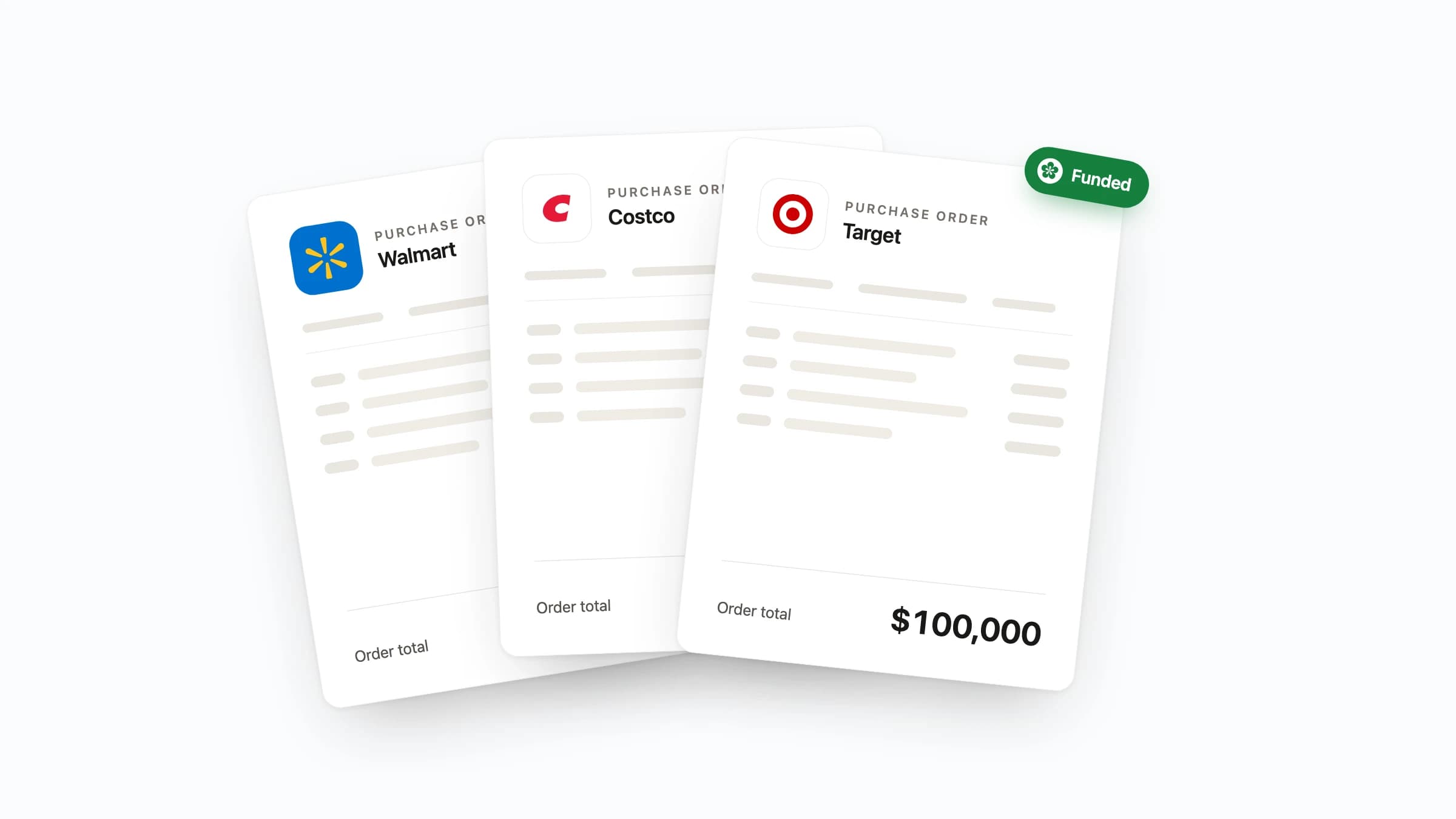
Yes. Spring funds invoices and purchase orders from retailers such as Walmart, Target and Costco, set up one retailer at a time with a Notice of Assignment. The first funding from each retailer waits on that notice; later orders fund from the documents as they arrive. See how to fund a big retailer order.
Do I need to upload purchase orders or invoices?
No. With SPS Commerce connected, the 850 and 810 are already there, so Spring funds from the source document.
How is Spring different from Settle for SPS Commerce suppliers?
Settle's working capital pays a vendor or your bank account and you repay it on a fixed biweekly or monthly schedule; it asks for a year in business and $500,000 in trailing revenue. Spring's purchase order financing and factoring are tied to a specific retailer order and repaid by that retailer's payment, so the funding grows with your orders.
What happens if a retailer short-pays a funded invoice?
Spring reads the 812 credit memos from SPS, so a deduction taken against a funded invoice is visible as soon as the credit memo clears, not weeks later as a short check. That gives you time to dispute a wrong one with the retailer.
Will my retailer know I use a funder?
Yes. Spring sends each retailer a Notice of Assignment asking it to pay your invoices to an account Spring holds for you. Retailers process these routinely, and it changes nothing about your price, terms or EDI. What a NOA is.
If your orders already flow through SPS Commerce, get started or talk to the team.
1 SPS Commerce, Inc., Form 10-K for the year ended December 31, 2025, Item 1, read October 2026.
2 Settle, Working capital, read October 2026.