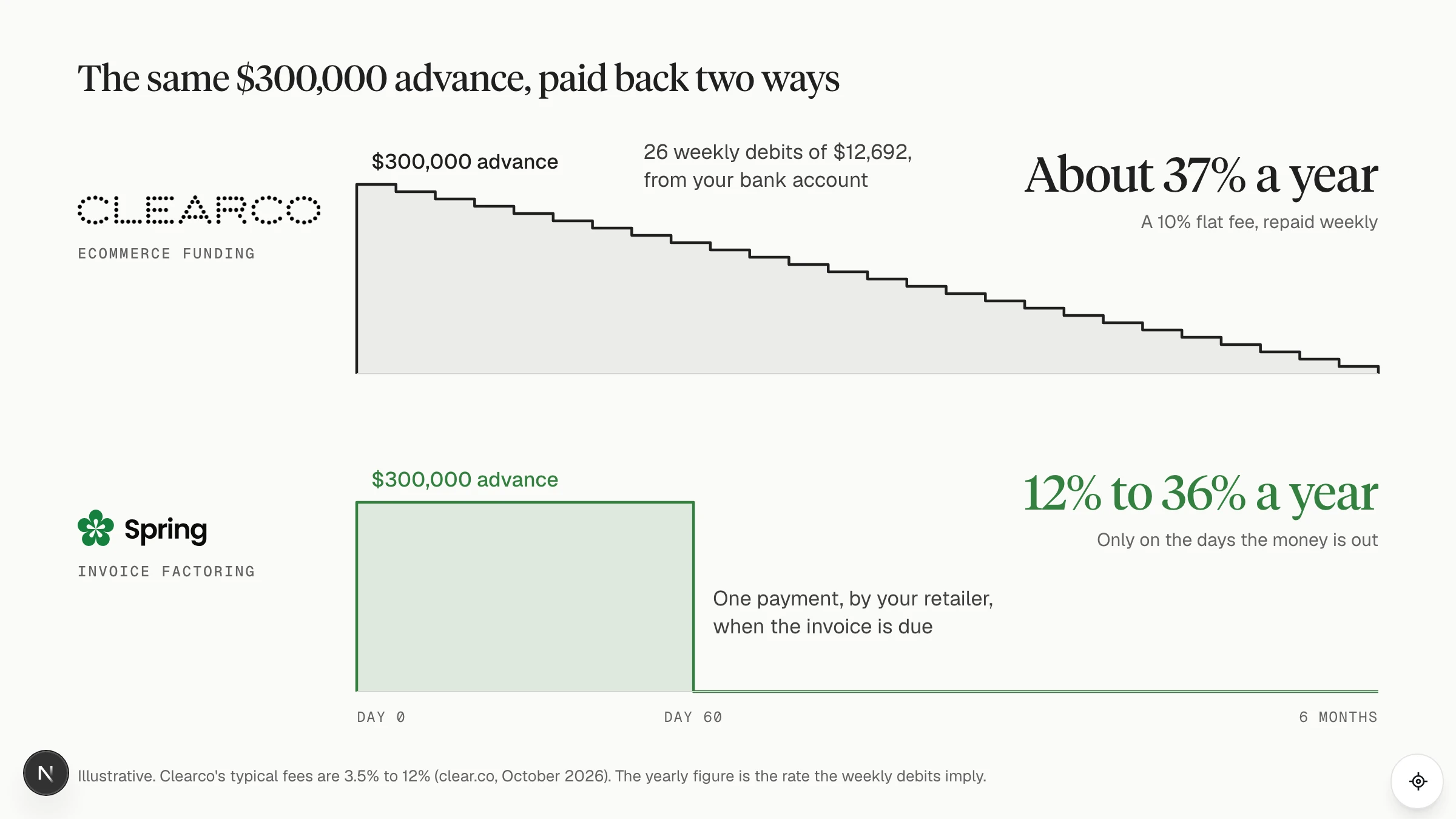
Clearco's flat fee of 3.5% to 12%, repaid weekly, can work out to about 37% a year. The alternatives for a consumer brand, when each fits, and how Clearco and Spring compare.
Last edited 5 min read
3.5% to 12% is Clearco's typical flat fee, repaid in capped weekly payments from your revenue, and a 10% fee repaid weekly over six months works out to about 37% a year. For a consumer brand that sells to retailers, the alternatives are invoice factoring and purchase order financing, which the retailer's payment repays and which cost 12% to 36% a year at Spring. For a brand that sells mostly online, the alternatives are other revenue-based funders, a bank line or equity.


This post explains how revenue-based financing works, lays out each alternative and when it fits, and compares Clearco with Spring on the five questions that decide it. Everything about Clearco comes from its own public pages, read in October 2026 and footnoted at the end. We sell some of the options, so check our work. It is not legal or financial advice.
How does revenue-based financing work?
A funder advances a sum sized on your online sales for one flat fee, and you repay it as a share of revenue, every week or every day.
Clearco funds US ecommerce brands with at least six months of history and more than $100,000 a month in revenue, up to $10 million, repaid in capped weekly payments over an estimated term of 4 to 12 months.1 Its typical fixed fees run from 3.5% to 12%, and it says most founders receive funding within 24 to 48 hours.2 Paying early carries no penalty, and the fee is prorated.1
A flat fee is not a yearly rate. The payments start in week one, so on average you hold about half the money for the term, and the same fee on half the money is roughly twice the rate. That is how a 10% fee over 26 weeks comes to about 37% a year; the arithmetic is in ecommerce funding vs invoice factoring.
What are the alternatives to revenue-based financing?
Six, and which one fits depends on where your revenue comes from.
- Invoice factoring. A factor advances most of a retailer or distributor invoice once you ship, and is repaid when that customer pays. Nothing is due from you while the retailer's terms run.
- Purchase order financing. A funder pays your supplier against a signed retailer order, so production can start before you have the cash, and the retailer's payment settles it.
- Demand plan financing. Funding sized on a retailer's demand plan rather than on one order, which you repay monthly.
- Another revenue-based funder. Wayflyer and Shopify Capital work the same way, sized on online sales for a flat fee; compare them on the yearly cost, not the fee. We did that on a real offer in revenue-based financing vs invoice factoring.
- A bank line or SBA-backed financing. Usually the cheapest money a business can get, if you qualify and it is already in place; setting one up takes weeks to months.
- Equity. Right for money the whole brand needs for years; an expensive way to pay for one season.


Is Spring an alternative to Clearco?
Yes, when most of your revenue is retailer invoices; no, when most of it is online.
| Question |  Ecommerce funding |  Invoice factoring |
|---|---|---|
| Built for | Online, direct-to-consumer sales1Six months of history and more than $100,000 a month in revenue | Sales to retailers on net termsUS brands that invoice retailers or distributors |
| Sized on | Your online revenue1Read from the platforms you connect. Up to $10 million | A retailer invoice or purchase orderUp to $10 million across products |
| Repaid by | You, every week1A capped payment over an estimated 4 to 12 months | Your retailer, onceWhen it pays the invoice |
| Price | A flat fee, typically 3.5% to 12%1, 2Prorated, with no penalty for paying early | 12% to 36% a yearCharged only on the days the money is out |
| Speed | Most founders funded in 24 to 48 hours2Once approved | DaysThe first funding waits on your retailer acknowledging a notice |
The difference is who pays it back and when. A brand that sells online is paid a little every day, so a weekly payment capped against that revenue rises and falls with it. A brand that sells into retail is paid a lot, rarely, and late: ship in March, get paid in May, in one payment. Weekly payments in March and April come out of a bank balance the retailer has not refilled yet. With invoice factoring, the retailer's payment is the repayment.
On the price: a $300,000 advance against a retailer invoice that pays in 60 days costs about $5,900 at 12% a year and about $17,800 at 36%. Clearco also offers Invoice Funding, but it funds invoices you owe your suppliers, repaid weekly; Spring funds invoices a retailer owes you.3
When is Clearco the better choice?
- Most of your revenue is online. That is who Clearco funds, and Spring has no retailer invoice to advance against.
- The spend is not tied to an order. Advertising, stock for your own store, a launch.
- You need the money in a day or two, or would rather your retailer was not sent a notice.
What does Spring need that Clearco does not?
A Notice of Assignment. Invoice factoring, purchase order financing and demand plan financing all require one: a letter asking your retailer to pay your invoices to an account Spring holds for you. Your retailer will know you have a funding partner, and your first funding waits until it acknowledges the notice, which usually takes days and occasionally a couple of weeks. It does not change your price, your terms or your shelf. What a NOA is and what it changes. Bridge Funding is the one Spring product that needs no notice.
Frequently asked questions
What are the alternatives to Clearco?
For a brand selling to retailers: invoice factoring, which advances the retailer invoice once you ship, and purchase order financing, which pays your supplier against the order; the retailer's payment repays both. For a brand selling online: other revenue-based funders such as Wayflyer or Shopify Capital, a bank line, or equity. Spring offers invoice factoring and purchase order financing at 12% to 36% a year.
Is Spring an alternative to Clearco?
Yes, for consumer brands whose revenue is mostly retailer and distributor invoices. Clearco funds online sales and is repaid weekly from your revenue; Spring funds retailer invoices and orders, and the retailer's payment repays it. The two compared on one $300,000 advance.
How much does Clearco cost per year?
Clearco says its typical fixed fees run from 3.5% to 12%. The yearly cost depends on the term: by our arithmetic, a 10% fee repaid weekly over 26 weeks is about 37% a year, and over 52 weeks about 19%. Clearco prorates the fee if you pay early.
Is invoice factoring cheaper than revenue-based financing?
Often, for a brand selling to retailers, because the fee runs only for the days until the retailer pays. Spring's invoice factoring costs 12% to 36% a year: a $300,000 advance on a 60-day invoice costs about $5,900 to $17,800. Compare any offer on its yearly cost, not its fee.
Can I get funding from Clearco if I sell to Walmart or Target?
Clearco funds ecommerce direct-to-consumer brands with more than $100,000 a month in revenue, sized on the online sales you connect. Retail invoices are what invoice factoring and purchase order financing fund instead.
Does my retailer find out if I use Spring instead of Clearco?
Yes. Spring sends your retailer a Notice of Assignment asking it to pay your invoices to an account Spring holds for you, and your first funding waits on the retailer acknowledging it. Retailers process these routinely. What a NOA is.
If you sell into retail, get started or talk to the team.
1 Clearco, Ecommerce funding, read October 2026.
2 Clearco, Why Clearco, "Our typical fixed fees range from 3.5% to 12%" and "Most founders receive funding within 24 to 48 hours", read October 2026. The yearly figures in this post are our arithmetic: the weekly rate that makes the payments worth the advance (the internal rate of return), times 52.
3 Clearco, Invoice Funding, read October 2026.