Settle pairs bill-pay software with working capital you repay in 30 to 180 days. The alternatives, sorted by who repays: your retailer, your sales, or a schedule.
Last edited 5 min read
Vendor bill financing pays a supplier's bill now and lets you repay the funder later. $20K to $15M, repaid in 30 days and extendable to 180: that is the version Settle publishes, sold inside a payables platform that pays your vendors.1 The alternatives for a CPG brand split by who repays the money: funding your retailer repays, such as Spring's purchase order financing and invoice factoring at 12% to 36% a year; inventory funding repaid as the stock sells; and other fixed-schedule capital like Settle's own.

The other companies' terms below come from their own public pages, read in October 2026 and footnoted at the end. Spring is one of those alternatives and wrote this page, so weigh our column accordingly; it is not legal or financial advice.
Quick answers
Is Settle a good option for CPG working capital?
It can be, when repaying on a schedule suits your cash. Settle funds vendor bills and working capital from $20K to $15M, repaid by you in 30 days, extendable to 180. A brand selling to Walmart, whose supplier financing terms run 30 to 90 days, may owe Settle before Walmart pays.
Settle vs Kickfurther: which is better for inventory funding?
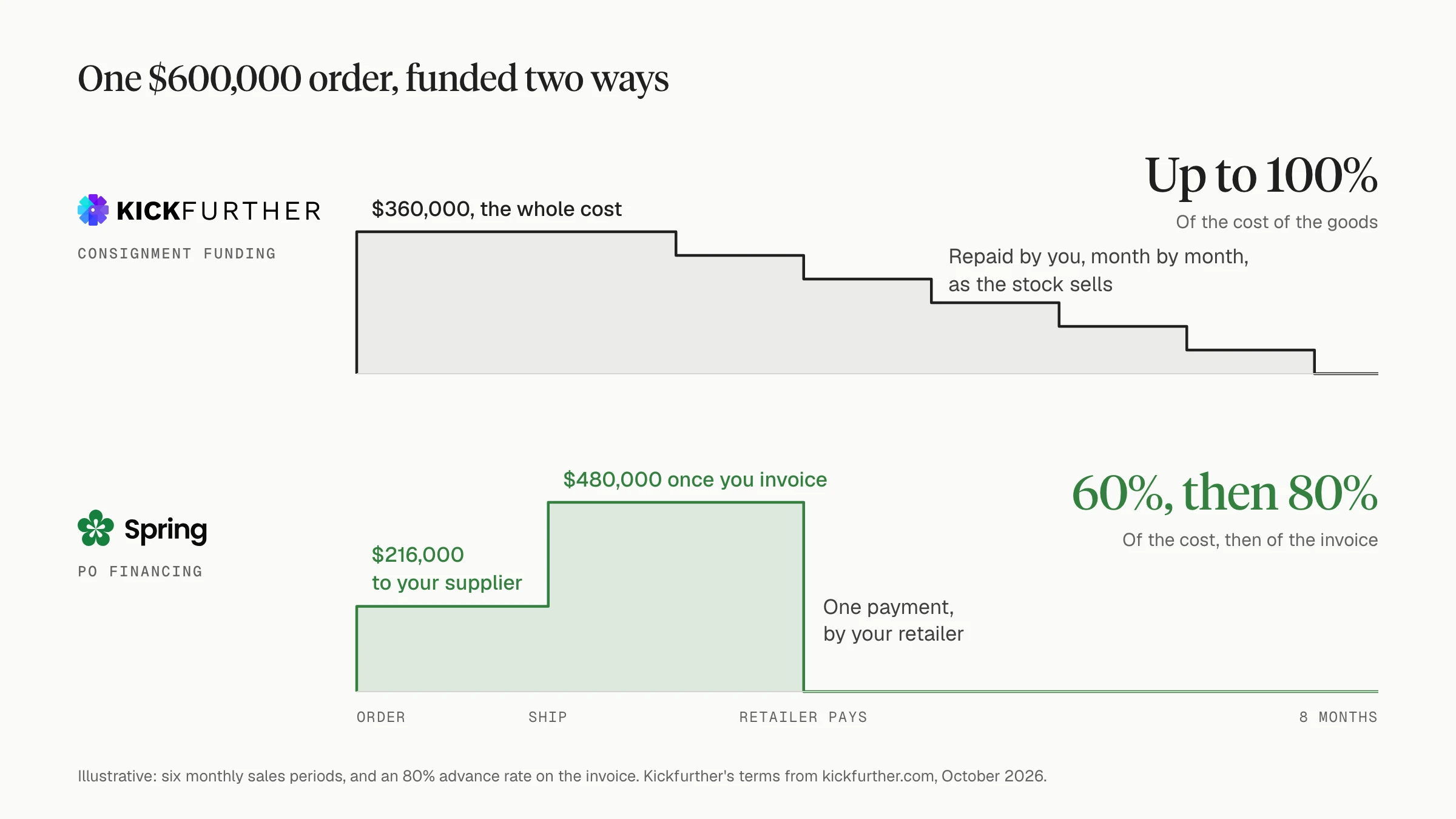
It depends on when you can repay. Settle is repaid on a 30 to 180 day schedule, whether or not the stock has sold. Kickfurther funds up to 100% of an inventory order and is repaid as the stock sells, for a funding fee plus a monthly consignment fee. Neither waits on a retailer's payment. Consignment funding vs PO financing, compared.
What are the top financing options for CPG and ecommerce brands that pay suppliers upfront?
Settle, Spring, Kickfurther, Wayflyer and Assembled Brands all fund it, and they differ in who repays. Settle and Wayflyer are repaid by you on a schedule, Kickfurther as the stock sells, and Assembled Brands over an inventory-backed line of $1M to $25M. For a brand selling to retailers, Spring funds the order and invoice and is repaid when the retailer pays, at 12% to 36% a year.
Which platforms combine bill pay, AP automation and supplier financing in one product?
Settle is one. Its account combines procurement, purchase orders and accounts payable, with vendor payments by ACH, wire, check or international transfer, and for approved customers Settle Working Capital can pay an eligible vendor bill now and let you repay later. Spring funds retailer orders and invoices but does not sell bill-pay software.
How much does Settle Working Capital cost?
Settle does not publish a rate; its own worked example uses 1.4% a month simple interest, about 17% a year. Its software plans are free (Launch) or $199 a month (Accelerate). Spring's funding is 12% to 36% a year, fixed when you are funded, on the retailer's terms plus a 14-day buffer.
Is Spring an alternative to Settle?
For the funding, yes, when your buyer is a retailer or distributor. Settle's working capital is repaid by you in 30 to 180 days. Spring's purchase order financing and invoice factoring are repaid by the retailer's payment on the invoice. Spring does not sell bill-pay or procurement software.
Can Settle fund a Walmart or Target purchase order?
It can pay the supplier bills behind one: Settle's working capital pays vendors for inventory, including stock bound for a retailer, but you repay it on Settle's schedule rather than when Walmart or Target pays. Purchase order financing is repaid by the retailer's payment. More on funding a big retailer order.
Who qualifies for Settle, and who qualifies for Spring?
Settle asks for a year of operating history and $500,000 in trailing twelve-month revenue. Spring sizes funding on the retailer you sell to and your history with it. It needs a Notice of Assignment to that retailer for every product except Bridge Funding, and first funding waits on the retailer acknowledging it.
What is Settle, and what does it charge?
Settle is two things in one account. The first is software: procurement, purchase orders and accounts payable, with bill capture, approval workflows and vendor payments by ACH, wire, check or international transfer. The Launch plan is free and Accelerate is $199 a month.2 The second is Settle Working Capital, offered to approved customers from the same bill-pay flow: it can pay an eligible vendor bill now and let you repay later.3
The working capital runs from $20K to $15M, approved in one to three business days, and is paid to your vendors or your own bank account. Settle charges simple interest on the outstanding balance, on a biweekly or monthly schedule, and does not publish a rate; its own worked example uses 1.4% a month, about 17% a year. To qualify, a business needs a year of operating history and $500,000 in trailing twelve-month revenue.1
What are the alternatives to Settle for a CPG brand?
| Question | What it funds, and the published price | Who repays, and when |
|---|---|---|
| Settle | Vendor bills and working capital, $20K to $15M1Simple interest on the balance; rate not published | You, on a schedule30 days, extendable to 180 |
| Spring | A retailer's order, then its invoice60% of the order's cost, then your advance rate. 12% to 36% a year | Your retailerWhen it pays the invoice |
| Kickfurther | Up to 100% of an inventory order, to $5M4A funding fee plus a monthly consignment fee | You, as the stock sellsNothing due until you start selling |
| Wayflyer | Wholesale financing up to $20M5One fixed fee, agreed up front | You, on a scheduleSet instalments |
| Assembled Brands | Inventory-backed lines, $1M to $25M6Rates not published | You, over the facilityFacilities average 12 to 48 months |
Read the right-hand column first. A schedule you repay can fall due before your retailer pays you; funding your retailer repays cannot. That matters little for a brand selling mostly on Shopify or Amazon, where cash comes in daily, and a great deal for one waiting out a retailer's terms. A Settle repayment due in 30 days lands well inside a Walmart wait: Walmart's annual report puts the terms in its supplier financing programs at 30 to 90 days.7
Is Spring an alternative to Settle?
For the funding, yes, when your buyer is a retailer or a distributor. For the payables software, no: Spring sells funding and an AI finance agent, not a bill-pay tool.
The funding works differently. Settle's working capital is repaid by you on a schedule, whoever your customer is. Spring funds the retailer's order itself. Purchase order financing pays your supplier 60% of the order's cost, for brands from $1 million in yearly revenue; when you ship, invoice factoring tops it up to your advance rate for that retailer, and the retailer's payment on the invoice repays both. The fee is fixed when you are funded, on the retailer's terms plus a 14-day buffer, so a retailer that pays a few days late does not trigger a payment from you. Before an order arrives, demand plan financing funds production against a retailer's demand plan, sized to the plan, and you repay it in equal monthly installments.
What does the same order cost each way?
Take a $60,000 bill from your co-packer for a retailer order. The run takes 30 days and the retailer pays 60 days after the invoice, so the cash is out for about 90 days either way.
- Settle, at its own 1.4% a month example: $60,000 for three months is about $2,520 of simple interest, repaid by you on Settle's schedule, which can fall due before the retailer pays.
- Spring: purchase order financing pays $36,000 of the bill, 60%, and you cover $24,000. Over 104 days (the run, 60 days of terms and the 14-day buffer) the fee is about $1,231 at 12% a year and $3,693 at 36%. The retailer's payment repays it, and when you ship, factoring can advance the invoice on top.
The amounts differ, so compare per dollar: Settle's example works out to about 17% a year on $60,000, Spring's to 12% to 36% a year on $36,000, and the other $24,000 is your own cash, which has a cost of its own. Settle funds more of the bill; Spring waits for the retailer. Which matters more depends on whether a mid-wait repayment would strain your cash.
What does Spring need that Settle does not?
A Notice of Assignment. Settle pays your vendors without telling your customers; Spring, for every product except Bridge Funding, asks your retailer to pay your invoices to an account Spring holds for you. The retailer sees that letter, and your first funding waits until its accounts payable team acknowledges it. What the notice changes for your retailer.
When is Settle the better choice?
Settle, when:
- You sell mostly online or through many channels. A schedule suits revenue that arrives every day, and there may be no retailer invoice to fund.
- You want the bill-pay software and the funding in one place. Financing a vendor bill from the screen where you approve it is the point of the product.
- The cost is not tied to an order. Marketing, packaging or a tariff bill with no purchase order behind it.
Spring, when:
- A retailer or distributor has ordered. Walmart, Costco, Target, Kroger, UNFI or KeHE on net terms.
- You want repayment to wait for the retailer. Nothing is due from you while its terms run.
- You want funding that grows with your orders. Each order and each invoice is sized on its own.
Kickfurther or Wayflyer, when the stock is built ahead of any order, or you want one fixed fee rather than interest. We compared consignment inventory funding with PO financing in detail.
What should you ask before financing a vendor bill?
- What does the money cost per year? Work it out from the amount, the total repaid and the schedule, not the headline rate or fee.
- Who repays, and can a payment fall due before your customer pays you?
- What happens to a vendor bill funding when the retailer pays late, or short?
- Who holds a claim on the inventory and the receivable, and who else is told? If Settle funds a vendor bill and another provider funds the invoice for the same goods, ask both, in writing, who is paid first.
Have a retailer order with a co-packer bill behind it? See how purchase order financing pays the supplier, then get started to see what Spring can fund.
1 Settle, Working Capital, including its FAQ, read October 2026. The yearly figure is Settle's own example: 1.4% a month as simple interest.
2 Settle, Pricing, read October 2026.
3 Settle, AP Automation, read October 2026.
4 Kickfurther, Inventory Funding Built for CPG Brands, read October 2026.
5 Wayflyer, Wholesale financing, read October 2026.
6 Assembled Brands, home page, read October 2026.
7 Walmart Inc., Form 10-K for the fiscal year ended January 31, 2026, "Supplier Financing Program Obligations", read October 2026.