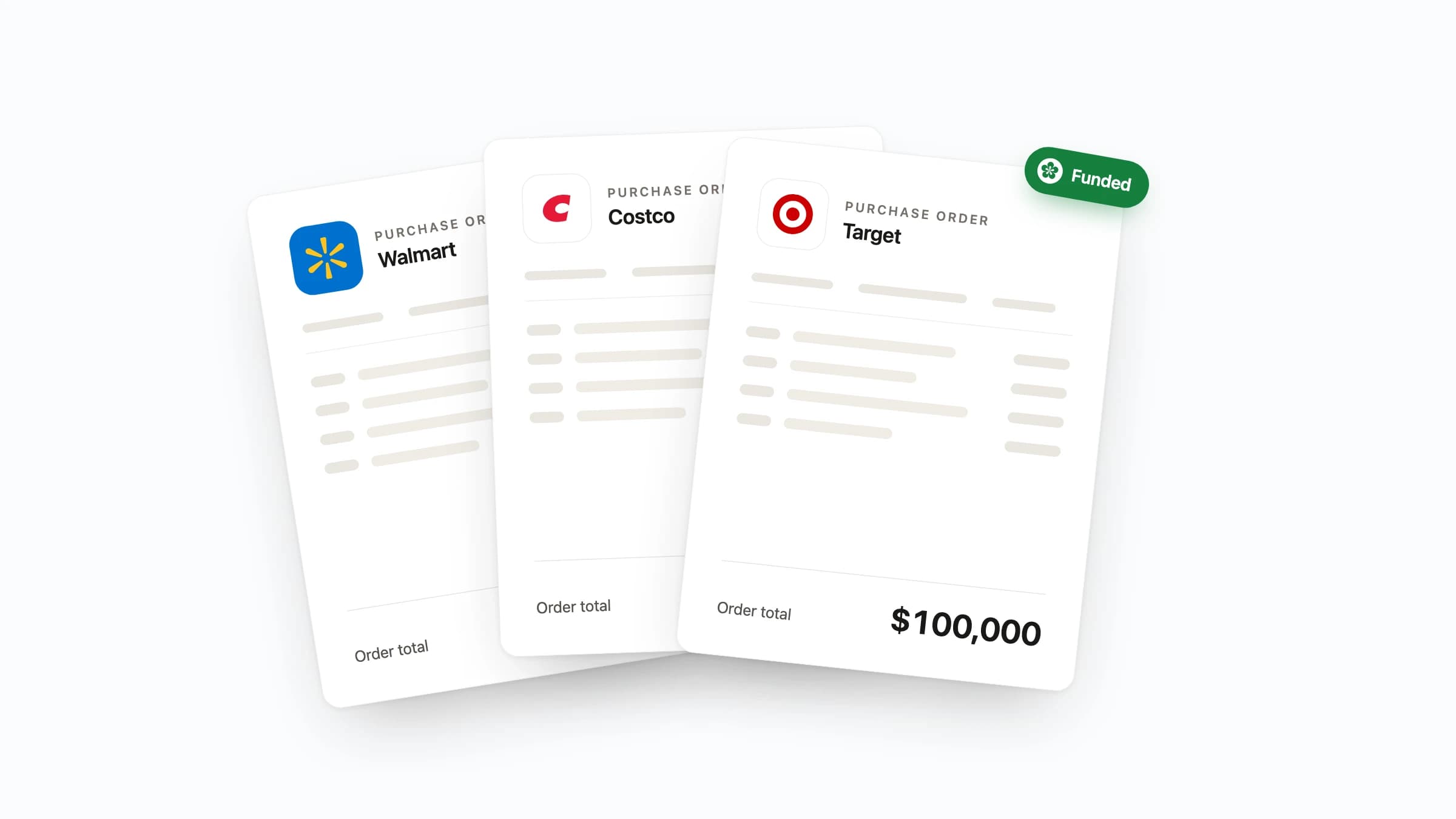
Cans, ingredients and the co-packer's line are paid for weeks before the retailer pays for a case. The ways to fund a beverage run, with one big retail order worked through.
Last edited 6 min read
Up to 60% of a beverage production run's cost can be paid straight to your co-packer and packaging suppliers against a signed retailer purchase order, with purchase order financing. When the cases ship, invoice factoring advances the invoice, and the retailer's payment settles both.
That is the short answer for a brand with a big retail order in hand. A beverage run is harder to fund than most consumer orders because so much of it is paid for before anything is filled: cans or bottles, labels or sleeves, ingredients, the co-packer's line time and the freight. This post covers where the money goes, the ways to fund it, and one order worked through from deposit to payment. We sell two of the options, so check our work. It is not legal or financial advice.
Why does a beverage production run need funding before the retailer pays?
Because you pay for the run weeks or months before the first case is invoiced.
Co-packers book line time in advance, often want a deposit to hold it, and run in minimums, so the smallest run worth making can be bigger than the order in front of you. Packaging is usually the long pole: printed cans, glass and sleeves are bought in volume and ahead of the run. Then the product ships to the retailer's warehouse or a distributor, and the retailer pays on its own terms after it receives the goods. Every step is cash out before cash in.
So funding a run is two questions. Who pays the co-packer and the packaging supplier before anything ships? And who carries the wait between shipping and the retailer's payment?
What are the ways to fund a beverage production run?
Purchase order financing and inventory funding pay for the run itself; factoring covers the wait after shipping; a bank line or equity pays for anything, slowly.
| Question | Pays the co-packer before the run? | Who repays it |
|---|---|---|
| Purchase order financing | Yes. Your suppliers are paid against the signed order | Your retailer, when it pays the invoice |
| Invoice factoring | No. It starts when you ship and invoice | Your retailer, when it pays the invoice |
| Inventory or consignment funding | Yes, against the inventory, with or without a retail order | You, as the stock sells |
| SBA-backed bank line | Yes, if the line is already in place | You, on the bank's schedule |
| Equity | Yes, and anything else | No one. You give up part of the company |
Purchase order financing
Purchase order financing pays your co-packer and packaging suppliers for most of the cost of goods behind a signed order from a retailer or distributor. The funder looks at the order and the retailer behind it more than at your balance sheet, which suits a brand whose orders are growing faster than its bank account. With Spring the money goes to the suppliers, never to you, and the invoice is factored when the goods ship.
Invoice factoring
Factoring advances most of an invoice soon after you ship, so you are not waiting out the retailer's terms. It cannot pay for the run itself, because until you ship there is no invoice. How one invoice moves, step by step.
Inventory and consignment funding
Kickfurther funds up to 100% of an inventory order's cost and is repaid as the stock sells.1 Settle offers working capital from $20,000 to $15 million for large purchase orders, seasonal inventory and supplier terms.2 Both can fund stock no retailer has ordered yet, which is their advantage, and you repay them, so a slow month is yours to carry. Consignment funding and PO financing, side by side.

Supplier terms, bank lines and equity
A co-packer that knows you may extend terms on a repeat run, but rarely on a first big one. The SBA's CAPLines program finances specific contracts and seasonal inventory,3 but a bank line takes weeks to months to set up. Equity is for permanent needs, not one season's run.
How does a big retail order get funded, from deposit to payment?
One illustrative order, funded with purchase order financing and then invoice factoring.
A sparkling water brand gets a $250,000 purchase order from a national retailer. Making it costs $150,000: $45,000 of printed cans and cartons, $30,000 of ingredients, $55,000 for the co-packer's run and $20,000 of freight. Production and transit take 30 days, and the retailer pays 60 days after the invoice.
- The order arrives. The brand uploads the purchase order, or it comes in through the retailer portal or EDI.
- The suppliers are paid. Against the signed order, Spring pays $90,000, 60% of the cost, directly to the co-packer and the can supplier. The brand covers the other $60,000, the part of this that does not flatter us.
- The run ships. The cases leave the co-packer for the retailer's distribution centers, and the brand invoices $250,000.
- The invoice is advanced. Factoring tops the funding up to that retailer's advance rate, $200,000 at an illustrative 80%, so the brand has working cash for the next run.
- The retailer pays. It pays the invoice to the account named in the Notice of Assignment. The advances and the fee are settled, and the rest goes to the brand.
At 12% to 36% a year, charged only on the days the money is out, the fee on this order is about $4,833 at the low end and $14,499 at the high end, so the brand keeps roughly $35,500 to $45,200 of the remaining $50,000 before any deductions.
Where does Spring fit for a beverage brand?
Spring does both halves: it pays your suppliers against the order, advances on the invoice when you ship, and the retailer's payment settles both.
Each retailer pays Spring on its own account number, so you can see every payment land. If a retailer gives you a demand plan before it sends purchase orders, demand plan financing can pay your co-packer earlier; you repay that one in monthly installments.
One thing to know before you apply: Spring needs a Notice of Assignment for every product except Bridge Funding. It is a letter asking your retailer's accounts payable team to pay invoices to an account Spring holds for you. Your retailer will know you have a funding partner, and your first funding waits until it acknowledges the notice, which usually takes days and occasionally a couple of weeks. What a NOA is, and what it does.
When is something else the better choice?
When there is no retail order behind the run, or the need outlasts one season.
- You sell mostly online. No retailer invoice means nothing for Spring to fund; inventory funding fits better.
- No retailer has ordered yet. You are building stock ahead of demand you cannot show on a purchase order.
- Your co-packer already gives you terms. Use them first.
- The need is permanent. A canning line or a new plant is what a bank or equity is for.
Frequently asked questions
How do beverage brands pay for a production run before Walmart, Costco or Target pays?
Most combine two products. Purchase order financing pays the co-packer and packaging suppliers against the signed purchase order, so the run can start. Invoice factoring then advances the invoice once the cases ship. The retailer's payment settles both. Spring offers both for brands selling to retailers.
Will my co-packer accept payment from a funder?
Yes. With Spring's purchase order financing the co-packer is paid directly, against its invoice, once its bank account is verified. To the co-packer it is simply a paid bill.
Can I fund a production run without a purchase order?
Not with purchase order financing or factoring, which fund retail orders and invoices. Inventory funders such as Kickfurther and Settle can fund stock ahead of an order. If a retailer has shared a demand plan, demand plan financing can fund against it, and Bridge Funding needs no retailer at all.
How is purchase order financing different from Kickfurther or Settle?
Kickfurther and Settle fund the inventory or the payables, and you repay them. Purchase order financing funds a retailer's order: Spring pays your suppliers, and the retailer's payment on the invoice repays it. The full comparison.
What does it cost to fund a production run with Spring?
12% to 36% a year, charged only on the days the money is out. On a $150,000 run with $90,000 paid to suppliers for 90 days and a $110,000 top-up for 60 days, that is about $4,833 to $14,499.
Does an order from Whole Foods, Kroger or a distributor like UNFI or KeHE qualify?
Spring funds orders and invoices from the retailers and distributors it works with, including grocery chains and natural-channel distributors. Each pays Spring on its own account number.
How long does it take to get funded?
With Spring, days once the order and the retailer are verified and the retailer has acknowledged the Notice of Assignment, which usually takes days and occasionally a couple of weeks.
If you have a retail order to fill, get started or talk to the team.
1 Kickfurther, Inventory Funding Built for CPG Brands, read October 2026.
2 Settle, home page, "Working capital from $20K–$15M", read October 2026.
3 U.S. Small Business Administration, CAPLines authorization, read October 2026.