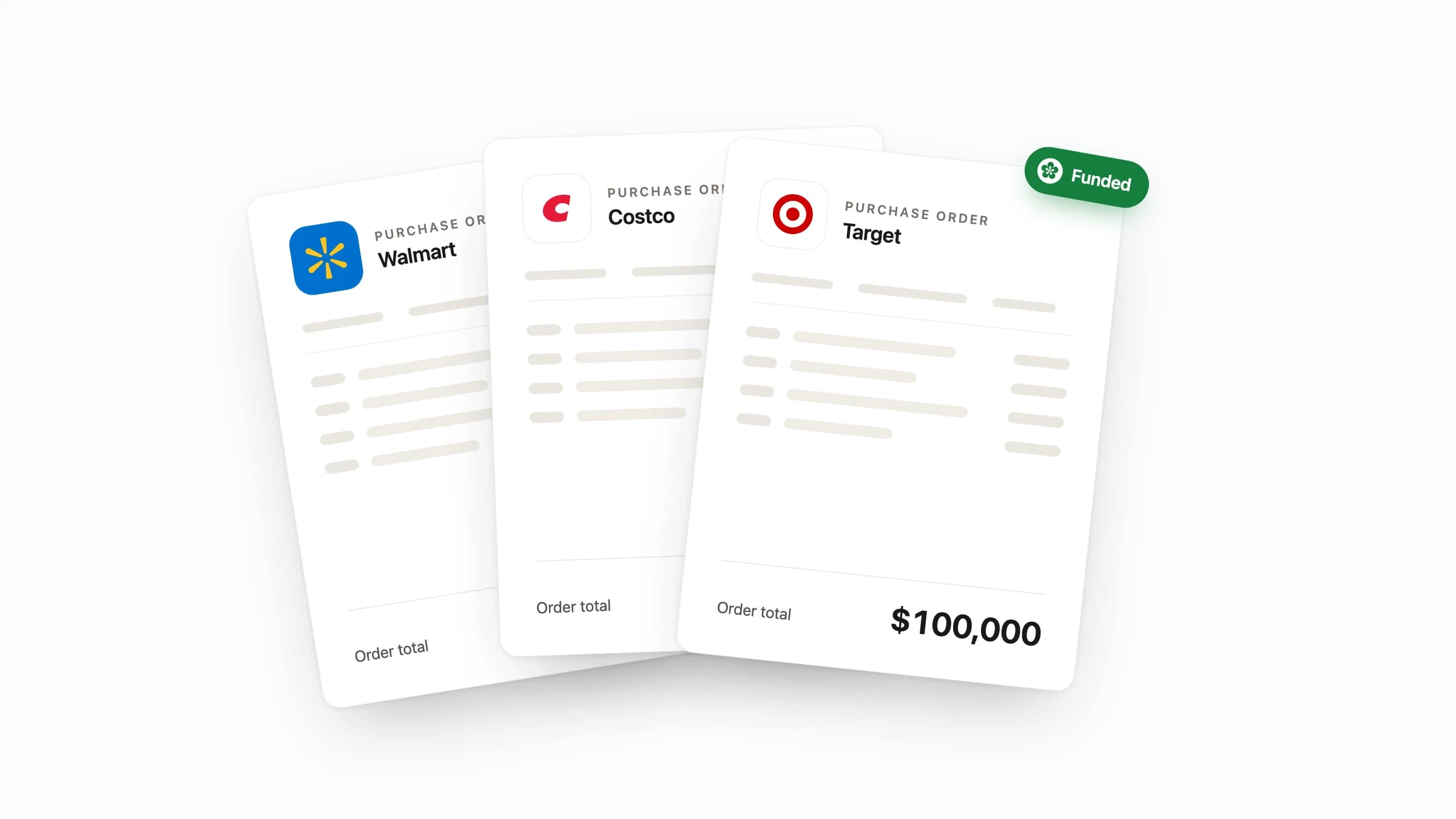
Factoring doesn't change when your retailer pays. It changes when you get paid. One $100,000 Target invoice, from the one-time notice to the last dollar back to you, with who holds the money at each step.
Last edited 6 min read
Once Target is set up with us, a $100,000 invoice on net-60 terms puts $80,000 in your bank the day you send it to us. The other $20,000 isn't our fee. It's the holdback, and it comes back to you when Target pays, less one fee you see before you sign. On this invoice that fee runs from about $2,000 to about $5,900, depending on where you sit in our range of 12% to 36% a year.
Factoring doesn't change when Target pays. It changes when you get paid. So the clearest way to explain it is on a calendar: one invoice, from the notice that sets it up to the last dollar coming back to you, and who holds the money at each step. The figure follows the step you're reading.
Once per retailer
Before we fund anything against a retailer, that retailer has to agree to pay us. A Notice of Assignment tells Target's accounts payable team to send your payments to an account number set up for you and Target alone. We draft it, you send it from your own inbox, and Target confirms it. This happens once per retailer, and your first invoice waits on it.
Day 0
The goods arrive and the invoice goes out. Target has 60 days to pay, and many retailers start that clock when the goods arrive, not when they leave your dock. Without factoring, that's your wait: the money is earned, but it's on your books, not in your bank.
Day 0
You upload the invoice and the purchase order, we check them, and you sign a one-page disclosure that fixes the fee. The advance usually lands the same day. Here it's $80,000, an 80% advance, which is a typical starting rate. All of it reaches you; the fee isn't taken out of it.
Days 1 to 60
The $20,000 holdback stays with us while Target's terms run. You put the $80,000 into the next production run, freight or payroll. Nothing about how you invoice Target changes, and Target's terms stay exactly as they were.
Day 60
Target pays into the account number from step 1. Big retailers rarely fail to pay. They pay less, after deductions for shortages, damages, late deliveries or promotions. A deduction comes out of the holdback first; your advance is already in your bank.
After Target pays
From Target's payment we take our fee, then the advance, and send you what's left: $18,027 or $14,082 at the two ends of our range, if Target pays in full. A $3,000 deduction makes it $3,000 smaller. We settle from your account balance, not invoice by invoice, which is how retailers pay anyway: one payment covering many invoices.
Why you get 80%, not 100%
If retailers paid every invoice in full, a factor could advance nearly all of it. They don't. Deductions and chargebacks can take up to 15% of gross sales, one industry CEO told Talk Business in January. The holdback is what absorbs them, so an advance rate is really a forecast of how much of each invoice a retailer will actually pay.
That's how we set yours: per retailer, from how that retailer actually pays you, deductions included. Most brands start at 70% to 80%. A retailer that has never paid us for any brand starts at 50% until it has a record with us. As your payments come in clean, your rate goes up automatically, to as much as 90%.
If a deduction is ever bigger than the holdback, the difference goes on your account balance and comes out of the next payment we'd send you.
Target will know, and your first invoice waits on it
There's no quiet version of this with a big retailer. We require a Notice of Assignment for every product except Bridge Funding (invoice factoring, purchase order financing and demand plan financing all need one), and we don't fund the first invoice against a retailer until that retailer has acknowledged it. That takes days, and occasionally a couple of weeks.
Each retailer has its own paperwork. At Target it's a factor relationship in Partners Online and a Domestic EFT form, then a penny test both sides confirm. Walmart uses a factor form in Retail Link, which takes about five business days. Costco wants paired factor letters, and UNFI an ACH form. We know each one and work through it with you.
Retailers treat this as routine because the rule is simple: once a retailer has the notice, paying you instead of the account on it doesn't settle the invoice. After that first acknowledgment, later invoices to the same retailer can usually be funded the same day. What a NOA says, line by line, is in What Is a Notice of Assignment?; why each retailer gets its own account number is here.
What it costs, and when the price is set
The fee is the yearly rate times the days, on the advance rather than the invoice: $80,000 × rate × days ÷ 365. Our range is 12% to 36% a year. The days run from funding to Target's due date plus a 14-day buffer, so a net-60 invoice funded on day 0 is priced for 75 days. You pay for the buffer even if Target pays on day 60, and paying early doesn't shrink the fee. In return it's fixed: one number on the disclosure you sign, collected from Target's payment, never from your advance.
If Target runs late, the schedule doesn't stretch to match. Late fees start after a grace period, and if nothing has arrived by the repayment date, day 74 here, we begin daily debits from your bank account.
| Question | Waiting out net 60 |  Invoice factoring Invoice factoring |
|---|---|---|
| Day 0 | $0The invoice is on your books, not in your bank | $80,000An 80% advance, once Target has acknowledged the notice |
| Day 60, Target pays | YouInto your own bank account | SpringInto an account number set up for you and Target |
| A deduction | Comes out of your $100,000You find it when the payment lands | Comes out of the $20,000 held backAnything bigger comes out of your next payment |
| What it costs | No feeTwo months without the cash | $1,973 to $5,91812% to 36% a year on $80,000 for 75 days, fixed when you sign |
| What you end with | $100,000On day 60, before deductions | $94,082 to $98,027$80,000 of it on day 0, before deductions |
Why a fee over days isn't the same thing as a flat fee is its own post: ecommerce funding vs invoice factoring.
What you sign
Three documents, once: a Receivables Sale and Purchase Agreement, under which we buy the invoices you send us; its terms; and a Validity Agreement, in which you confirm the invoices are real. That last one applies only to fraud or misrepresentation. It doesn't guarantee that Target pays. Then one notice per retailer, and one disclosure per funding with the fee on it. There's no personal guarantee, and we take no equity.
Frequently asked questions
Who owns the invoice once Spring pays me?
Spring does. Under the Receivables Sale and Purchase Agreement we buy the invoice, and the retailer's payment comes to us. There's no personal guarantee and no equity.
Do I have to send every invoice?
No. You choose which invoices to fund. Once the retailer has acknowledged the notice, its payments all arrive in the account number set up for you, and what isn't owed to Spring is sent on to you.
How long does the first funding take?
As long as the retailer takes to acknowledge the notice: days, sometimes a couple of weeks. Walmart's factor form takes about five business days. After that, invoices to the same retailer are usually funded the same day.
I already financed the purchase order. Can I factor the invoice?
Yes, for the difference. If the purchase order was funded at 60% and the retailer's invoice rate is 85%, the invoice adds the remaining 25%. How the two fit together.
Send the invoices you're waiting on and see what they're worth: get started, or read more about invoice factoring at Spring.