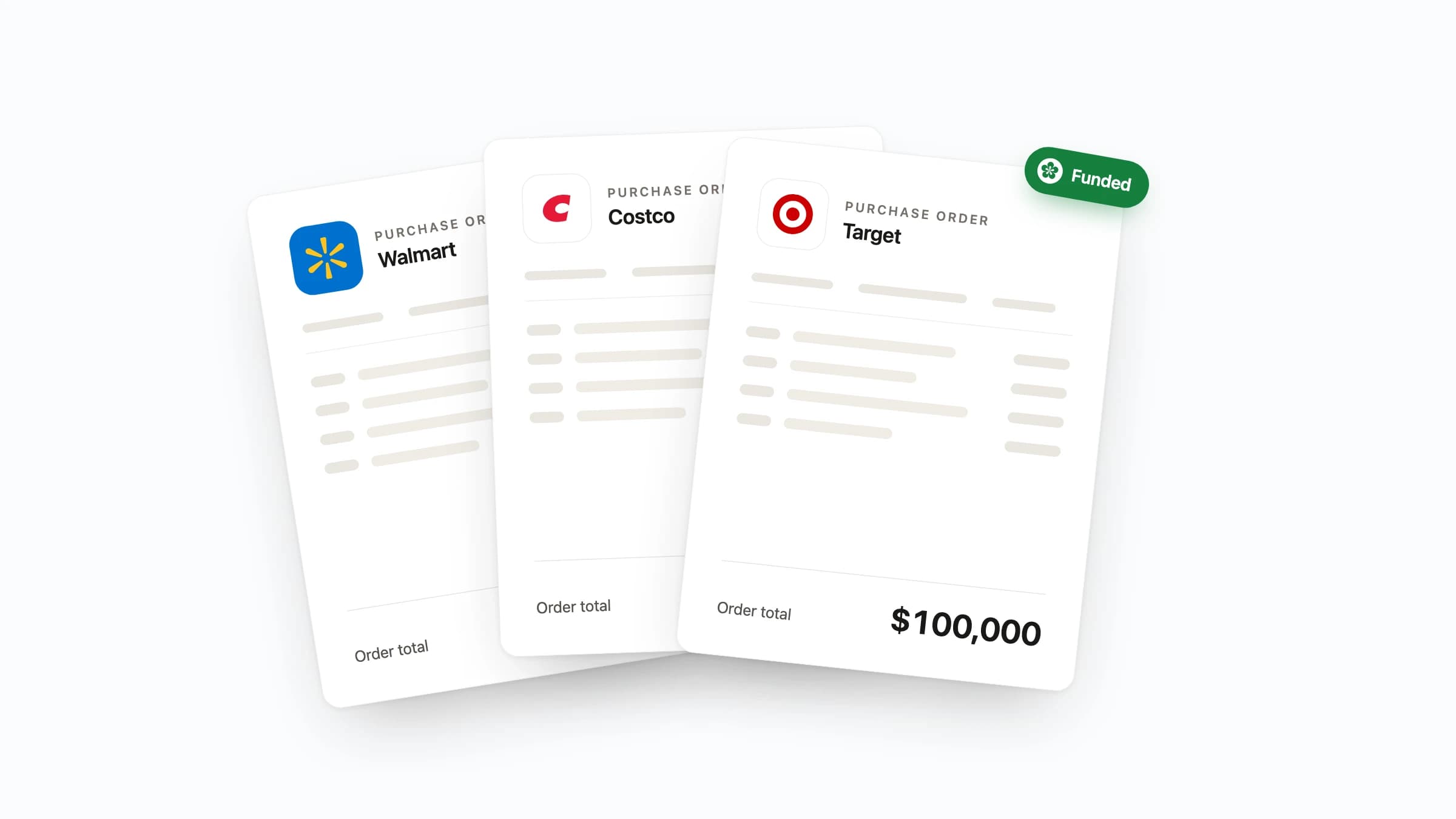
A Chewy, Petco or PetSmart order has to be made and shipped before the retailer pays for it. Who pays you in each pet channel, and one order funded start to finish.
Last edited 5 min read
Americans spent $68.3 billion on pet food and treats in 2025, the largest share of what they spend on their pets.1 A pet food brand that wins an order from Chewy, Petco, PetSmart or Tractor Supply can fund it the way other consumer brands do: purchase order financing pays up to 60% of the cost of making the order, and invoice factoring advances most of the invoice once it ships, both at 12% to 36% a year.
This post covers who pays you in each pet channel, how one order is funded from purchase order to payment, and when something other than Spring is the better fit. We sell two of the options, so check our work. None of it is legal or financial advice.
Why does a growing pet food brand need working capital?
Because the order has to be made and shipped before the retailer pays for it.
Proteins, other ingredients, bags and a co-manufacturer's run are paid up front, and freight to the retailer's distribution centers comes next. The retailer then pays on its own terms, and promotions, shortages and late-delivery fines can come off what it pays. Pet food sells on repeat purchase, so a new retail listing usually means a run of reorders, each one paid for before the last is collected. The faster you grow, the more of that cost you carry at once.
Who pays you in each pet channel?
Whoever you invoice, and that decides which funding fits.
| Question | Who you invoice | What can fund the order |
|---|---|---|
| Online pet retailer (Chewy) | The retailerIt pays your invoice on its own terms | Purchase order financing, then factoringThe retailer's payment settles both |
| Pet specialty chains (Petco, PetSmart) | The retailerIt pays your invoice on its own terms | Purchase order financing, then factoringThe retailer's payment settles both |
| Mass, club and farm stores (Walmart, Costco, Tractor Supply) | The retailerIt pays your invoice on its own terms | Purchase order financing, then factoringThe retailer's payment settles both |
| Independent pet stores | A pet distributor, or each storeMany small invoices if you sell direct | Factoring on the distributor's invoicesSingle-store invoices are harder to fund |
| Your own site or Amazon | No oneThe shopper pays at checkout | Bridge Funding, or inventory fundingThere is no retailer invoice to fund |
How each Spring product works is on its own page: purchase order financing, invoice factoring, demand plan financing and Bridge Funding.
How is a pet food order funded, start to finish?
One illustrative order: a $200,000 purchase order from a pet specialty chain that costs $120,000 to make.
- The order arrives. Purchase order financing pays your co-manufacturer $72,000, 60% of the cost, against the signed order. You cover the other $48,000.
- You ship and invoice. About 45 days later the order ships, and invoice factoring tops the funding up to an illustrative 80% advance rate: $160,000 in total.
- The retailer pays. On its terms, say 60 days, the retailer pays the $200,000 invoice into a collection account Spring holds for you. Spring settles the $160,000 and its fee, and the rest is released to you.
At 12% to 36% a year on the days the money is out, the fee on that order comes to about $4,200 at the low end and about $12,700 at the high end. A retailer that pays sooner costs you less; one that pays later costs more, for the extra days only.
Does every reorder need a new application?
No. Once a retailer is set up, each new purchase order from it is funded as its own order, against the same terms. That matters in pet food, where a listing that works turns into a steady run of replenishment orders. The first funding with a new retailer is the slow one, because it waits on the notice below; repeat orders from that retailer do not. If you sell against a retailer's demand plan rather than order by order, demand plan financing funds the plan, and you repay it monthly.
What does Spring need from you before the first funding?
A Notice of Assignment. Purchase order financing, invoice factoring and demand plan financing all require one: a letter asking your retailer's accounts payable team to pay your invoices to the collection account Spring holds for you. Your retailer will know you have a funding partner, and your first funding waits until it acknowledges the notice, which usually takes days and occasionally a couple of weeks. Each retailer is set up once, not per invoice; here is what a notice actually does. Bridge Funding is the one Spring product that needs no notice.
When is something else the better choice?
- You sell mostly on your own site or Amazon. No retailer invoice means nothing to factor. Look at Bridge Funding, sized on your recent sales.
- You need inventory ahead of any order. Consignment funding from Kickfurther pays for stock no retailer has ordered yet and is repaid by you as it sells.2 We compared the two in consignment inventory funding vs PO financing.
- You will draw the money all year. A brand with millions in steady receivables and inventory may do better with a bank or an asset-based line.
- The need is permanent. A new kitchen or your own production line is what equity is for.

What should a pet food brand ask any funder?
- What does it cost per year? If the price is a flat fee, work it out from the amount funded, the total repaid and how long the money is out.
- Who repays, and from which account? A retailer's payment and a weekly debit from your bank account are very different months.
- Does it pay my co-manufacturer directly? If the money comes to you first, production still waits on you.
- What happens if the retailer pays late or short? Ask what an extra month, or a deduction, does to the total.
Ask them of us too.
Frequently asked questions
How do pet food brands get working capital to fill Chewy, Petco or PetSmart orders?
Most combine two products. Purchase order financing pays the co-manufacturer and suppliers against the retailer's signed purchase order, so production can start. Invoice factoring then advances most of the invoice once the order ships. The retailer's payment settles both. Spring offers both at 12% to 36% a year: purchase order financing and invoice factoring.
Can I factor invoices to Chewy, Petco, PetSmart or Tractor Supply?
Factoring works on any invoice to a retailer that pays on net terms and acknowledges a Notice of Assignment. With Spring, each retailer is set up once with a notice before its first invoice is funded, and has its own advance rate, shown in your offer before you accept.
Does purchase order financing pay a pet food co-manufacturer directly?
Yes. Spring pays your co-manufacturer or supplier directly, up to 60% of the cost of goods behind a signed retailer order. When the order ships, invoice factoring tops the funding up against the invoice.
How much does working capital for a pet food brand cost?
With Spring, 12% to 36% a year, charged on the days the money is out. On an illustrative $200,000 order that costs $120,000 to make, that is about $4,200 at the low end and about $12,700 at the high end.
Is Kickfurther or purchase order financing better for a pet food brand?
It depends on whether a retailer has ordered the goods. Kickfurther funds inventory and is repaid by you as it sells, which suits stock no one has ordered yet. Purchase order financing funds a signed order and is repaid by the retailer's payment. The full comparison: consignment inventory funding vs PO financing.
Will Chewy, Petco or PetSmart know I am using a funding partner?
Yes. A Notice of Assignment asks the retailer's accounts payable team to pay your invoices to an account Spring holds for you. Retailers process these routinely, and the first funding waits until they acknowledge it. What a NOA is and what it does.
Can I get funding if I sell pet food mostly online?
Yes, but not against invoices, because a shopper paying at checkout leaves none. Bridge Funding is sized on your recent sales and needs no Notice of Assignment.
If you have a retailer order to fill, get started or talk to the team.
1 American Pet Products Association, Industry Trends and Stats, 2025 actual sales in the US market, read October 2026.
2 Kickfurther, Inventory Funding Built for CPG Brands, read October 2026.