Settle pairs bill-pay software with working capital you repay in 30 to 180 days. The alternatives, sorted by who repays: your retailer, your sales, or a schedule.
Last edited 5 min read
$20K to $15M, repaid in 30 days and extendable to 180: that is the working capital Settle publishes, sold inside a payables platform that pays your vendors.1 The alternatives for a CPG brand split by who repays the money: funding your retailer repays, such as Spring's purchase order financing and invoice factoring at 12% to 36% a year; inventory funding repaid as the stock sells; and other fixed-schedule capital like Settle's own.

Everything about the other companies here comes from their own public pages, read in October 2026 and footnoted at the end. We are Spring, so we sell one of the alternatives; check our work. None of this is legal or financial advice.
What is Settle, and what does it charge?
Settle is two things in one account. The first is software: procurement, purchase orders and accounts payable, with bill capture, approval workflows and vendor payments by ACH, wire, check or international transfer. The Launch plan is free and Accelerate is $199 a month.2 The second is Settle Working Capital, offered to approved customers from the same bill-pay flow: it can pay an eligible vendor bill now and let you repay later.3
The working capital runs from $20K to $15M, approved in one to three business days, and is paid to your vendors or your own bank account. Settle charges simple interest on the outstanding balance, on a biweekly or monthly schedule, and does not publish a rate; its own worked example uses 1.4% a month, about 17% a year. To qualify, a business needs a year of operating history and $500,000 in trailing twelve-month revenue.1
What are the alternatives to Settle for a CPG brand?
| Question | What it funds, and the published price | Who repays, and when |
|---|---|---|
| Settle | Vendor bills and working capital, $20K to $15M1Simple interest on the balance; rate not published | You, on a schedule30 days, extendable to 180 |
| Spring | A retailer's order, then its invoiceUp to 60% of the order's cost, then your advance rate. 12% to 36% a year | Your retailerWhen it pays the invoice |
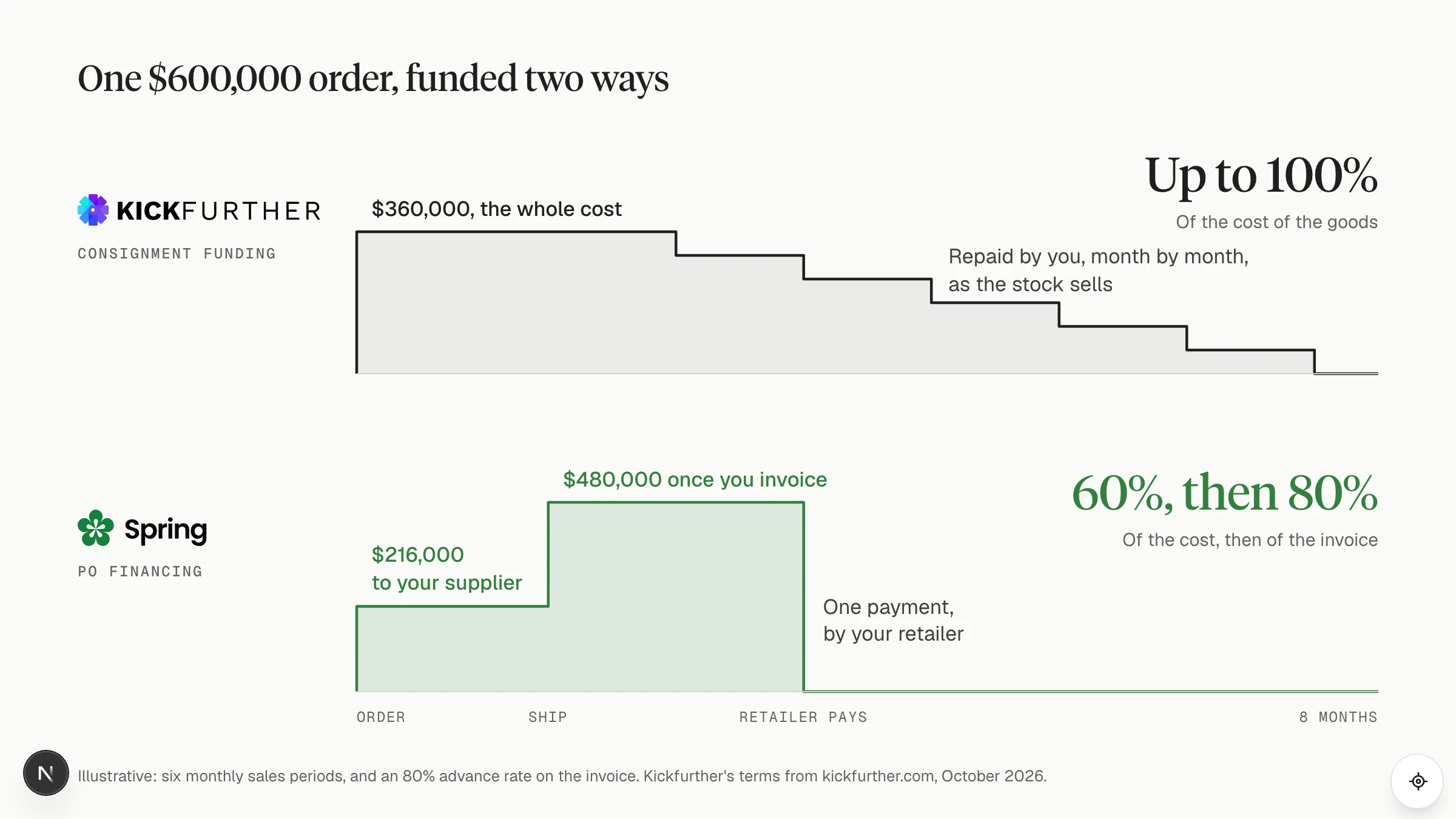
| Kickfurther | Up to 100% of an inventory order, to $5M4A funding fee plus a monthly consignment fee | You, as the stock sellsNothing due until you start selling |
| Wayflyer | Wholesale financing up to $20M5One fixed fee, agreed up front | You, on a scheduleSet instalments |
| Assembled Brands | Inventory-backed lines, $1M to $25M6Rates not published | You, over the facilityFacilities average 12 to 48 months |
Read the right-hand column first. A schedule you repay can fall due before your retailer pays you; funding your retailer repays cannot. That matters little for a brand selling mostly on Shopify or Amazon, where cash comes in daily, and a great deal for one waiting out a retailer's terms. Walmart, for one, says the terms in its supplier financing programs generally run 30 to 90 days.7
Is Spring an alternative to Settle?
For the funding, yes, when your buyer is a retailer or a distributor. For the payables software, not one for one: Spring sells funding and an AI finance agent, not a bill-pay tool, so if bill pay is what you are shopping for, compare AP tools.
The funding works differently. Settle's working capital is repaid by you on a schedule, whoever your customer is. Spring funds the retailer's order itself. Purchase order financing pays your supplier up to 60% of the order's cost; when you ship, invoice factoring tops it up to your advance rate for that retailer, and the retailer's payment on the invoice settles both. If the retailer takes 70 days instead of 60, the fee covers ten more days, and nothing leaves your bank account in between. Before an order arrives, demand plan financing funds production against a retailer's demand plan, and you repay it monthly.
Spring's price is 12% to 36% a year, charged only on the days the money is out. What it asks of you is a Notice of Assignment for every product except Bridge Funding: a letter asking your retailer to pay your invoices to an account Spring holds for you. Your retailer will know you have a funding partner, and your first funding waits until it acknowledges the notice, which usually takes days and occasionally a couple of weeks. What a NOA is, and what it does.
When is Settle the better choice?
Settle, when:
- You sell mostly online or through many channels. A schedule suits revenue that arrives every day, and there may be no retailer invoice to fund.
- You want the bill-pay software and the funding in one place. Financing a vendor bill from the screen where you approve it is the point of the product.
- The cost is not tied to an order. Marketing, packaging or a tariff bill with no purchase order behind it.
Spring, when:
- A retailer or distributor has ordered. Walmart, Costco, Target, Kroger, UNFI or KeHE on net terms.
- You want repayment to wait for the retailer. A schedule can come due in the middle of a 60-day wait.
- You want funding that grows with your orders. Each order and each invoice is sized on its own.
Kickfurther or Wayflyer, when the stock is built ahead of any order, or you want one fixed fee rather than interest. We compared consignment inventory funding with PO financing in detail.
Using more than one? If Settle funds a vendor bill and another provider funds the invoice for the same goods, ask both, in writing, who holds a claim on the inventory and the receivable, and who is paid first.
Frequently asked questions
What are the best alternatives to Settle for a CPG brand?
It depends on who you want to repay the money. For a brand selling to retailers, Spring funds the retailer's order and invoice and is repaid when the retailer pays, at 12% to 36% a year. Kickfurther funds inventory repaid as it sells. Wayflyer and Assembled Brands are repaid by you on a schedule, as Settle is.
Is Spring an alternative to Settle?
For the funding, yes, when your buyer is a retailer or distributor. Settle's working capital is repaid by you in 30 to 180 days. Spring's purchase order financing and invoice factoring are repaid by the retailer's payment on the invoice. Settle also sells bill-pay and procurement software; Spring sells funding and an AI finance agent.
How much does Settle Working Capital cost?
Settle charges simple interest on the outstanding balance and does not publish a rate; its own worked example uses 1.4% a month, about 17% a year. Its software plans are free (Launch) or $199 a month (Accelerate). Spring's funding is 12% to 36% a year, charged only on the days the money is out.
Settle vs Kickfurther: which is better for inventory?
Settle is repaid on a 30 to 180 day schedule, whether or not the stock has sold. Kickfurther funds up to 100% of an inventory order and is repaid as the stock sells, for a funding fee plus a monthly consignment fee. Neither waits on a retailer's payment. Consignment funding vs PO financing, compared.
Can Settle fund a Walmart or Target purchase order?
Settle's working capital can pay suppliers for inventory, including stock bound for a retailer, but you repay it on its schedule rather than when Walmart or Target pays. Purchase order financing is repaid by the retailer's payment. More on funding a big retailer order.
Who qualifies for Settle, and who qualifies for Spring?
Settle asks for a year of operating history and $500,000 in trailing twelve-month revenue. Spring sizes funding on the retailer you sell to and your history with it, and needs a Notice of Assignment to that retailer for every product except Bridge Funding.
If a retailer has ordered from you, get started or talk to the team.
1 Settle, Working Capital, including its FAQ, read October 2026. The yearly figure is Settle's own example: 1.4% a month as simple interest.
2 Settle, Pricing, read October 2026.
3 Settle, AP Automation, read October 2026.
4 Kickfurther, Inventory Funding Built for CPG Brands, read October 2026.
5 Wayflyer, Wholesale financing, read October 2026.
6 Assembled Brands, home page, read October 2026.
7 Walmart Inc., Form 10-K for the fiscal year ended January 31, 2026, "Supplier Financing Program Obligations", read October 2026.