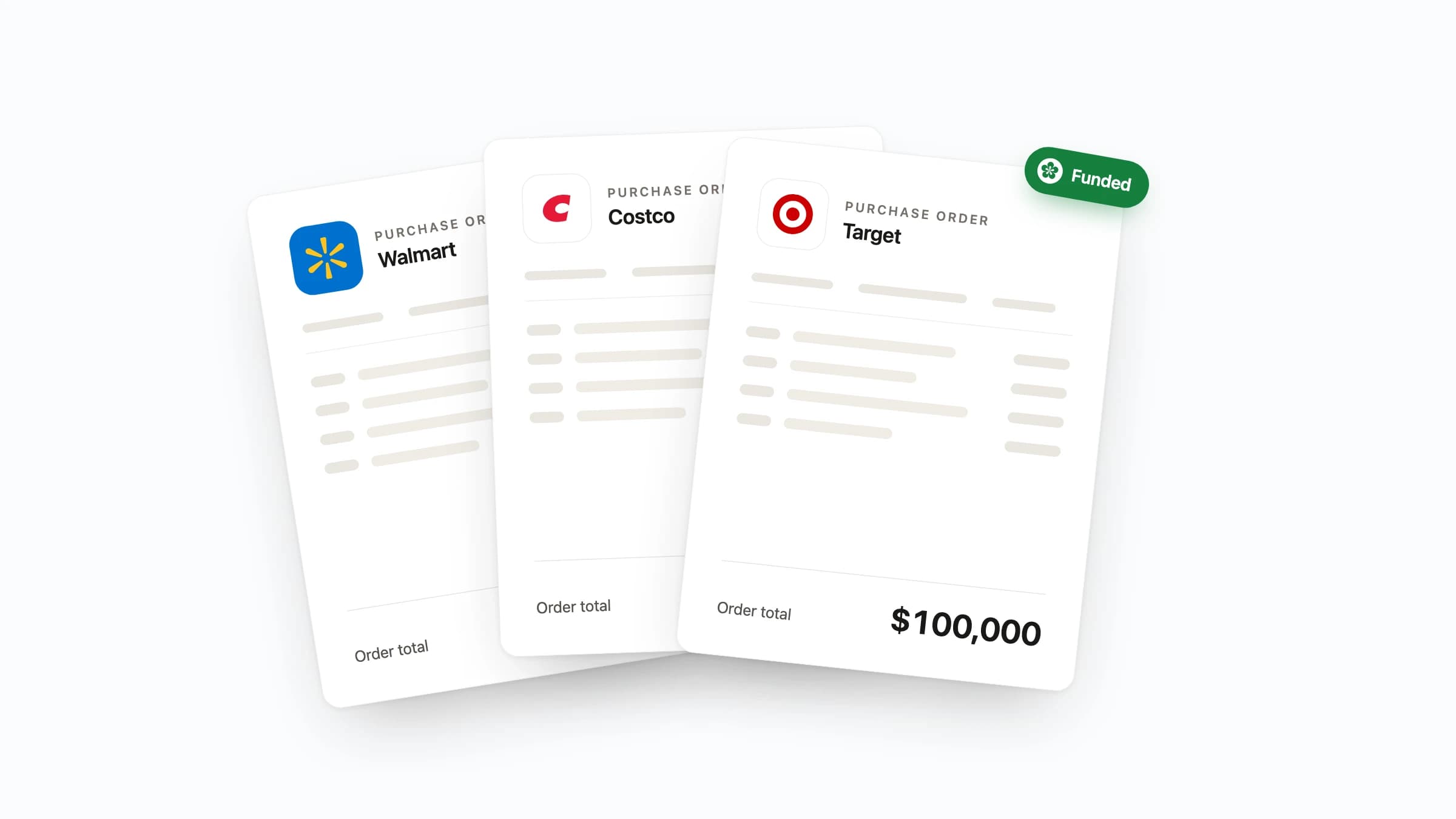
Walmart's annual report puts the terms in its supplier finance programs at 30 to 90 days. Every one of them is a day you carry goods you have already shipped. The ways a brand can carry that wait, and what each costs.
Last edited 6 min read
30 to 90 days is the range Walmart's own annual report gives for its payment terms with suppliers in its supplier finance programs,1 and every one of those days is a day your brand carries the cost of goods it has already shipped. Most consumer brands finance that wait with invoice factoring: a funder advances most of the invoice when you ship, and the retailer's payment settles it. The alternatives are the retailer's own early-pay program, a bank line, or asking for shorter terms.
This post explains where long terms come from, what they cost a growing brand, and how each way of carrying them works. We sell one of the options, so check our work. It is not legal or financial advice.
Why do retailers pay on 60 to 90 day terms?
Because a retailer's payment terms are its own working capital: the longer it holds your money, the less it has to borrow.
Large retailers set terms supplier by supplier and department by department. Walmart discloses a 30 to 90 day range for suppliers in its supplier finance programs.1 In 2015 Walmart asked suppliers for longer terms on slower-selling items; trade press reported one supplier asked to move from 20-day terms to 90 days, which gave Walmart 105 days between invoice and payment.2 Target, Costco, Kroger and distributors such as UNFI and KeHE each set their own.


Two details can make the wait longer than the number on the contract. Check whether the terms run from the invoice date or from when the retailer receives the goods, which can be days after they leave your dock. And deductions for shortages, damages or promotions come off before the payment lands, so what arrives on day 90 can be less than you invoiced.
What does a 90-day wait cost a growing brand?
It costs you the next order. Cash tied up in one invoice is cash you cannot spend making the next one.
Take an illustrative $100,000 invoice on 90-day terms for goods that cost $60,000 to make. You paid the co-packer before you shipped; the retailer pays three months later. If the retailer reorders every month, two or three of those invoices are open at once, and $120,000 to $180,000 of your own money sits in the retailer's accounts payable. The faster a brand grows, the more of its cash ends up there, which is why growth and cash shortages so often arrive together.
What are the ways to finance 60 to 90 day terms?
Factoring and early pay turn an invoice into cash before its due date; a bank line is general money you can draw for anything; purchase order financing covers the step before there is an invoice.
| Question | When the cash arrives | What it needs from you |
|---|---|---|
| Invoice factoring | Days after you ship and invoice | An invoice to a retailer or distributor and, usually, a Notice of Assignment |
| Retailer early pay | After the retailer approves the invoice | A retailer that runs a program, and enrollment in it |
| Bank line | Whenever you draw, once it is in place | Weeks to set up, financial statements, collateral and usually a personal guarantee |
| Shorter terms | Sooner, on the retailer's schedule | A retailer willing to agree, usually for a discount off every invoice |
| Purchase order financing | Before you ship: it pays your supplier | A signed purchase order; factoring takes over once you invoice |
How does invoice factoring cover the wait?
A funder pays you most of the invoice when you ship, waits out the terms, and is repaid by the retailer.
You ship and invoice as usual. The funder advances a share of the invoice, often up to 90%, within days. The retailer pays the full invoice into an account the funder holds for you, under a Notice of Assignment. The funder keeps its fee and the advance and sends you the rest. The retailer's terms do not change; only when you get paid does.
Because the fee runs for as long as the retailer takes to pay, it scales with the terms. At Spring the fee is 12% to 36% a year on the amount advanced. On a $100,000 invoice with a $90,000 advance, a retailer that pays on day 60 makes the fee $1,775 to $5,326; on day 90 it is $2,663 to $7,989. A deduction comes out of the $10,000 held back, not out of your advance. The full walk-through, step by step: how invoice factoring works.
Is a retailer's early-pay program cheaper?
Sometimes, if your retailer runs one and you are enrolled. It only works one retailer at a time.
These programs, often called supply chain finance, let a bank pay your approved invoice early at a discount, and the retailer pays the bank on the due date. Walmart describes its programs as optional for the supplier, who negotiates the terms directly with the financial institution.1 The discount is usually priced on the retailer's standing rather than yours, which is why it can be low. The catch is timing and reach: the money comes only after the retailer approves the invoice, and it covers that retailer's invoices and no one else's.
Can Spring fund 60 to 90 day retailer terms?
Yes, on invoices to retailers and distributors, and on the purchase orders before them.
Invoice factoring advances your invoices to retailers and distributors when you ship, at 12% to 36% a year, with the advance rate set per retailer from how that retailer actually pays you. Purchase order financing pays your supplier before you ship, and demand plan financing funds production against a retailer's demand plan before the purchase orders arrive. Each retailer pays Spring on its own account number.
What you should know before you apply: every product except Bridge Funding needs a Notice of Assignment, a letter asking your retailer to pay your invoices to an account Spring holds for you. Your retailer will know you have a funding partner, and your first funding waits until it acknowledges the notice, which usually takes days and occasionally a couple of weeks. A business without retailer invoices can look at Bridge Funding, which needs no notice.
When is something else the better choice?
- Your retailer already pays you early. If you are enrolled in its program, use it before adding a funder.
- You already have a bank line. A line you draw all year is usually the steadier way to carry terms across every customer.
- Your terms are short and your margins thin. On net 30, waiting may cost less than any fee.
- The problem is production, not the wait. If you cannot fill the order at all, start with purchase order financing, or read how to fund a big retailer order.
Frequently asked questions
How do CPG brands finance 60 to 90 day payment terms from Walmart, Target or Costco?
Most use invoice factoring: a funder advances most of the invoice when the brand ships and is repaid when the retailer pays. Brands enrolled in a retailer's early-pay program can use that instead, and brands with a bank line draw on it. Spring factors invoices to retailers and distributors at 12% to 36% a year.
What are Walmart's payment terms for suppliers?
Walmart's annual report says its payment terms with suppliers in its supplier finance programs generally range from 30 to 90 days. Terms are set per supplier, and in 2015 Walmart asked some suppliers to move to 90 days.
How much does it cost to factor a 90-day invoice?
It depends on the rate and how long the retailer takes to pay. At Spring, 12% to 36% a year on the amount advanced: on a $100,000 invoice with a $90,000 advance, $2,663 to $7,989 if the retailer pays on day 90, and $1,775 to $5,326 if it pays on day 60.
Can I factor invoices to distributors like UNFI and KeHE?
Yes. A distributor's invoice is factored the same way as a retailer's, with its own Notice of Assignment. Spring factors invoices to retailers and distributors including Walmart, Target, Costco, Whole Foods, UNFI and KeHE.
Will Kroger or Target know I am factoring my invoices?
Yes, with Spring and with most factors. A Notice of Assignment asks the retailer to pay your invoices to an account the funder holds for you. Retailers process these routinely. What a NOA is and what it does.
What is the difference between factoring and a retailer early-pay program?
An early-pay program is run by the retailer's bank and pays an invoice only after the retailer approves it, for that retailer alone. Factoring is arranged by you, starts when you invoice, and can cover several retailers and distributors at once.
Can I get funded before the order ships?
Yes, with purchase order financing, which pays your supplier against a signed retailer order. Once the goods ship, factoring takes over on the invoice. How Spring's version works.
If you are waiting on retailer payments, get started or talk to the team.
1 Walmart Inc., Form 10-K for the fiscal year ended January 31, 2026, note on supplier financing program obligations, read October 2026.
2 Talk Business & Politics, The Supply Side: Contract changes ask more from Wal-Mart suppliers, June 24, 2015, read October 2026.