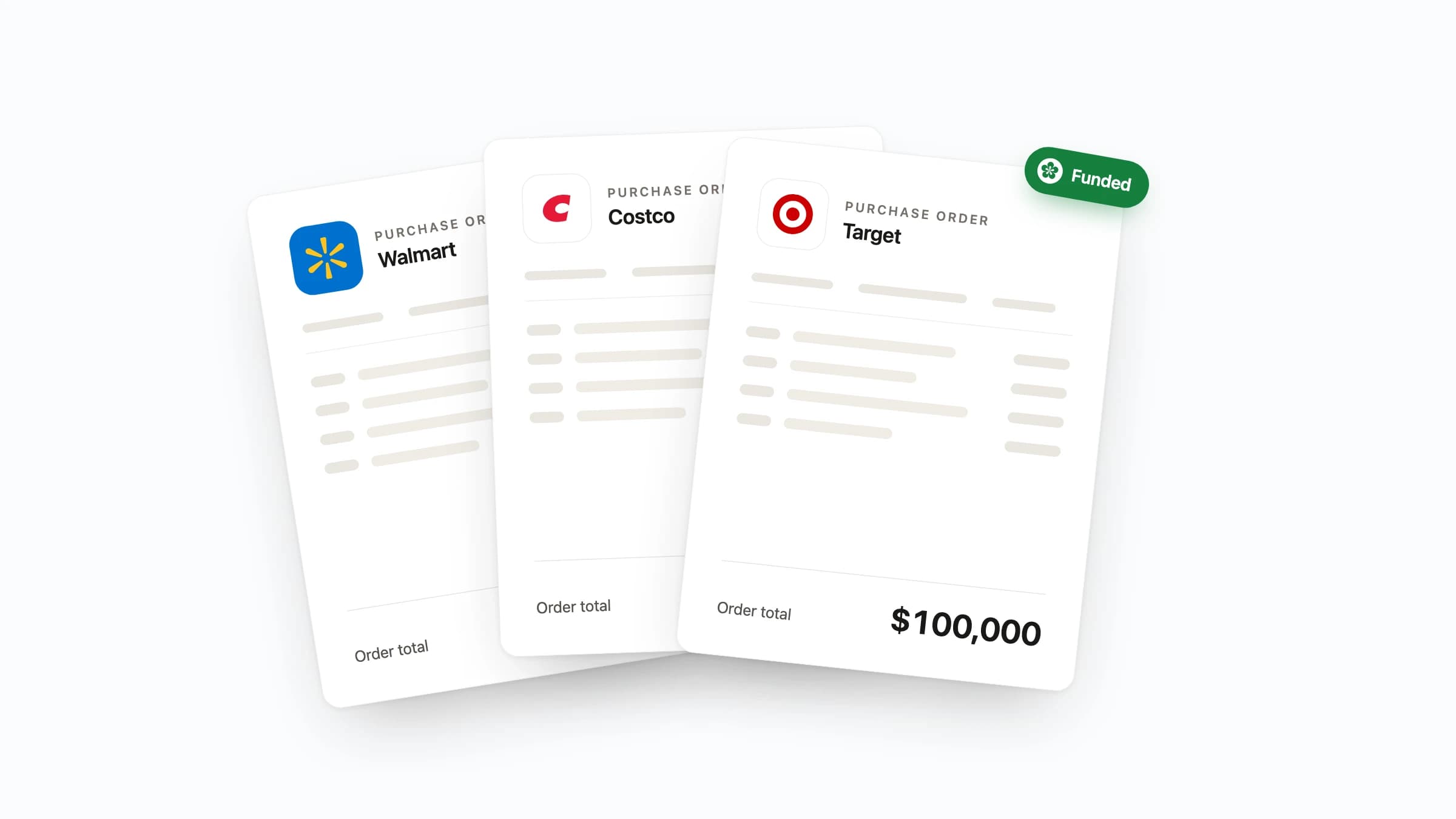
Most growth funding asks what you earn. Funding sized on a retailer's order asks who is paying. The options for a brand growing faster than its margins, and what each costs.
Last edited 5 min read
Three kinds of funding are open to a consumer brand that is not yet profitable: funding sized on a retailer's order or invoice, funding sized on your sales, and equity. The first is judged mostly on the retailer that will pay, not on your profit and loss, and only equity costs you a share of the company.
Most food, beverage and personal-care brands lose money while they grow into retail. A first production run, slotting and launch promotions all land before the margin does, and a bigger order makes the gap wider before it closes. This post covers who will fund a brand at that stage, what each option looks at instead of profit, and what it costs. We sell two of the options, so check our work. None of it is legal or financial advice.
Do you need to be profitable to get funding?
No, not for most of what a consumer brand uses. What a funder looks at instead depends on what repays it.
A bank line is repaid out of the business's own cash flow, so a bank reads your financial statements first and usually wants collateral and a personal guarantee from the owners. Funding sized on a retailer's order or invoice is repaid by the retailer's payment, so the question that matters most is whether Walmart, Costco or Target will pay. Funding sized on sales is repaid out of those sales, so it looks at how much and how steadily you sell. Equity is not repaid at all: investors buy a share of what the company becomes.
Which funding does not ask for profit?
All of the options below fund brands that are still losing money. They differ in what they are sized on and in what they cost you.
| Question | Sized on | What it costs you |
|---|---|---|
| Purchase order financing | The retailer's signed orderYour supplier is paid against it | A fee on the days the money is out12% to 36% a year with Spring |
| Invoice factoring | The retailer's invoiceAdvanced once you ship | A fee on the days the money is out12% to 36% a year with Spring |
| Revenue-based financing | Your sales, usually onlineWith a few months of trading behind them | A flat fee, repaid daily or weeklyAnnualise it before you sign |
| Inventory funding | The cost of the stockRepaid as it sells | A funding fee plus a monthly feeQuoted per deal |
| Equity | Your growth and your storyProfit is not the test | A share of the companyPermanently |
How does order and invoice funding work without profit?
The retailer's payment repays it, so the funder looks hardest at the retailer and the order.
Purchase order financing pays your co-packer or supplier against a signed retailer order, so production starts before you have the cash for it. When the goods ship, invoice factoring advances most of the invoice, so you are not waiting out the retailer's payment terms. The retailer pays, both are settled out of that payment, and the rest comes back to you. A brand with a loss on last year's statements can still have a $250,000 order from a retailer that always pays, and that order is what gets funded. We worked one order through from purchase order to payment in how to fund a big retailer order.
The limit is the flip side of the strength: it funds retail orders and invoices only. A brand that sells only online has nothing for it to advance against.
What do revenue-based and inventory funders ask for instead?
Revenue and time trading, not profit. Each sets its own floor.
Wayflyer starts at around $10,000 a month in revenue with six months of trading.1 Clearco asks for six months of history and more than $100,000 a month in online revenue.2 Kickfurther funds inventory for brands from $200,000 in yearly revenue.3 On the asset-based side, Dwight Funding says it provides capital to a brand that is not yet profitable.4


None of them makes profit a condition, so compare them on price and schedule. A flat fee repaid out of daily or weekly sales costs far more than it sounds: on one real offer, an 8.75% fee came to about 85% a year (the arithmetic). And a payment that starts next week comes out of the same thin margin you are trying to grow past.
How do you grow without selling more of the company?
Fund the temporary needs with funding that closes out, and keep equity for the permanent ones.
An order is a temporary need: the retailer's payment closes it out in a few months. Selling a share of the company to pay for it means paying forever for money you needed for one season. Equity is the right answer for what never pays itself back on a schedule: a team, a new category, years of growth ahead of revenue. Spring never takes equity.
What does Spring look at if you are not profitable yet?
The retailer, the order and your revenue. Profit is not a requirement for purchase order financing or invoice factoring.
Spring reads your revenue from a read-only bank connection, and sets an advance rate for each retailer from your payment and deduction history with it. Your margins and cash runway shape the size and the price of an offer, which runs from 12% to 36% a year on the days the money is out. Demand plan financing, which you repay monthly, looks harder at whether your cash covers the term. Bridge Funding is sized on the deposits your business already receives, with no retailer involved.
One thing you should know before you apply: a Notice of Assignment. Purchase order financing, invoice factoring and demand plan financing all require one: a letter asking your retailer's accounts payable team to pay your invoices to an account Spring holds for you. Your retailer will know you have a funding partner, and your first funding waits until it acknowledges the notice, which takes days and occasionally a couple of weeks. What a NOA is and what it does. Bridge Funding is the one Spring product that needs no notice.
When is something else the better choice?
When the need is permanent, the revenue is online, or the business is already profitable enough for a bank.
- Most of your revenue is online. Revenue-based funders were built for a brand paid a little every day through Shopify and Amazon, and Spring has no retailer invoice to advance against.
- The need is permanent. Hiring ahead of revenue or opening a new category is what equity is for.
- You are profitable and draw all year. A bank line or an asset-based line sized on what you already own will usually cost less over a full year.
- You need inventory before any retailer has ordered it. Inventory funding repaid as the stock sells may fit; so may financing the season against a retailer's demand plan.
Frequently asked questions
Who funds CPG brands that aren't profitable yet?
Most growth funding for consumer brands does not require profit. Purchase order financing and invoice factoring are judged mostly on the retailer's order or invoice; Spring offers both. Revenue-based funders such as Wayflyer and Clearco look at your sales, inventory funders such as Kickfurther at your revenue and stock, and Dwight says it provides capital to brands that are not yet profitable. Equity investors fund growth without asking for profit, in exchange for a share of the company.
Can I fund a Walmart, Costco or Target order if my brand is losing money?
Yes. Purchase order financing pays your supplier against the signed order, and invoice factoring advances the invoice once you ship. Both are repaid by the retailer's payment, so the retailer and the order matter more than your profit. Spring needs a Notice of Assignment for each retailer before its first funding. Worked example: how to fund a big retailer order.
How can a consumer brand grow without selling more of the company?
Fund each order with funding that closes out when the retailer pays, and keep equity for permanent needs such as a team or a new category. Spring never takes equity: purchase order financing and invoice factoring are settled out of the retailer's payment.
Do Wayflyer, Clearco or Kickfurther require profitability?
None of them lists profit as a requirement on its public pages; each sets a revenue floor instead. Wayflyer starts at around $10,000 a month in revenue with six months of trading, Clearco asks for more than $100,000 a month in online revenue and six months of history, and Kickfurther works with brands from $200,000 in yearly revenue. Check each page for current terms.
Is invoice factoring easier to get than a bank line when you are not profitable?
Usually. A bank is repaid out of your own cash flow, so it reads your financial statements first and usually wants collateral and a personal guarantee. Invoice factoring is repaid by the retailer that owes the invoice, so the retailer's record of paying weighs more than your profit. More on how invoice factoring works.
What does Spring cost for a brand that is not yet profitable?
Purchase order financing and invoice factoring cost 12% to 36% a year, charged only on the days the money is out, with the exact price shown in your offer before you accept. Your business, the product and the retailer decide where in that range you land. Apply in minutes to see yours.
If you have a retailer order to fill, get started or talk to the team.
1 Wayflyer Help Center, What are the requirements to get funding from Wayflyer?, read September 2026.
2 Clearco, Ecommerce funding, read October 2026.
3 Kickfurther, Inventory Funding Built for CPG Brands, read October 2026.
4 Dwight Funding, Product, read September 2026.