Faire pays you on the payout speed you pick, so the cash problem is the inventory you buy before the orders come. The ways a wholesale brand selling to independent stores funds it, and where each one fits.
Last edited 5 min read
A brand selling on Faire and in independent stores is rarely short of cash for an order it has shipped; it is short for the inventory it has to buy before the orders come in. Faire lets eligible retailers take 60 days to pay, but it pays the brand on the payout speed the brand picks (next day, 30 days or 60 days after the order ships), for a processing fee set by that choice.

This post is for a wholesale brand selling to boutiques, gift shops and independent grocers through Faire, its own wholesale accounts and distributors. Below: when Faire pays, why a wholesale brand still runs short, four ways to fund the stock, and the two that Spring sells. Treat this as a guide for wholesale brands, not legal or financial advice.

When does Faire pay brands?
On the payout speed you choose, whatever terms the retailer took.
Faire offers eligible retailers the option to buy now and pay 60 days later, and the brand can be paid sooner on the payout speed it selects.1 In North America, Faire's published pricing charges 15% commission on orders from retailers who found you on its marketplace, a $10 fee on a new customer's first order, 0% commission on Faire Direct orders from retailers you bring, and a payment processing fee that depends on whether you choose to be paid next-day, in 30 days or in 60.2
So a Faire order is not an invoice waiting to be paid: Faire's payout is the payment. There is nothing for a funder to advance on it.
Why do Faire and independent-retail brands still run short of cash?
Because the stock has to exist before anyone orders it.
A brand selling to hundreds of small stores holds inventory for all of them at once: a production run sized for the season, reorders it cannot predict, and a trade-show or holiday spike that lands in one month. The orders are small and many, so no single purchase order is big enough to finance. And as the brand grows, part of its independent business moves to distributors such as UNFI and KeHE, which buy from you and pay on their own terms.

What are the ways to fund a brand selling on Faire?
Each pays for a different thing, so most brands use two. Faire's faster payout speeds, above, are the first lever: they cost a processing fee and no paperwork.
| Question | What it pays for | How it is repaid |
|---|---|---|
| Consignment inventory funding | The inventoryFunded up front, sold through any channel | YouAs the stock sells |
| Settle working capital | Vendor bills3Paid to your vendor or your account | YouIn 30 days, extendable up to 180 |
| Bridge Funding | Anything the business needsSized on the deposits you already receive | YouA set share of each day's deposits |
| Invoice factoring | The wait on a distributorAn advance on a UNFI or KeHE invoice | The distributorWhen it pays the invoice |
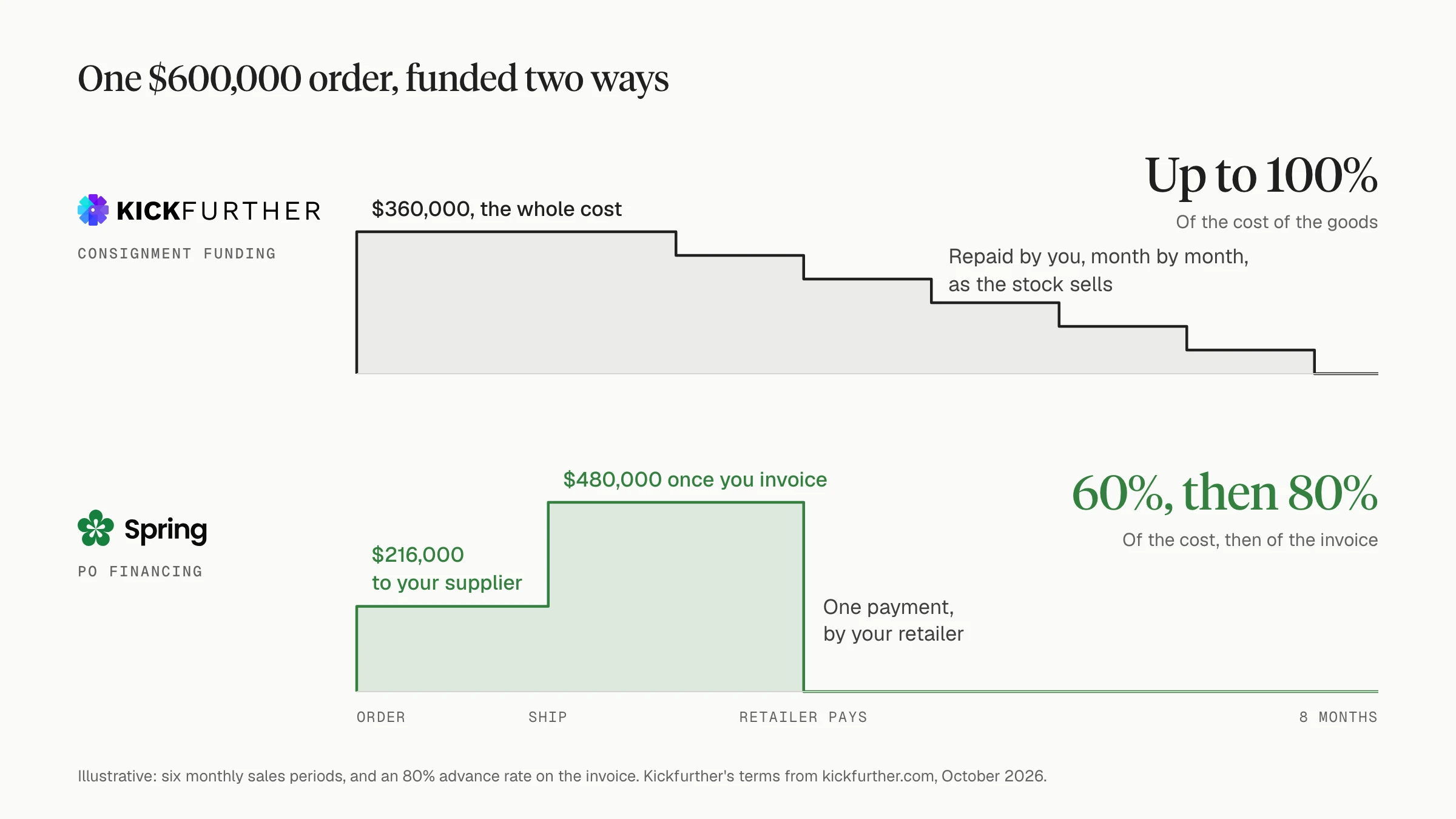
Consignment funding from companies such as Kickfurther buys a run of stock and is paid back out of what the boutiques and gift shops reorder, wherever they buy it (how it compares with PO financing). Settle pays a supplier's bill for you, to be repaid on a set date; its page lists Faire among the channels it serves and wants twelve months of trading and $500,000 of revenue over the past year.3 Bridge Funding and invoice factoring are Spring's, below.

How does Spring fund a brand that sells on Faire?
With Bridge Funding sized on your deposits, and factoring for the distributors.
Spring does not connect to Faire. It reads your business bank account, read-only through Plaid, and your Faire payouts land there alongside your Shopify sales and the checks from your own wholesale accounts. Bridge Funding is sized on those deposits, with one flat fee shown in the offer before you accept, repaid as a set share of each day's deposits. It is a smaller amount than order funding, built for a reorder or a trade-show month rather than a season's production. It needs no retailer and no Notice of Assignment, so it fits a business whose orders come from hundreds of small stores.
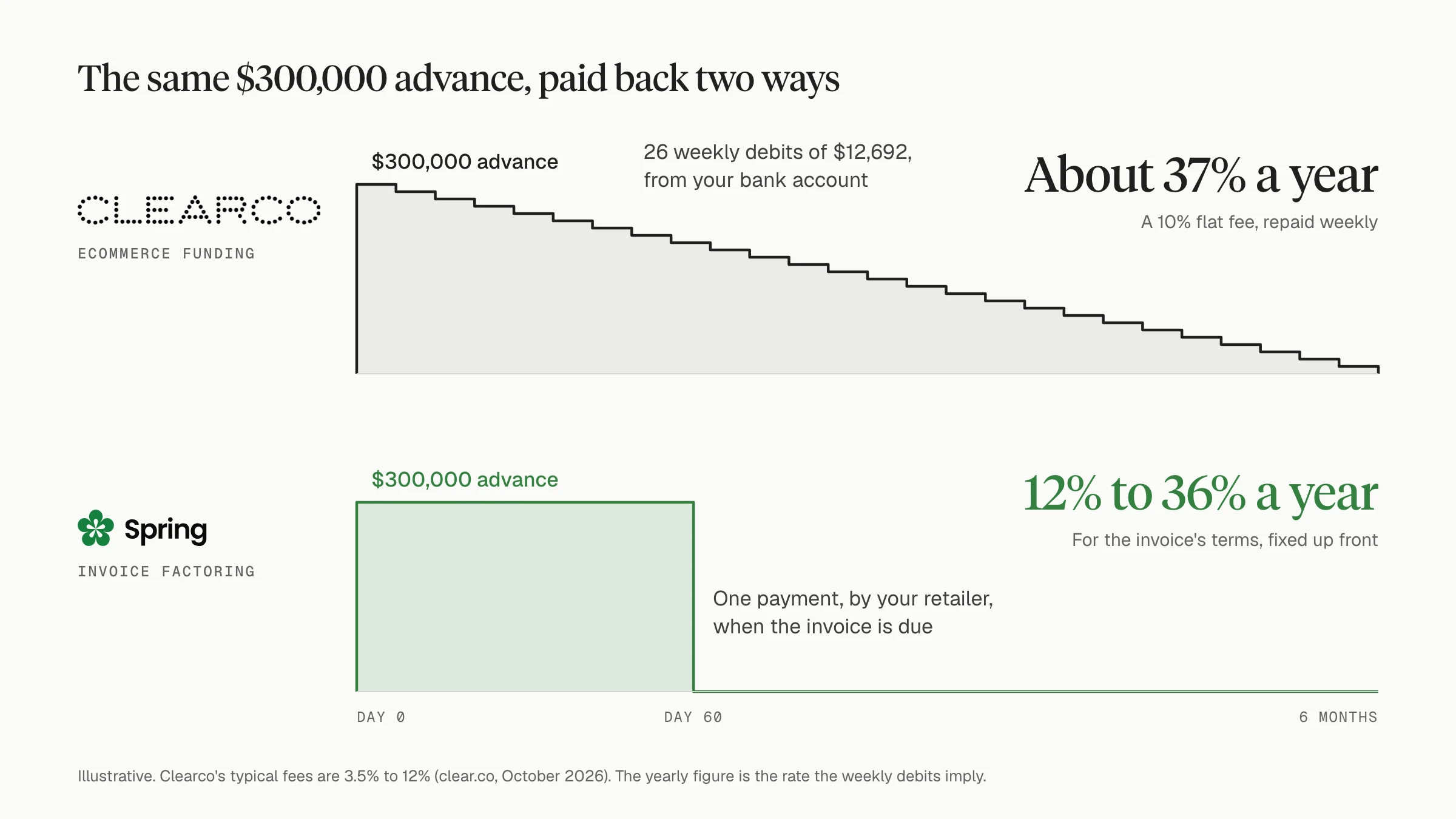
An illustrative draw: $10,000 for a trade-show month. The flat fee is set by your grade, 7.5% to 15% of the amount, so $750 to $1,500 in total, shown before you accept and not annualized. It comes back as a set share of each day's deposits, typically over about five weeks. Want to see your own number? Get started with your business bank account connected; what our process looks like shows each step from pre-qual to funded.
When part of the business moves to a distributor, invoice factoring takes over for those invoices. Take an illustrative brand that ships a $40,000 order to KeHE. Spring advances $32,000 at an illustrative 80%. On illustrative 30-day KeHE terms plus Spring's 14-day buffer, the $32,000 is priced for 44 days, and that fee, $463 at 12% a year or $1,389 at 36%, is taken the day the advance goes out. KeHE's payment then clears the $32,000, and the $8,000 held back comes to you less whatever KeHE deducts.
Factoring is set up one payer at a time, each with its own notice, so it suits a few large payers like a distributor rather than dozens of small shop invoices. Your own wholesale accounts can keep paying you as they do today.
What do my stores or distributors see?
For Bridge Funding, nothing: no store or distributor receives a notice.
For invoice factoring, only the distributor does. UNFI or KeHE gets one Notice of Assignment that changes where it sends payment for your invoices, and nothing is advanced until its vendor team confirms the change. The boutiques buying from that distributor never hear of it. The notice, line by line.
When does a Faire brand need no funding at all?
When the gap is a payout setting or a commission, not the stock.
- The gap is Faire's payout timing. A faster payout speed changes the processing fee, not your paperwork.
- You can bring your stores to Faire Direct. Their orders carry 0% commission, which keeps more of each order.
If your big accounts are national retailers rather than boutiques, the answer is different: purchase order financing pays the maker against a chain's signed order (the Walmart, Target and Costco version).
Frequently asked questions
How do brands selling on Faire get working capital?
Mostly from funding sized on the business, not on Faire orders, because Faire pays brands on their chosen payout speed whatever terms the store took. For a boutique-and-gift-shop brand that usually means Kickfurther consignment for a big seasonal run, Settle for a supplier bill, or Spring's Bridge Funding for a reorder month, sized on the Faire payouts and other deposits you already receive.
Does Spring integrate with Faire?
No. Spring has no Faire integration and does not fund Faire orders. It reads your business bank account read-only through Plaid, where your Faire payouts land, and sizes Bridge Funding on those deposits.
When does Faire pay brands?
Faire lets eligible retailers pay in 60 days but pays the brand on the payout speed it chooses: next-day, 30 days or 60 days after the order ships, with a processing fee that depends on the speed. Check your Faire account for the current fees.
Is Kickfurther a better fit than Spring for a Faire brand?
They do different jobs. Kickfurther buys a run of your stock and is paid back out of what the stores reorder. Spring's Bridge Funding is sized on your deposits and needs no retailer, and its invoice factoring advances distributor invoices such as UNFI's or KeHE's.
Can I factor invoices from independent stores or distributors?
Not invoice by invoice to dozens of boutiques. Spring factors the few large payers a Faire brand may also have, a UNFI or KeHE account, each set up once with its own Notice of Assignment, at 12% to 36% a year. See invoice factoring.
How is Settle different from Spring for a Faire brand?
Settle pays a supplier's bill for you and wants it back within 30 days, or up to 180 if extended, once you have twelve months of trading and $500,000 of revenue behind you. Spring's Bridge Funding is repaid as a set share of each day's deposits, for one flat fee shown before you accept.
Will my stores know I use Spring?
Not for Bridge Funding, which involves no retailer. For invoice factoring, the distributor whose invoices you factor receives a Notice of Assignment. What a NOA is.
Connect your business bank account when you get started to see a Bridge Funding offer sized on your deposits. Selling to UNFI or KeHE too? Those invoices are covered in factoring UNFI and KeHE invoices.
1 Faire Help Center, How do 60-day payment terms work?, read October 2026.
2 Faire Help Center, How much does it cost to sell on Faire if I'm based in North America?, read October 2026.
3 Settle, Working capital, read October 2026.