Faire pays you soon after an order ships, so the cash problem is the inventory before it. The ways a wholesale brand selling to independent stores funds it, and where each one fits.
Last edited 5 min read
60 days is how long Faire lets eligible retailers wait before they pay, but Faire pays the brand itself soon after the order ships, on a payout speed the brand chooses. So a brand selling on Faire and in independent stores is rarely short of cash for an order it has shipped; it is short for the inventory it has to buy before the orders come in.

This post is for a wholesale brand selling to boutiques, gift shops and independent grocers through Faire, its own wholesale accounts and distributors. It covers where the cash goes, the ways to fund it and where Spring fits. Spring has no Faire integration and does not fund Faire orders. We sell some of the options, so check our work. It is not legal or financial advice.

When does Faire pay brands?
Shortly after the order ships, whatever terms the retailer took.
Faire offers eligible retailers the option to buy now and pay 60 days later, and the brand can be paid sooner on the payout speed it selects.1 In North America, Faire's published pricing charges 15% commission on orders from retailers who found you on its marketplace, a $10 fee on a new customer's first order, 0% commission on Faire Direct orders from retailers you bring, and a payment processing fee that depends on whether you choose to be paid next-day, in 30 days or in 60.2
So a Faire order is not an invoice waiting to be paid: Faire's payout is the payment. There is nothing for a funder to advance on it.
Why do Faire and independent-retail brands still run short of cash?
Because the stock has to exist before anyone orders it.
A brand selling to hundreds of small stores holds inventory for all of them at once: a production run sized for the season, reorders it cannot predict, and a trade-show or holiday spike that lands in one month. The orders are small and many, so no single purchase order is big enough to finance. And as the brand grows, part of its independent business moves to distributors such as UNFI and KeHE, which buy from you and pay on their own terms.

What are the ways to fund a brand selling on Faire?
Each pays for a different thing, so most brands use two.
| Question | What it pays for | How it is repaid |
|---|---|---|
| Faire's payout speed | Shipped orders2Paid next-day, in 30 days or in 60, for a processing fee | NobodyIt is the payment, not funding |
| Consignment inventory funding | The inventoryFunded up front, sold through any channel | YouAs the stock sells |
| Settle working capital | Vendor bills3Paid to your vendor or your account | YouOn a fixed biweekly or monthly schedule |
| Bridge Funding | Anything the business needsSized on the deposits you already receive | YouA share of each day's sales |
| Invoice factoring | The wait on a distributorAn advance on a UNFI or KeHE invoice | The distributorWhen it pays the invoice |
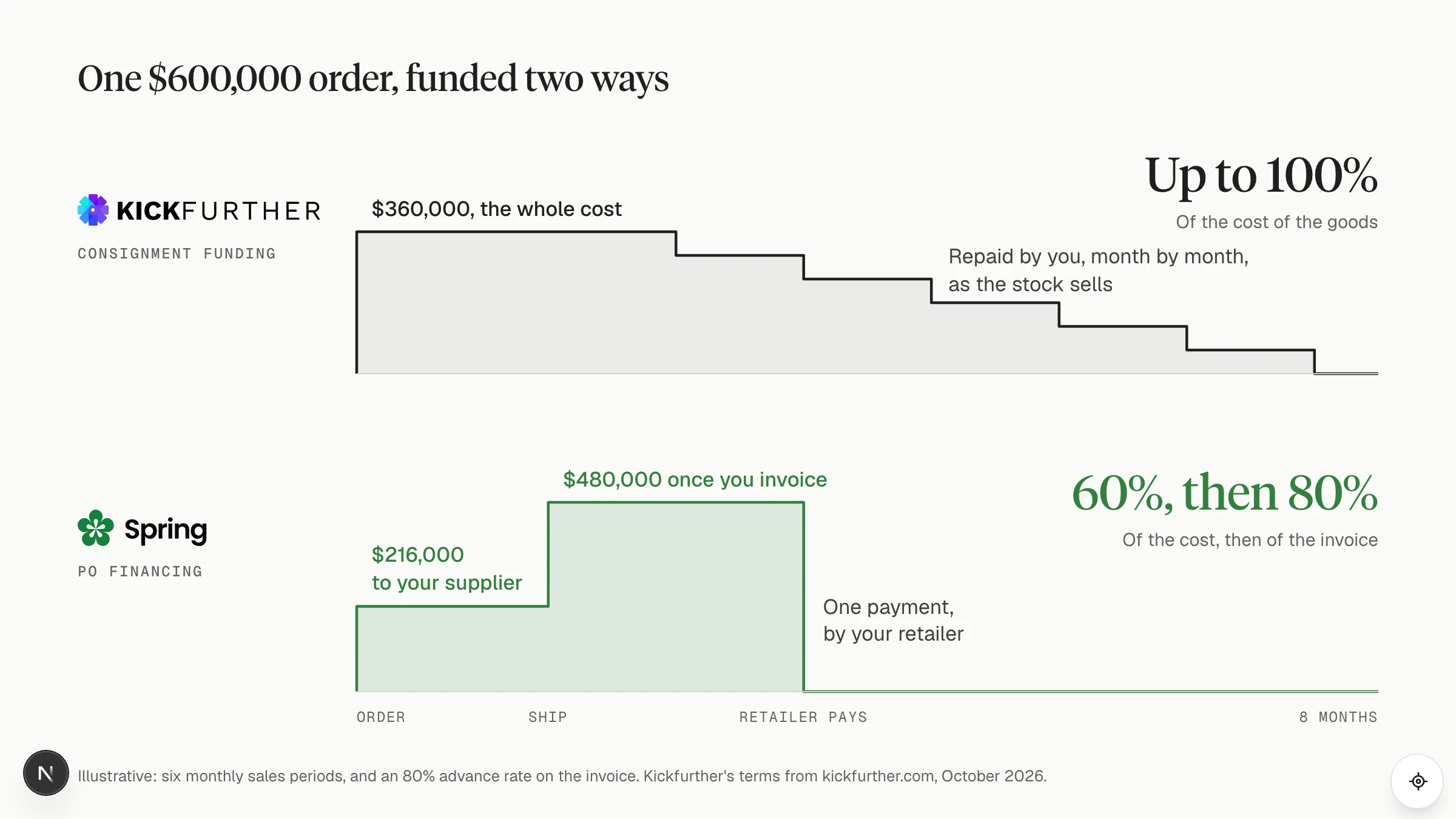
Consignment funding from companies such as Kickfurther buys your inventory up front and is repaid by you as it sells, which suits a brand selling through many channels at once (how it compares with PO financing). Settle's working capital pays a vendor or your bank account and is repaid on a schedule; its page lists Faire among the channels it serves and asks for a year in business and $500,000 in trailing revenue.3 Bridge Funding and invoice factoring are Spring's, below.

How does Spring fund a brand that sells on Faire?
With Bridge Funding sized on your deposits, and factoring for the distributors.
Spring does not connect to Faire. It reads your business bank account, read-only through Plaid, and your Faire payouts land there alongside your Shopify sales and the checks from your own wholesale accounts. Bridge Funding is sized on those deposits: up to $500,000 for a US business, with one fixed fee shown in the offer before you accept, repaid as a share of each day's sales. It needs no retailer and no Notice of Assignment, so it fits a business whose orders come from hundreds of small stores.
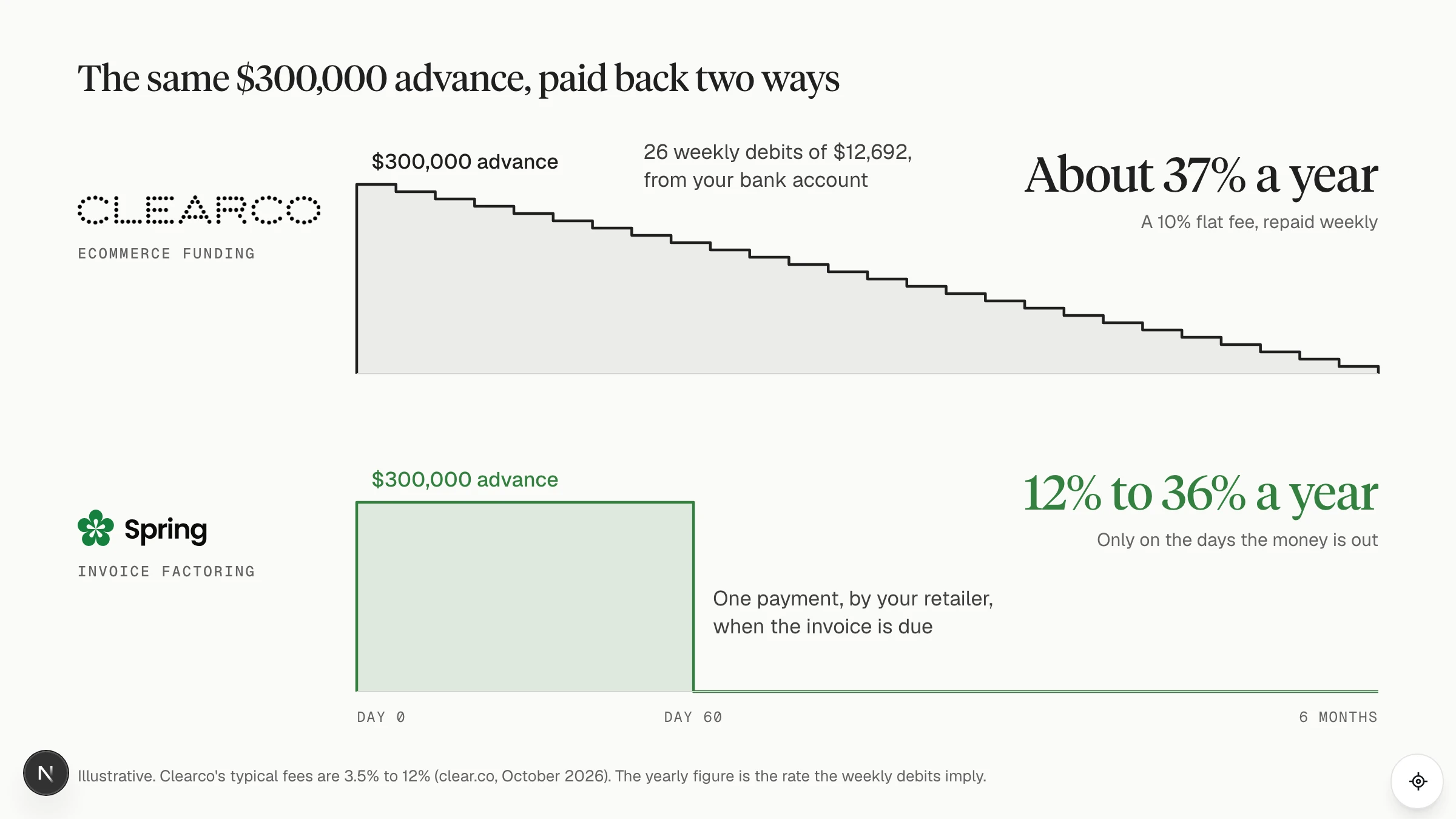
When part of the business moves to a distributor, invoice factoring takes over for those invoices. Take an illustrative brand that ships a $40,000 order to KeHE. Spring advances $32,000 at an illustrative 80%, and when KeHE pays the invoice to the account named in the Notice of Assignment, Spring keeps the advance and its fee and releases the rest. If the money is out for 30 days, the fee is about $320 at 12% a year and about $950 at 36%.
Factoring is set up one payer at a time, each with its own notice, so it suits a few large payers like a distributor rather than dozens of small shop invoices. Your own wholesale accounts can keep paying you as they do today.
What do my stores or distributors see?
For Bridge Funding, nothing: no store or distributor receives a notice.
For invoice factoring, the distributor receives a Notice of Assignment asking it to pay your invoices to an account Spring holds for you. The first funding waits until it acknowledges the notice, which usually takes days and occasionally a couple of weeks. It does not change your price or terms. What a NOA is and what it changes.
When is something else the better choice?
When the cheapest fix is the one you already have.
- The gap is Faire's payout timing. Choosing a faster payout speed costs a processing fee and no paperwork.
- You can bring your stores to Faire Direct. Their orders carry 0% commission, which keeps more of each order.
- The money is for the company. A new line or a team is what equity is for.
- Your big accounts are national retailers. Then purchase order financing pays for the run against the order: see how to fund a big retailer order.
Frequently asked questions
How do brands selling on Faire get working capital?
Mostly from funding sized on the business, not on Faire orders, because Faire already pays brands soon after an order ships. Options include consignment inventory funding such as Kickfurther, working capital from providers such as Settle, and Bridge Funding from Spring, sized on the deposits your business already receives.
Does Spring integrate with Faire?
No. Spring has no Faire integration and does not fund Faire orders. It reads your business bank account read-only through Plaid, where your Faire payouts land, and sizes Bridge Funding on those deposits.
When does Faire pay brands?
Faire lets eligible retailers pay in 60 days but pays the brand on the payout speed it chooses: next-day, 30 days or 60 days after the order ships, with a processing fee that depends on the speed. Check your Faire account for the current fees.
Is Kickfurther or Ampla a better fit than Spring for a Faire brand?
They do different jobs. Kickfurther's consignment funding buys inventory up front and you repay it as the stock sells. Ampla has offered working capital and credit to consumer brands; check its current products directly. Spring's Bridge Funding is sized on your deposits and needs no retailer, and its invoice factoring advances distributor invoices such as UNFI's or KeHE's.
Can I factor invoices from independent stores or distributors?
Spring factors invoices to retailers and distributors such as UNFI and KeHE, set up one payer at a time with a Notice of Assignment, at 12% to 36% a year. That suits a few large payers better than dozens of small boutique invoices. See invoice factoring.
How is Settle different from Spring for a Faire brand?
Settle's working capital pays a vendor or your bank account and is repaid on a fixed biweekly or monthly schedule; it asks for a year in business and $500,000 in trailing revenue. Spring's Bridge Funding is repaid as a share of each day's sales, for one fixed fee shown before you accept.
Will my stores know I use Spring?
Not for Bridge Funding, which involves no retailer. For invoice factoring, the distributor whose invoices you factor receives a Notice of Assignment. What a NOA is.
If you sell on Faire and in independent stores, get started or talk to the team.
1 Faire Help Center, How do 60-day payment terms work?, read October 2026.
2 Faire Help Center, How much does it cost to sell on Faire if I'm based in North America?, read October 2026.
3 Settle, Working capital, read October 2026.