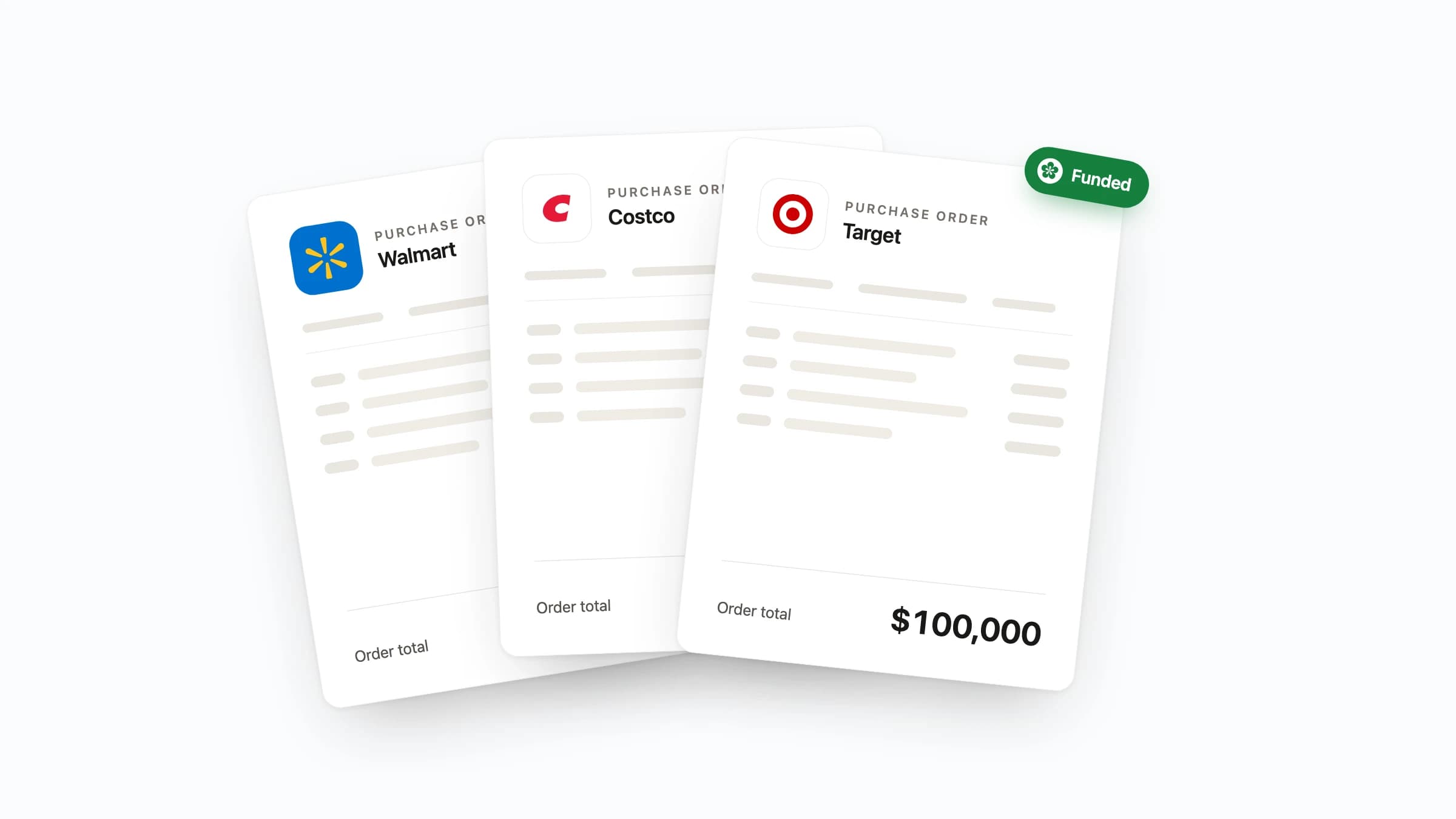
The opening order, the slotting and free fills, and the freight all come due before a regional chain pays its first invoice. How food and beverage brands fund a rollout, wave by wave.
Last edited 6 min read
Three bills come due before a regional grocery chain pays its first invoice: the production run that fills every store, the slotting and free fills that win the shelf, and the freight to the chain's warehouses or distributor. Most brands fund the run with purchase order financing against the chain's order and carry the wait with invoice factoring; demand plan financing can fund the run, and some launch cash, before the purchase orders arrive.
A first regional chain, often one Kroger division, H-E-B, Publix, Wegmans, Meijer or Hy-Vee, is where many food and beverage brands prove their sales velocity before going national. The acceptance letter is good news that arrives as a cash problem. This post covers what a rollout costs before the first payment, the ways to fund it, and one rollout worked through. We sell some of the options, so check our work. It is not legal or financial advice.

What does a regional grocery rollout cost before the first payment?
More than the order, because the opening order has to fill every store at once and the launch costs come on top.
- The opening order. Enough to put the item on every shelf in the rollout and stock the chain's warehouses behind them. It is usually the largest single order of the year.
- Getting on the shelf. Many chains ask for a slotting fee per item, free fills (the first cases free to each store) and introductory promotions or demos. The Federal Trade Commission found slotting fees vary considerably by product category, and are less common and smaller for products delivered straight to stores rather than through a retailer's warehouse.1 How brands pay slotting fees.
- Getting it there. Freight to the chain's distribution centers, or to a distributor such as UNFI or KeHE, whose margin comes out of your price.

Much of the launch cost never arrives as a bill. It comes off your first invoices as deductions, so the first payments are smaller than the orders behind them.
Why is a rollout harder to fund than one big order?
Because the cost is front-loaded and the proof comes later.
The opening order is paid for before the chain knows how the item sells. Reorders depend on velocity in the first weeks, so you cannot count on the second purchase order when you fund the first. Deductions shrink the first payments. And many rollouts go out in waves, one group of stores or one division at a time, so each wave is a new order to fund.
What are the ways to fund a regional grocery rollout?
Purchase order financing and demand plan financing pay for the goods; factoring frees the cash tied up in invoices; bank lines and equity pay for anything, slowly.
| Question | Pays for the opening order? | Who repays it |
|---|---|---|
| Purchase order financing | Yes. Your suppliers are paid against the chain's order | The chain or distributor, when it pays the invoice |
| Invoice factoring | No. It starts when you ship and invoice | The chain or distributor, when it pays the invoice |
| Demand plan financing | Yes, sized on the chain's demand plan before its orders land | You, in equal monthly installments |
| SBA-backed bank line | Yes, if the line is already in place | You, on the bank's schedule |
| Equity | Yes, and the launch costs too | No one. You give up part of the company |
Purchase order financing and factoring
Purchase order financing pays your co-packer and packaging suppliers for most of the cost of goods behind the chain's or the distributor's purchase order. When you ship and invoice, factoring advances most of the invoice, which is cash you can spend on demos, the next wave's inventory or anything else. The chain's payment settles both. How the two work together on one order.
Demand plan financing
When a chain shares a demand plan for the rollout before it sends purchase orders, demand plan financing can pay your manufacturers against it, and add working capital paid to you. Unlike the other two, you repay it in equal monthly installments, and the chain's payments pass through to you.
Inventory funding, bank lines and equity
Kickfurther funds up to 100% of an inventory order's cost and is repaid as the stock sells.2 Settle offers working capital from $20,000 to $15 million for large purchase orders, seasonal inventory and supplier terms.3 A bank line is inexpensive if it is already in place and slow to set up if not. Equity pays for slotting and launch spend that no order covers, at the price of part of the company.

How does a rollout get funded, wave by wave?
One illustrative first wave, funded with purchase order financing and then invoice factoring.
A granola brand is accepted into 120 stores of a regional chain. The opening purchase order is $180,000, and making it costs $108,000. Production and transit take 30 days, the chain pays 60 days after the invoice, and $15,000 of free fills and slotting comes off the first payment as deductions.
- The order arrives. The chain's purchase order for the first 120 stores comes in through its portal or EDI.
- The suppliers are paid. Spring pays $64,800, 60% of the cost, directly to the co-packer and the packaging supplier. The brand covers the other $43,200.
- The wave ships. The cases go to the chain's distribution centers, and the brand invoices $180,000.
- The invoice is advanced. Factoring tops the funding up to $144,000, an illustrative 80% advance rate, and the brand spends part of it on in-store demos.
- The chain pays. It pays $165,000 after deductions to the account named in the Notice of Assignment. The advances and the fee are settled, and the rest goes to the brand.
At 12% to 36% a year, charged only on the days the money is out, the fee is about $3,480 at the low end and $10,439 at the high end, so the brand keeps roughly $10,560 to $17,520 of the remaining $21,000. When the chain reorders, or opens the next wave, that order is funded the same way.
Where does Spring fit in a regional rollout?
Spring funds the goods for each wave, the invoices as they ship, and, with a demand plan, the run before the orders.
Orders from grocery chains and from distributors both qualify, and each one pays Spring on its own account number, so you can see which payment landed and what came off it.
One thing to know before you apply: Spring needs a Notice of Assignment for every product except Bridge Funding. It is a letter asking the chain's or the distributor's accounts payable team to pay invoices to an account Spring holds for you. They will know you have a funding partner, and your first funding waits until they acknowledge the notice, which usually takes days and occasionally a couple of weeks. What a NOA is, and what it does.
When is something else the better choice?
When the money is needed before any order exists, or all year.
- The slotting is due before the order. Purchase order financing funds goods, not fees; equity or cash on hand pays a fee due on acceptance.
- You deliver straight to stores. A direct-store-delivery brand with its own route may face smaller slotting costs and need less funding.
- You will draw all year. A brand in hundreds of stores with steady reorders may do better with an asset-based line sized on its receivables and inventory.
- No chain has said yes yet. Without an order or a demand plan, look at inventory funding or Bridge Funding.
Frequently asked questions
How do I fund a Kroger or regional grocery chain rollout?
Most brands combine two products. Purchase order financing pays the co-packer and packaging suppliers against the chain's opening order, and invoice factoring advances the invoice once the order ships. The chain's payment settles both. If the chain shares a demand plan first, demand plan financing can fund the run before the purchase orders. Spring offers all three.
Can I get funding for an H-E-B, Publix or Wegmans launch?
Yes, if the chain has sent a purchase order or a demand plan and is one Spring works with. The order and the chain behind it matter more than your balance sheet.
Does funding cover slotting fees and free fills?
Not directly. Purchase order financing pays for the goods. But a factoring advance or the working-capital part of demand plan financing is paid to you and can go toward launch costs, and free fills and slotting usually come off your first invoices as deductions rather than as a check.
What if I sell to the chain through UNFI or KeHE?
Orders and invoices from distributors qualify too. The distributor pays Spring on its own account number, and the payment settles the funding.
How is this different from Kickfurther or Settle?
Kickfurther and Settle fund the inventory or the payables, and you repay them, whether or not a chain has ordered. Spring's purchase order financing and factoring are repaid by the chain's payment on the invoice. The full comparison.
What does it cost?
Spring's price is 12% to 36% a year, charged only on the days the money is out. On an illustrative $180,000 opening order, that is about $3,480 to $10,439.
Will the chain know I am using a funder?
Yes. A Notice of Assignment asks its accounts payable team to pay your invoices to an account Spring holds for you. Grocery chains and distributors process these routinely. What a NOA is.
If a chain has said yes, get started or talk to the team.
1 Federal Trade Commission, FTC Releases Grocery Industry Slotting Allowance Report, November 2003, read October 2026.
2 Kickfurther, Inventory Funding Built for CPG Brands, read October 2026.
3 Settle, home page, "Working capital from $20K–$15M", read October 2026.